What are the methods for growing plum blossom bonsai?
1. Soil.
Plum blossom bonsai does not have very high requirements for soil; a well-draining, breathable, loose and fertile soil is ideal. There is soil specially formulated for growing plum blossoms on the flower market, which gardening enthusiasts can buy and use directly.
2. Light.
Plum blossoms bloom in the cold winter, and winter is also their period of vigorous growth. Although plum blossoms grow in the cold winter with poor light, if the plum blossom bonsai is kept indoors, it must receive an appropriate amount of light; otherwise, insufficient light will affect its flowering and growth. Plum blossom bonsai is generally kept in a place with ample light and good ventilation.
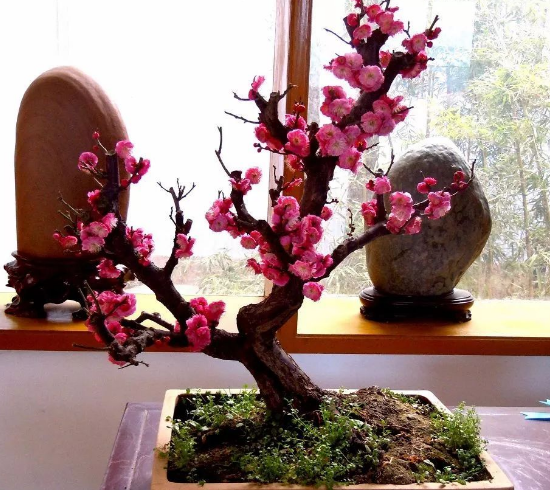
3. Watering.
Potted plum is relatively sensitive to water and has rather strict requirements. If the soil in the pot is too wet, at best the root system will develop poorly and the leaves will turn yellow and drop; at worst, the roots will be damaged and the tree ruined. If it is too dry, there will be few short branches, slow elongation of new shoots, easy leaf drop, and poor flower bud development. Therefore, watering potted plum should follow the principle of watering when dry and stopping when wet, watering only when dry, and watering thoroughly when watering; on rainy days, avoid water accumulating in the pot. During the new shoot growth period, avoid excessive watering that causes overly long shoots. In early summer before flower bud differentiation, control water appropriately to help form flower buds and set flower buds. In summer, water normally; at this time, insufficient water easily causes leaf drop and affects flower bud formation. After leaf drop in autumn, reduce the frequency of watering and keep the soil neither dry nor wet to help the branches become sturdy. In late winter and early spring, appropriately increase watering, and you can achieve the effect of abundant flowers covering the branches.
4. Fertilizing.
Because potted plum has already been given sufficient base fertilizer and does not like heavy fertilizer, when new shoots grow to about 5 cm, you can apply a thin cake fertilizer water once to promote healthy branch growth. When leaves unfold after flowering, fertilizer and water should be sufficient, applying a dilute liquid fertilizer once every 4-5 weeks. When the branches grow to 20 cm, control fertilization. To promote flower bud differentiation, apply a top dressing in late summer and early autumn. After each fertilization, water should be given.
5. Pruning.
If you want to control the tree shape and encourage young trees to bloom earlier, timely pruning and shaping are needed. The flower buds of plum blossoms form on new branches of the current year. Generally, when the seedlings grow to 25-30 cm, cut off the top. After budding, keep 3-5 branches at the top as main branches. When the branches grow to about 20 cm, pinch the tips to help the flower buds become plump. The next year, after flowering, retain 2-3 buds at the base and prune heavily. When pruning, pay attention to the direction of the bud at the cut, choosing outward-facing buds and inward-facing buds accurately. After sprouting, cut off crossing branches, overly dense branches, and overlapping branches. Because potted plum lacks grace when straight, lacks scenery when upright, and lacks form when dense, pruning should follow the principle of "sparse, slanting, and curved" without being artificial or contrived.
6. Pests.
Plum blossoms rarely attract pests, but pest problems cannot be ruled out. If your plum blossom is unfortunately attacked by pests, you can spray pesticide, but be sure to pay attention to the solution ratio; otherwise, the plum blossom itself will be harmed, and its petals will turn yellow. If you spray the flowers to death too, the loss will outweigh the gain.
7. Diseases.
If plum blossoms suffer from disease, the most common symptom is yellowing leaves, and the whole tree looks listless. First observe whether there are pests. If there are none, then it is disease. You can spray some nutrient solution. It does not need to be sprayed every day; once every 7 days for about 30 days will show results. Also, do not use too much; just ensure that the flowers are covered everywhere.
II. Precautions for growing plum blossom bonsai
In summer, when light is too strong and the temperature is too high, plum blossoms must be shaded. Generally, keeping them indoors in a bright place with good ventilation is sufficient.
How to cultivate plum blossom bonsai? Detailed explanation of plum blossom bonsai cultivation techniques
Plum blossom has a long history of cultivation in our country and is a traditional famous Chinese flower, symbolizing strength and elegance. With the continuous development of cultivation techniques, plum blossom bonsai is now popular with the public. Below, the editor of Huinong Network will explain the detailed cultivation techniques of plum blossom bonsai to you.
I. Wild plum is suitable for small bonsai
There are many varieties of plum blossom, which can be roughly divided into several categories such as wild plum, red-flowered types, Feng Hou types, and apricot types.
Among them, wild plum has the thickest trunk and is also easy to cultivate into a tree shape, so wild plum is most suitable for small potted bonsai and is also the variety cultivated by the most people.
Although apricot-type plum has good flower color, it lacks fragrance. Red flower systems such as red plum and crimson plum have poor trunk thickness. Feng Hou type plum (peach-system varieties) has flowers that are too large and is not suitable for small potted bonsai.
The trunk of wild plum easily becomes thick, and the tree height is also low. Even as a small potted bonsai, it easily shows the appearance of an old tree. It is best to choose a wild plum stump that has already flowered. Because as long as it has flowered, it will bloom many flowers every year.
II. Tips for small potted bonsai
Choose a stump with vigorous branches as the best quality. After purchasing the material, you can cultivate it into a small bonsai through cutting. This is the secret to making it bloom very well every year. When cutting, the timing must be chosen. Generally, transplant after flowering and before leaf buds grow, but at this time cut only slightly. Then after August to September of the following year when flower buds have formed, keep the flower buds and cut off unused branch sections and excessively vigorous branches.
If the material is still a young tree, wire the branches and trunk, create a shape, expose the upper part of the roots to sunlight, and promote root extension.
The tree shape is generally made into moyogi and slanting trunk styles, wiring as necessary. The trunk can be made to have bark and treetop with a sense of ancient wood, thus presenting the pleasure of small potted bonsai.
III. Precautions for repotting
Plum must be repotted every year. After flowering, transplant during the period when leaf buds extend. For early-flowering varieties such as cold plum, this period is very long. As soon as you see the flowers bloom, you can cut off about 1 node of the branch tips, and wait until the cold period passes before repotting. Transplant around spring. Around March, cutting and transplanting can also be done at the same time. Cut off the branch tips, untangle the roots, cut off 1/2, and then transplant. At this time, plant the roots a bit higher; this is the secret of repotting.
IV. Fertilizer and pest removal
For fertilizer, you can use a base fertilizer made by mixing oil cake and bone meal, applying fertilizer about 2 times a month from spring to autumn.
The above is the detailed explanation of plum blossom bonsai cultivation techniques compiled by the editor of Huinong Network. Have you all learned it? Plum blossom is a traditional famous flower with national spirit, and gardening enthusiasts must pay more attention to care when growing it.