How to grow pattypan squash? Detailed planting methods and techniques
Cultivation points
Pattypan squash prefers a warm environment, and the suitable temperature for its growth is generally 13°C-28°C. If the growing environment temperature exceeds 30°C, it will cause fruit abortion, and if the environment temperature is below 10°C, the squash will stop growing. Pattypan squash loves light, so both open-field cultivation and protected cultivation of pattypan squash can be adapted.
Because of its large leaves and strong transpiration, pattypan squash requires special attention to water management in cultivation. Try to keep the air humidity at 70%-80%. Otherwise, if the humidity is too high, powdery mildew is likely to occur. The cultivation land should preferably be weakly acidic sandy loam or loam.
Raising seedlings
Select plump pattypan squash seeds free of pest damage, and soak the seeds to promote germination at a temperature of about 29°C. During the germination process, keep the germination bag moist, and change the water once or twice a day. When more than half of the seeds have sprouted, sow them in a sowing tray. After the seedlings emerge, lower the temperature appropriately and transplant the seedlings into seedling pots. During the seedling stage, maintain sufficient light, keeping the light duration at about 10 hours per day. Use alternating temperature management.
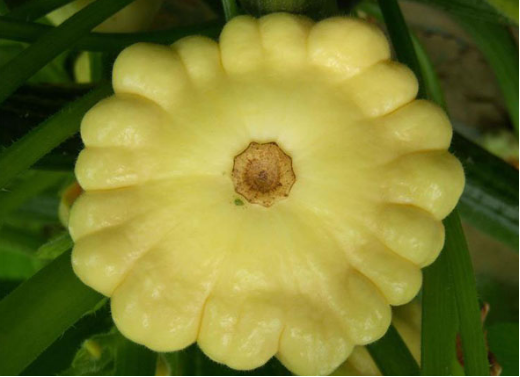
Land preparation and planting
After the frost period, plant when the minimum temperature steadily exceeds 10°C. For planting, usually flat beds or ridge planting are chosen.
If flat beds are chosen, the bed spacing is about 40 cm, the bed width is 1.2 m, the plant spacing does not exceed 100 cm, with 2 rows per bed; if ridge planting is used, the ridge spacing is 70 cm, the plant spacing is 1 m, and the plant and row spacing need to be determined specifically according to the characteristics of the variety. Before planting, prepare the land first, and remember to apply 4000-5000 kg of decomposed organic fertilizer, 30 kg of diammonium phosphate, and 50-100 kg of superphosphate.
Field management
After planting and recovery from transplanting, water the pattypan squash once to promote vine growth, and increase the amount of watering during its flowering and fruiting period. During the hot summer period, water twice a day. During the growth period, apply topdressing once each after recovery from transplanting, at full flowering stage, and at full fruiting stage.
Avoid weed overgrowth. Before pattypan squash flowering, hoe the soil and loosen it two to three times to promote root development. Also, tie the vines in time and remove old leaves and diseased leaves to prevent wasting nutrients. At the same time, pay attention to pest and disease control. Spray dimethoate emulsifiable concentrate on the leaf surface to kill aphids; secondly, whiteflies can be controlled by spraying buprofezin; if powdery mildew occurs, it is recommended to use triadimefon for spraying and control.
The above is the pattypan squash planting method introduced to you by the editor. As long as you take good care of pattypan squash in these areas, you can be sure that the pattypan squash you grow will be enviable!
Pattypan squash planting methods
Ecological habits
Pattypan squash has very high requirements for environmental temperature. Generally, keeping the temperature within 13°C-28°C is most suitable for growth. If it falls below ten degrees, it will stop growing. Also pay attention to its growing humidity, water, and soil.
Planting methods
Raising seedlings
Soak the selected good-quality seeds in water at 30°C for about ten hours. Then place the seeds in a greenhouse at 28°C to germinate. With careful care, once they grow to a certain height, they can be transplanted outdoors.
Sowing
To plant pattypan squash, first fertilize and plow the land, divide it little by little, with a spacing of about 70 cm for each plant, then plant the seedlings into the soil, and the best distance between every two seedlings is 100 cm.
Management
After the pattypan squash seedlings are transplanted, apply additional fertilizer and water to help the seedlings obtain better nutrients. At the same time, do daily management well, remove weeds and dried diseased leaves on time, and ensure sufficient sunlight so that nutrients go directly to the squash. During the flowering period, manual pollination is needed. If you want more fruit set, you must not be lazy during this period.
Pests and diseases
Pattypan squash is extremely susceptible to aphid infestation, and the prevention method is spraying dimethoate emulsifiable concentrate to kill the insects; secondly, whiteflies can be controlled by spraying buprofezin; if powdery mildew occurs, it is recommended to use triadimefon for spraying and control.
Growing pattypan squash in pots
Raising seedlings
Using pots, plant when the plant has unfolded 1-2 leaves.
Planting
The planting pot should be a large pot with a top diameter of 40-50 cm, filled with nutrient soil. The nutrient soil formula is: field soil, decomposed livestock and poultry manure, sawdust or decomposed horse manure in a ratio of 7:2:1. Plant one pattypan squash per pot, and set up one support stake 1 m tall and 2-3 cm thick. Water thoroughly after planting. Keep the soil moist during the growth period. Also place the pot in a well-ventilated and well-lit place to facilitate the growth of pattypan squash.
Management
The soil needs to be kept moist. Note that every time the plant extends 20 cm, it needs to be tied to the stake once. During the growth period, mainly prevent the occurrence of aphids and powdery mildew. Pick the squash promptly after it matures.
After reading the above introduction, you should know that pattypan squash can be eaten raw, so go ahead and try it! But remember, you must not eat too much! At the same time, I also hope the supplementary information on growing pattypan squash in pots is useful to you! Thank you for reading!