What are the propagation methods for Exochorda racemosa? Explained clearly in one article
1. Seed propagation.
The seeds of Exochorda racemosa ripen in August and September in autumn. After harvesting, they are sun-dried, threshed and stored in a sealed container. In February to March of the following year, they are sown in drills with a row spacing of about 20 cm. After sowing, a 1 cm thick layer of mud ash is spread on top, then covered with grass to retain moisture. Seedlings generally emerge after one month. In early April, once the seedlings emerge evenly, the grass cover can be removed. When the seedlings grow to 3-4 cm tall, thinning is carried out in stages; thinning is best done after rain or after watering on a sunny day.
During the seedling stage, attention should be paid to weeding, loosening the soil, and applying fertilizer two or three times. In hot summer weather, cover with grass to prevent drought. By the end of the year, the seedlings reach about 30 cm tall. They are transplanted in the following spring at the vernal equinox, and after two or three years of cultivation they can be used for landscaping or potted ornamental planting.
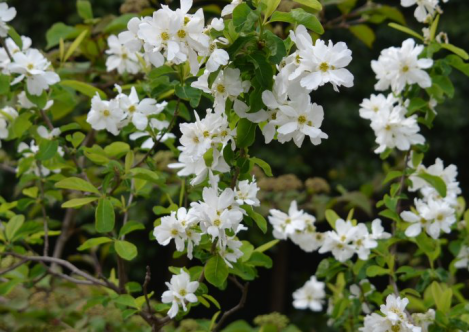
2. Cuttage.
Cuttage is best done in early spring when buds begin to sprout. For the cuttings, choose robust dormant branches from the previous year, cut them evenly at the node to about 12 cm long, treat them with rooting powder before inserting, then insert them into the cutting bed to a depth of a little less than half the length of the cutting. After inserting, water thoroughly, cover with a plastic film frame to retain moisture and provide shade, and keep the cutting bed moist.
3. Division.
Division is generally carried out in spring. Dig up the mother plant, keeping the roots intact, split it with a knife, and replant the divisions; they will survive.
Propagation methods of Exochorda racemosa
Cuttage of Exochorda racemosa
Hardwood cutting
Use dormant old branches of Exochorda racemosa for cuttage. This should be done in spring before buds sprout and leaves appear. Select robust old branches and cut them evenly at the node, with 2-3 internodes, and a cutting length of about 15 cm. Insert the cutting into the seedbed to two-thirds of its length. After inserting, water thoroughly, and roots will form in half a month.
Softwood cutting
For softwood cutting, usually choose vigorously growing plants in late spring or early autumn, and select current-year vigorously growing semi-lignified branches, keeping the front 2-3 internodes. Remove the leaves from the lowest internode, make a slanted cut of about 0.5 cm at the base, then insert the cutting into the seedbed, also to two-thirds of its length. Roots generally form in about 10 days.
Layering of Exochorda racemosa
Exochorda racemosa can be propagated by air layering, generally carried out in early spring and late autumn. The part of the branch buried in soil needs to be wounded to promote rooting. During layering, keep the soil moist, place it in an area with scattered light, and once it roots, separate it from the mother plant to form a new plant.
Sowing of Exochorda racemosa
Seed collection can be done in September, and sowing can be done in March of the following year. Choose well-aerated and fertile soil. After sowing, cover with plastic wrap to maintain humidity and temperature, and place in an area with scattered light. It will sprout and emerge in about 20 days. After emergence, the plastic wrap can be removed. When the seedlings grow to about 5 cm, thinning can be done to enhance their vigor and prevent sunscald. Before buds sprout and leaves appear the following year, they can be transplanted into new pots. Be sure to transplant with soil to prevent root damage.
Cultivation methods and precautions for Exochorda racemosa
Chinese scientific name: Bai Juan MeiLatin scientific name: Exochorda racemosa (Lindl.) Rehd.Other names: Bai Juan Mei, Jin Gua Guo, Jian Zi HuaBinomial name: Exochorda racemosaKingdom: PlantaePhylum: AngiospermsSubphylum: SpermatophytaClass: DicotyledoneaeSubclass: ArchichlamydeaeOrder: RosalesSuborder: RosineaeFamily: RosaceaeSubfamily: SpiraeoideaeGenus: ExochordaSpecies: Exochorda racemosaDistribution area: Zhejiang, Jiangsu, Jiangxi, Hubei and other provinces in ChinaSubkingdom: EmbryophytaExochorda racemosa (scientific name: Exochorda racemosa) is a species in the genus Exochorda under the family Rosaceae. It is produced in Henan, Jiangxi, Jiangsu, and Zhejiang. It grows in shady mountain slopes at an altitude of 250-500 m.1. Names
Exochorda racemosa (Chinese Tree Taxonomy), Zong Hua Bai Juan Mei (Economic Plant Handbook), Jian Zi Hua (Seed Plant Handbook of Southern Jiangsu), Jiu Huo Tou (local name in Anhui), Jin Gua Guo (local name in Zhejiang)2. Morphological characteristics
Deciduous shrub, up to 3-5 m tall, with slender and spreading branches; branchlets cylindrical, slightly angular, glabrous, reddish brown when young, brown when old; winter buds triangular-ovoid, apex obtuse, smooth and glabrous, dark purple-red. Leaves elliptical, oblong to oblong-obovate, 3.5-6.5 cm long, 1.5-3.5 cm wide, apex rounded-obtuse or acute, rarely abruptly pointed, base cuneate or broadly cuneate, margin entire, rarely with obtuse teeth above the middle, both surfaces glabrous; petiole short, 5-15 mm long, or nearly sessile; stipules absent.Terminal raceme, with 6-10 flowers, glabrous; bracts small, broadly lanceolate; flowers 2.5-3.5 cm in diameter; hypanthium shallowly campanulate, glabrous; sepals broadly triangular, about 2 mm long, apex acute or obtuse, margin with sharp fine teeth, glabrous, yellow-green; petals 5, obovate, about 1.5 cm long, about 1 cm wide, apex obtuse, base with a short claw, white; stamens 15-20, in bundles of 3-4 attached to the edge of the disk, opposite the petals; carpels 5, styles free.
Capsule with 5 ribs, fruiting pedicel 3-8 mm long, seeds winged. Flowering in May, fruiting from June to August.
3. Growth habits
Light-loving, also tolerant of half shade, highly adaptable, tolerant of drought and barren soil, somewhat cold-tolerant, and can be cultivated outdoors in Beijing.4. Habitat and distribution
It grows in shady mountain slopes at an altitude of 250-500 m.It is produced in Henan, Jiangxi, Jiangsu, and Zhejiang. It grows in shady mountain slopes at an altitude of 250-500 m.
5. Cultivation techniques
(1) Exochorda racemosa is light-loving, drought-tolerant, slightly shade-tolerant, and not demanding about soil; it can grow in both acidic and neutral soils.(2) It can be propagated by sowing, division, cuttage, and tissue culture. Sowing, division, and cuttage are mostly carried out in spring.6. Main value
Its branches and leaves are elegant, and its white flowers in spring make it a beautiful ornamental tree species. Root bark and tree bark: used for soreness and pain in the lower back and bones.
[Edible development]Both species of Exochorda racemosa have large and beautiful flowers and are woody plants that are both ornamental and edible. Their flower buds and tender leaves are both edible, and this has a long history among the people of China.
Exochorda racemosa has a graceful tree form, with large and numerous flowers, white as snow, clear and moving. It is an excellent tree species for beautifying gardens. Its flowers and tender leaves are also extremely rich high-quality food ingredients. According to literature such as the Illustrated Atlas of Chinese Wild Vegetables, its content of various vitamins and nutrients such as calcium, iron, and zinc is so high that many common vegetables cannot match it. It can be seen that the folk consumption of this plant in China has a strong scientific basis.
Like many edible woody plants, Exochorda racemosa can be eaten in many ways. People generally pick its tender leaves and flower buds between April and May; they can be eaten fresh or blanched in water and then sun-dried for later use.
Its tender leaves and flower buds can be stir-fried, made into soup, or seasoned and served cold; as an ingredient, they can be used to cook a variety of meat and vegetable dishes, all fresh-scented and delicious with a distinctive flavor. The flower buds are used to make steamed flower cakes, and as snacks they are especially popular.
The dried product can be soaked in water and then used to stew meat, steam fish, make soup, prepare fillings, and so on, likewise delicious and pleasant.
[Health benefits]Modern research shows that every 100 g of fresh tender leaves of Exochorda racemosa contains 6.9 mg of carotene, vitamin
B2 at 0.35 mg, vitamin C at 271 mg, and other nutrients.
Every gram of dried product contains 9.8 mg of potassium, 10.3 mg of calcium, 3.14 mg of magnesium, 1.5 mg of phosphorus, 0.48 mg of sodium, iron
154 micrograms, manganese 127 micrograms, zinc 22 micrograms, copper 10 micrograms, and other nutrients.
Every 100 g of fresh flowers contains 2.1 mg of carotene, vitamin B2 at 0.35 mg, vitamin C at 92 mg, and
other nutrients.
Therefore, it has multiple health functions such as benefiting the liver and improving eyesight, enhancing human immunity, and providing antioxidant effects.