How to grow shrimp plant? Sharing of cultivation methods and tips
First of all, the shrimp plant blooms in all four seasons, so we need to separate different seasons with different cultivation methods.
1. Sufficient light
In spring and autumn, we need to let the shrimp plant get full exposure to light. The plant cannot stay in a sunless state for a long time, otherwise it will easily become leggy, affecting the quantity and quality of blooming.
2. Moderate fertilization
Fertilizing: in spring and autumn, sufficient water and fertilizer should be maintained. The shrimp plant has high demands, and its potting soil needs to be kept moist. Apply decomposed liquid fertilizer once, and apply phosphorus fertilizer during flowering.
3. Suitable moisture
In summer, it is a rainy season, so pay attention to drainage. But when there is plenty of sunlight, the water requirement is still very high, so remember to spray water frequently to maintain moisture, which can also lower the temperature. Also, if the temperature gradually rises and the light becomes stronger and stronger, remember to do timely shading and ventilation work, and place the shrimp plant in a cool, ventilated place; it cannot be exposed to sunlight all the time.
Cultivation methods of shrimp plant
Cultivation methods of shrimp plant
Basic information about shrimp plant
Scientific name: Callispidia guttata. Aliases: shrimp plant, shrimp grass, yellow shrimp flower, foxtail wood, foxtail flower, small shrimp flower, shrimplet flower, qilin spitting pearl, duckbill flower, yellow foxtail wood. Japanese name: small shrimp grass.
Family and genus: Acanthaceae, genus Callispidia (also called genus qilin spitting pearl).
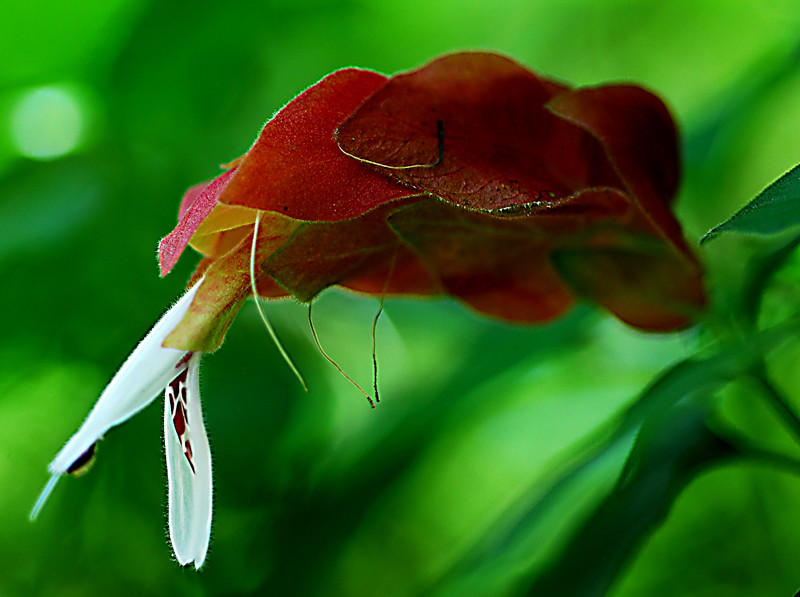
Evergreen subshrub, 70-80 cm tall. Base woody, much branched, branches and stems slender and soft. Leaves ovate, leaf tip pointed, narrowing at the lower part, 7-8 cm long, covered with soft hairs. Blooms from April to November, with April to June as the peak period; spike terminal, about 8 cm long, slightly drooping; with persistent bracts in brown, red, yellow-green, or yellow, flowers white, extending beyond the bracts, corolla with two lips, lower lip with red spots. Capsule, with 4 or 2 seeds.
The shrimp plant's inflorescence bracts, nearly 10 cm long, overlap layer upon layer, closely resembling a lobster and also like a foxtail. It is unique and interesting, and the flowering period is especially long. It is also easy to care for, making it a flowering ornamental plant suitable for home cultivation.
[Common flowers of the same genus as shrimp plant]
(1) Purple foxtail wood (c. atropurpurea): plant height about 1 m, flowers purple.
(2) Yellow Queen foxtail wood (C. guttata cv. Yellow Queen): a cultivar of shrimp plant, flower bracts yellow, flowers white.
(3) Violet foxtail wood (C. v/o/e/): plant height about 1 m, flowers violet.
(4) California foxtail wood (C. California): flowers bright red.
[Shrimp plant propagation] Cuttings, division, sowing.
(1) Cuttings: usually carried out from April to June or September to October, with spring cuttings being the best. Cut 10-15 cm long, robustly growing branches with short internodes as cuttings. After inserting, place in semi-shade, keep room temperature at 20-25°C, and spray frequently to keep the environment moist. Roots and survival can occur in about half a month. Cuttings that survive in spring bloom in autumn of the same year, while those inserted in autumn bloom in spring of the following year.
(2) Division: carried out in spring together with repotting.
(3) Sowing: because the fruit automatically pops open in sunlight after ripening, it can shoot seeds to a place about 1 m away, making seed collection difficult. In addition, the fruit of potted plants is not easy to mature, so it is seldom used.
[Key points for cultivating shrimp plant]
(1) Temperature: likes warmth, the most suitable temperature for growth is 18-25°C. If a temperature above 10°C can be maintained and sufficient sunlight is given, it can continue to bloom in winter. But when the temperature is on the low side, the bract color is dull and not beautiful. Not very cold-tolerant; the minimum temperature for overwintering is 5°C.
(2) Light: likes sufficient sunlight and also tolerates semi-shade, but avoids direct strong sunlight.
From May to September, shading should be carried out, but during the plum rain season when it is cloudy and rainy, the shading material should be removed so that the light is not too dim, which helps the plant grow and bloom. When light is insufficient, the plant becomes leggy, the flower spikes are thin and long, and the flower bract color fades, making the plant shape and flower color unattractive. From October to April of the following year, sufficient sunlight should be given.
(3) Watering: likes a moist soil environment. During the growth period, water should be supplied fully to keep the potting soil moist, but avoid waterlogged potting soil, otherwise the leaves turn yellow, the flowers wilt, and even root rot occurs. In winter, watering should be controlled so that the potting soil is on the dry side, which helps overwintering.
(4) Environmental humidity: likes a humid environment, and the suitable relative air humidity is 50%-60%. In summer, during high temperature and clear, dry weather, while watering, spray water on the plant and around it to create a humid and cool environment.
(5) Fertilization: because the flowering period is long and nutrient consumption is high, during the growing season apply a fertilizer combining nitrogen, phosphorus, and potassium once about every 10 days to meet the nutrient needs of branch and leaf growth and flowering. However, fertilizer and water should not be too abundant, so as to keep the plant low and compact. Especially avoid applying nitrogen fertilizer alone, otherwise branches and leaves grow vigorously but flowering decreases. Stop applying nitrogen fertilizer in September, and apply phosphorus and potassium fertilizer twice to help improve cold resistance. Stop fertilizing in winter.
(6) Pruning: strong sprouting ability. Every spring, prune the plant together with repotting. Mainly shorten the branches, generally cutting off about 1/3 of the branch length, to control plant height and promote branching. For young propagated plants, pinch when they grow to 10 cm tall to promote branching and form a full plant shape. Because flowers are borne at the tips of new branches, after each flowering, remove the spent flowers in time and apply fertilizer, which can promote new branches and continuous blooming.
(7) Potting and repotting: rooted seedlings are planted in pots with a diameter of 10 cm. Mature plants need repotting once every 1-2 years, which can be done in spring. After repotting, first place in semi-shade, and only after new leaves emerge can they be moved to a place with sufficient light. It is not particular about soil, but loose, fertile, well-drained sandy loam is best. The potting soil can be prepared with materials such as leaf mold, peat soil, garden soil, coarse sand, or perlite.
(8) Pest and disease control: there are diseases and pests such as powdery mildew and damage from scale insects, red spiders, and whiteflies.
[Common problems in cultivating shrimp plant]
Common problems Causes
Thin and slender plant, flower bract color fading Usually caused by insufficient light
Vigorous branches and leaves, but few flowers Caused by applying fertilizer, especially too much nitrogen fertilizer
Cultivation methods and precautions for shrimp plant
Chinese scientific name: shrimp plantLatin scientific name: Callispidia guttataOther names: shrimp plant, shrimp grass, foxtail wood, qilin spitting pearlKingdom: PlantaePhylum: AngiospermsClass: DicotyledonsSubclass: AsteridaeOrder: ScrophularialesFamily: AcanthaceaeGenus: CallispidiaSpecies: shrimp plantDistribution area: native to Mexico, mostly cultivated in greenhouses in ChinaEnglish name: Justicia brandegeanaShrimp plant (scientific name: Calliaspidia guttata) is a plant in the genus Callispidia of the family Acanthaceae. The shrimp plant's red bracts overlap in strings and droop, and the inflorescence is about 10 cm long, resembling a lobster and a foxtail, very interesting. It blooms all year round and is suitable for pot cultivation, placed on indoor high shelves for viewing, and can also be used for flowerbed arrangements. The shrimp plant likes a warm, humid environment, with a minimum temperature of 5°C to 10°C. It likes light but avoids exposure to strong sun, and has a certain ability to tolerate shade. The shrimp plant has strong resistance and few pests and diseases. In greenhouse cultivation, attention should be paid to controlling the damage of scale insects and red spiders.1. Morphological characteristics
Evergreen subshrub, 1-2 m tall, whole plant hairy. Stems round, slender, much branched, the bases of young stem nodes red-purple. Leaves ovate, apex shortly pointed, base wedge-shaped, entire. Spike terminal, 6-9 cm long, drooping, with persistent bracts in brown, red, yellow-green, and yellow. Flowers white, extending beyond the bracts, flowers divided into upper and lower lips, upper lip entire or slightly lobed, lower lip shallowly lobed, with 3 rows of purple spotted markings. Stems round, much branched at the base, with short coarse hairs. Leaves 2.5-6 cm long, entire, with short hairs on both sides. Spike drooping, with bright, brown-red persistent large bracts; bracteoles ovate-lanceolate; 5 calyx lobes, slightly hairy; corolla white, extending beyond the bracts, with short hairs outside, lip-shaped, upper lip entire or slightly lobed, lower lip shallowly lobed, with 3 rows of purple spots; 2 stamens.2. Growth habits
Likes moisture, relatively drought-tolerant, likes loose, fertile, well-drained neutral and slightly acidic soil. Full sun or partial sun. It likes a warm, humid environment and is cultivated in greenhouses. The minimum temperature needs to be 5-10°C, suitable growth temperature: 18-28°C. Likes sunlight and also tolerates shade relatively well, avoids exposure to strong sun, likes moisture. Blooms continuously all year round. Fruiting period year-round. Habits: likes a warm, humid environment, cultivated in greenhouses. The minimum temperature needs to be 5-10°C. Likes sunlight and also tolerates shade relatively well, avoids exposure to strong sun, likes moisture. Blooms continuously all year round.3. Geographical distribution
Native to Mexico, cultivated throughout the world.4. Cultivation and care
Cultivation technique: cutting propagation
As long as the temperature is suitable, cuttings can be taken in all four seasons, but mainly in spring and summer. If cutting in summer, attention should be paid to shading and moisture retention. Cut current-year full 2-3 node shoots as cuttings. Both old branches and tender branches can be used for cuttings. Under the same temperature conditions, tender branches root faster. Insert the basal 1 node into plain sand soil. At room temperature of 20°C, they root in about 10 days and bloom the next year. Yellow sand, vermiculite, or perlite can all be used as cutting substrate. For tender branch cuttings, the substrate must be strictly disinfected. After the cuttings root, transplant them into pots in time and shade them appropriately. After new leaves grow, move them to a place with sufficient sunlight. After cutting, the following management should be noted: Temperature: the optimum temperature for cutting rooting is 20-30°C. Below 20°C, rooting of cuttings is difficult and slow; above 30°C, the upper and lower cut surfaces of the cuttings are easily infected by pathogens and rot, and the higher the temperature, the greater the proportion of rot. When low temperature is encountered after cutting, the main measure for heat preservation is to wrap the flowerpot or container used for cutting with plastic film; when the temperature is too high after cutting, the main cooling measure is to shade the cuttings, blocking 50%-80% of sunlight, and at the same time spray the cuttings 3-5 times a day. On sunny days with higher temperatures, spray more often; on cloudy and rainy days with lower temperatures and higher humidity, spray less or not at all.Humidity: after cutting, the relative air humidity must be maintained at 75%-85%. The basic requirement for cutting rooting is that before the cuttings root, they must be kept fresh and tender so they can carry out photosynthesis to produce rooting substances. However, cuttings that have not rooted cannot absorb enough water to maintain their internal water balance. Therefore, spraying must be used to reduce water evaporation from the cuttings: under shaded conditions, spray the cuttings 3-5 times a day. The higher the temperature on sunny days, the more frequent the spraying; the lower the temperature on cloudy and rainy days, the less frequent the spraying or no spraying. But excessive spraying makes the cuttings easily infected by pathogens and rot, because many kinds of pathogens exist in water.
Light: cutting propagation cannot be separated from sunlight, because the cuttings still need to continue photosynthesis to produce nutrients and rooting substances to supply their rooting needs. However, the stronger the light, the higher the temperature inside the cuttings, the more vigorous the transpiration of the cuttings, and the more water consumed, which is not conducive to the survival of the cuttings. Therefore, after cutting, 50%-80% of sunlight must be blocked. After the root system grows, gradually remove the shading net: on sunny days, remove the shading net at 4:00 p.m. every day, and cover the shading net before 9:00 a.m. the next day.