How to grow the silk floss tree (Chorisia speciosa)? Detailed guide to cultivation methods
Soil requirements
The silk floss tree is not particularly demanding about soil, but the drainage system must be good; it is best planted in relatively fertile soil or sandy soil.
Water requirements
The silk floss tree likes a high-temperature, high-humidity environment, so it needs a large amount of water during its growth process; this is why it has high drainage requirements. Only by ensuring good drainage can its roots be kept from rotting easily.
Fertilizer requirements
If the soil itself is fertile enough, applying a mixed fertilizer of organic fertilizer and compound fertilizer once every 40 days is enough to achieve its best growth rate; but if the soil is average or relatively poor, it needs fertilizing once every 20 days. Only in this way can the growth rate of the silk floss tree be maintained.
Cultivation methods and precautions for the silk floss tree
Cultivation methods for the silk floss tree
Soil requirements
The silk floss tree is not strict about soil, but good drainage is essential; it is most suitable for planting in relatively deep fertile soil or sandy soil.
Water requirements
The silk floss tree likes a high-temperature, high-humidity environment, so it needs a large amount of water support during its growth process; this further requires that the soil drainage must be good, otherwise the roots rot easily.
Fertilizer requirements
If the soil itself is fertile enough, applying a mixed fertilizer of organic fertilizer and compound fertilizer once every 40 days can achieve its best growth rate; but if the soil is average or relatively poor, a mixed fertilizer needs to be applied once every 20 days to maintain the growth rate of the seedlings.
Precautions for cultivating the silk floss tree
The silk floss tree is a fast-growing tree species, so when transplanting, when the crown spreads, at least 2 m of spacing is needed between each plant; therefore, it is recommended to use a whole pot for each silk floss tree.
The silk floss tree rarely suffers from pests and diseases; if pests or diseases are found, please deal with them promptly.
When cultivating the silk floss tree, just pay special attention to its living environment; it also grows very fast. If there are friends who do not have one at home, you can try growing one.
Silk floss tree Chorisia speciosa Silk floss tree illustrated guide: how to grow the silk floss tree / how to propagate the silk floss tree
Silk floss tree profileSilk floss tree Chorisia speciosa
Cultivation methods and precautions for the silk floss tree Introduction to the silk floss tree
The silk floss tree has an umbrella-shaped crown and emerald-green leaves; the trunk of a mature tree is wine-bottle-shaped. In winter, during the full bloom period, the whole tree is brilliantly colored and beautiful, making it an excellent flowering ornamental tree and a high-grade tree species for courtyard greening and landscaping. It can also serve as a high-grade street tree and park greening plant.
Morphological characteristics of the silk floss tree
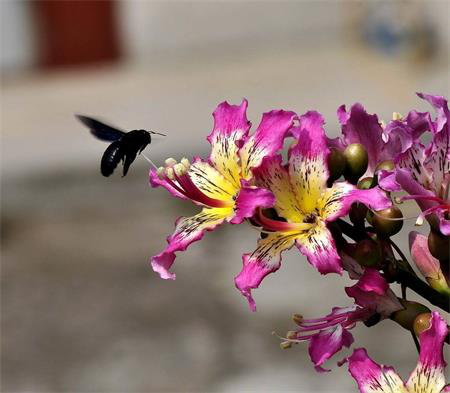
A large deciduous tree, an extremely excellent flowering ornamental tree, 10-15 m tall; the lower part of the trunk is swollen; the bark of young trees is dark green, densely covered with conical prickles; side branches spread radially horizontally or extend obliquely. Palmately compound leaves have 5-9 leaflets; leaflets are elliptical, 11-14 cm long. Flowers are solitary; the corolla is light purplish-red with a white center; petals 5, recurved; filaments united into a staminal tube surrounding the style. Winter is the flowering period. Capsules are elliptical. Seeds mature in spring the following year. The flowering period lasts as long as three months. Flowers are solitary, buds are round-bead-shaped, the corolla is light purplish-red, and near the center the corolla is initially golden yellow, gradually turning white. In short, when in bloom the tree is full of bright flowers, dazzling and exceptionally beautiful.
It grows rapidly; if planted deeply in soil, in 3-5 years it can reach 8 m tall with a diameter at breast height of 15-20 cm. Different plants of the silk floss tree have different flower colors, including red, white, pink and yellow; even the same plant may have yellow flowers, white flowers and black-spotted flowers at the same time, making it even more rare and unusual, with high ornamental value. The flowering period is December; a single plant's flowering period lasts as long as 3 months. The flower colors are brilliant, the flowers are large and numerous, and at full bloom the whole tree is profusely colorful and very spectacular. The silk floss tree grows very rapidly. After sowing, it can grow to 1.5 m in 1 year and can bloom in 4-5 years.
After the silk floss tree's flowers fade, it bears fruit. Some fruits are as large as pomelos, hanging upside down on the bare branches one by one like cannonballs, quite spectacular. After the fruits mature, the thick outer skin falls off naturally, and a mass of white flocculent material emerges, dazzling white, hanging on the branches, shaped like a mature cracked cotton boll. Moreover, this flocculent material is softer and warmer than real cotton, and it can also be used to fill pillows.
Ecological habits of the silk floss tree
The silk floss tree likes a high-temperature, humid climate, grows rapidly, resists wind, and is not drought-tolerant. It is not strict about soil, but drainage must be good. Its transplant survival rate is high, making it a greening tree species worth promoting. It is a strongly heliophilous tree species; if used as a shade roadside tree, it should be planted in a single row with a row spacing of 15-20 m. The roots are huge like a Buddha's belly, and the bark is rich in fiber, giving it strong resistance to windthrow and wind breakage. No serious pests or diseases have been found so far.
Distribution area of the silk floss tree
Native to Argentina in South America. In China it is widely cultivated in southern cities such as Guangdong, Fujian, Guangxi, Hainan, Yunnan and Sichuan.
In 1972, a small number were introduced in China at the Jianfengling Tropical Forestry Research Institute on Hainan Island; at present only 1 plant remains, growing normally, but it only flowers and does not set fruit. Taiwan, China introduced it relatively early as well; it was introduced after successful introduction and acclimatization via Okinawa, Japan, and there are more in Chiayi City. In the autumn of 1985, Yoshida Tomoaki, director of the Japan Environmental Sanitation Research Institute, brought two seedlings introduced and acclimatized in Japan and presented them to a university in Guangdong; by 1993 they had grown into towering trees 10 m tall, starting to bloom at the end of September and beginning of October each year and not fading until after Spring Festival, with a flowering period of 3-4 months. One plant bears red flowers and one bears white flowers. At full bloom the whole tree is resplendent, with flowers and leaves present together; after full bloom the leaves fall, and after the flowers fade it quickly sprouts leaves. But it still only flowers and does not set fruit.
Propagation methods of the silk floss tree
The silk floss tree is a new tree species introduced by the new, rare and exotic tree species seedling base of the Guangxi Agricultural Garden of the Agriculture Department of Guangxi Zhuang Autonomous Region. It is generally propagated by sowing. In Guangzhou, its seeds mature in March-April, and it is best to sow them immediately after collection; the germination rate can reach 90%, and as time passes the germination rate decreases. In China, the silk floss tree is mainly distributed in Taiwan, China and other coastal areas.
Sowing substrate used
Peat soil : sand = 3:1, adjust the pH to about 6.0, add 10 kg of chicken manure and 2 kg of compound fertilizer to each cubic meter of sowing substrate and mix, then sieve. Because the seeds are relatively large (about the size of soybeans), the dibbling method can be used in the sowing container, with a dibbling density of 500 seeds/sq m.
When dibbling, the dibbling depth of the seeds should be the thickness of the seeds themselves; sowing too deep will delay seed germination and reduce germination vigor. After dibbling is completed, drench thoroughly the first time with 500-times-diluted Miebingwei. The suitable germination temperature for the seeds is 18°C-24°C. Germination begins about one week after sowing. On days with strong sunlight, use a 50% shade net to lower the temperature, but to avoid excessive elongation of the seedlings, let the seedlings receive as much sunlight as possible.
Cultivation techniques for the silk floss tree
When the silk floss tree seedlings grow to 15-625px tall, they can be transplanted. First transplant them into planting bags (or planting pots), manage them intensively for 20-30 days, and then plant them out in the field. When planting out, divide the seedlings into 3 grades according to a certain height, and plant seedlings of the same grade in the same plot for ease of management. Before planting out, prepare the planting beds; the bed width is 1.5 m, and only one row of seedlings is planted per bed. Because the silk floss tree is a fast-growing tree species and its crown spreads, the plant and row spacing must be at least 2 m x 2 m. The silk floss tree is a plant that fears waterlogging, so a drainage ditch more than 1000px deep must be dug every 2 beds. The suitable planting site for the silk floss tree is deep fertile loam or sandy loam.
Landscape uses of the silk floss tree
The trunk is upright, the main trunk has protruding prickles, the crown layer is umbrella-shaped, and the leaves are emerald green; the trunk of a mature tree is wine-bottle-shaped. In winter, during the full bloom period, the whole tree is brilliantly colored and beautiful, and it is called the "beauty tree". It is an excellent flowering ornamental tree and a high-grade tree species for courtyard greening and landscaping. It can also serve as a high-grade street tree.
The silk floss tree is a tree that can reach 15 m tall; 70% of the straight main trunk is covered with prickles, and the tree shape is beautiful, making it a very good urban greening tree species. After dwarfing, it is about 1 m tall and can be planted in the ground or made into a bonsai; the base root is 4.16 cm thick, and in the same year it can bloom 300-500 flowers, and can be brought indoors for appreciation.
Uses and functions of the silk floss tree
The silk floss tree has luxuriant branches and leaves, and its large umbrella-shaped crown gives excellent shade. It has a strong ability to absorb harmful floating dust and to break down sulfur dioxide and carbon dioxide while releasing fresh air.
Silk floss tree pictures