What issues should be noted when growing coral bean (Erythrina corallodendron)
Avoid excessive contact
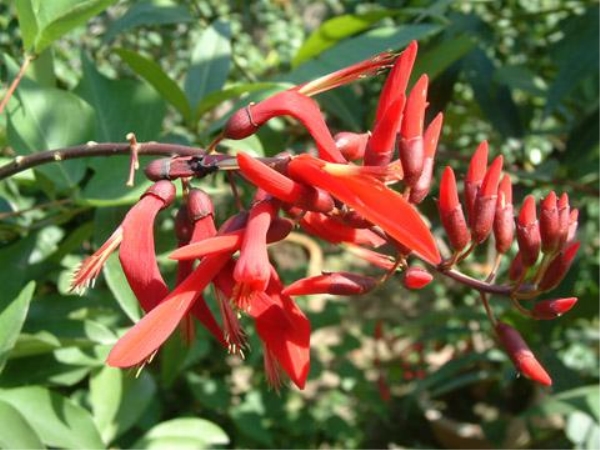
Coral bean (Erythrina corallodendron) has many flowers with bright colors and is very suitable for growing as an ornamental flower, but it is toxic. Therefore, during cultivation, care must be taken to avoid excessive contact, do not let hands touch its sap, and do not place it where children can easily reach it.
Never "swallow"
Although coral bean (Erythrina corallodendron) is toxic, its floral fragrance is non-toxic, so as long as we do not come into excessive contact with it, placing it on a windowsill or balcony as a potted ornamental is fine. It is only for viewing, and must never be mistaken for food and swallowed.
When coral bean (Erythrina corallodendron) blooms, it has high ornamental value. We can only view it and must never eat it! As long as we do not pick and eat it by mistake, its toxicity will not harm us!
Notes on growing coral bean (Erythrina corallodendron)
During growth, coral bean (Erythrina corallodendron) is prone to pests and diseases. The common diseases are mainly root rot, wilt and anthracnose, and the pests are mainly aphids and scale insects. When diseases occur, agents such as Bordeaux mixture can be sprayed for treatment, and when pests occur, insecticides can be used or relatively eco-friendly homemade insecticides can be used to kill the insects.
Although coral bean (Erythrina corallodendron) has high ornamental value, during cultivation it must also be remembered that it is quite toxic, and eating it must be strictly avoided!
How to grow coral bean (Erythrina corallodendron) and notes
How to grow coral bean (Erythrina corallodendron)
Pot and soil selection
Coral bean (Erythrina corallodendron) is a relatively large woody flower, so a larger flowerpot is needed for potting, and the soil should be well-drained, fertile and loose sandy loam. It does not have high fertility requirements, but the soil must not be too poor. In soil that is too poor or too dry, coral bean (Erythrina corallodendron) will grow poorly.
Light and temperature
Coral bean (Erythrina corallodendron) likes a growing environment with ample light and can tolerate partial shade; it is best to provide about 5 hours of light per day. It likes a warm climate, can tolerate high temperatures, and has poor cold tolerance. The suitable temperature for coral bean (Erythrina corallodendron) growth is between 20°C and 28°C. In winter, insulation is needed, and if conditions permit, it can be moved into a greenhouse to overwinter.
Watering and fertilizing
Coral bean (Erythrina corallodendron) likes a moist environment, but it should not be waterlogged. Watering should be moderate. During the hot and dry summer, watering should be increased to keep the potting soil moist, and if needed, water can be sprayed on the leaves. In winter, when the temperature is low, watering should be reduced, especially after it is placed in a greenhouse. As for fertilizing, during the growing period, fertilizer can be applied once every half month, and during the flowering period, phosphorus and potassium fertilizer can be applied once or twice. After early autumn, fertilizing should be stopped.
Notes on growing coral bean (Erythrina corallodendron)
Repotting
Coral bean (Erythrina corallodendron) is a large plant, and as it grows it needs to be repotted, generally once every 2 to 3 years, in spring. Pruning can be done together with repotting.
Pruning
Coral bean (Erythrina corallodendron) can be pruned in spring, cutting off dead branches and long branches, which can produce more flowering branches. Pruning can also be done in winter, for better overwintering.
Pests and diseases
The common diseases of coral bean (Erythrina corallodendron) are mainly root rot, wilt and anthracnose, and the pests are mainly aphids and scale insects. When diseases occur, agents such as Bordeaux mixture can be sprayed for treatment, and when pests occur, insecticides can be used or relatively eco-friendly homemade insecticides can be used to kill the insects.