What to Do When Red Flower Loropetalum Encounters Pests and Diseases? Detailed Explanation of Prevention and Control Methods
The common diseases of Red Flower Loropetalum are mainly three kinds, namely: anthracnose, damping-off, and mosaic disease
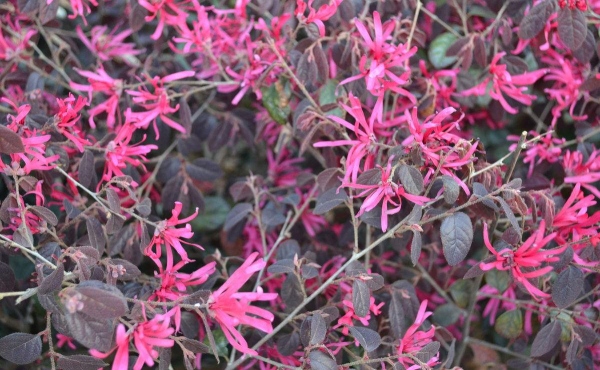
Anthracnose
The main symptom of Red Flower Loropetalum suffering from anthracnose is the appearance of black spots on the leaves. The pathogen of anthracnose is caused by Actinomyces, and the pathogen overwinters on diseased leaves, thereby causing disease in the following year.
Damping-off
If Red Flower Loropetalum suffers from damping-off, this disease generally accompanies the plant for life and harms the root system of Red Flower Loropetalum. Dark lesions appear at the site of pathogen infection and also show a water-soaked state, causing the epidermis to separate from the xylem, thereby causing the death of the plant.
Mosaic disease
Mosaic disease is a disease caused by a virus in Red Flower Loropetalum, which causes the plant leaves to appear mottled white and green.
Next, follow the editor to learn about the prevention methods!
[Red Flower Loropetalum] Red Flower Loropetalum bonsai, Red Flower Loropetalum ball cultivation and planting techniques
[Red Flower Loropetalum] Red Flower Loropetalum bonsai, Red Flower Loropetalum ball cultivation and planting techniquesRed Flower Loropetalum (Loropetalum chinense var. rubrum) has luxuriant branches and leaves, an elegant posture, and is tolerant of pruning and wiring. It can be used for hedges and can also be used to make stump bonsai. When it blooms, the whole tree is full of red flowers, which is extremely spectacular. This article [Red Flower Loropetalum] Red Flower Loropetalum bonsai, Red Flower Loropetalum ball cultivation and planting techniques includes relevant information and cultivation and planting techniques for Red Flower Loropetalum, Red Flower Loropetalum balls, and Red Flower Loropetalum bonsai. We hope it will be helpful to readers.
Red Flower Loropetalum | Red Flower Loropetalum price | Red Loropetalum price
[Table of Contents] 1. Cutting propagation and cultivation management of Red Flower Loropetalum 2. Key points of propagation and cultivation of Red Flower Loropetalum balls 3. Maintenance and management of Red Flower Loropetalum bonsai 4. Transplanting management of Red Flower Loropetalum seedlings
1. Cutting propagation and cultivation management of Red Flower Loropetalum
First, let me introduce to readers the cutting propagation and cultivation management of Red Flower Loropetalum;Red Flower Loropetalum is propagated by grafting. The two main methods are cut grafting and bud grafting. Grafting can be carried out from February to October. Cut grafting is best done before sprouting in spring, while bud grafting is suitable in September to October. Using medium and small plants of white Loropetalum as rootstock for multi-head grafting, strengthening water and fertilizer and pruning management, they can leave the nursery within 1 year.
Cutting propagation
It can be carried out from March to September. Use loose loess as the cutting substrate, ensure that the cutting substrate is aerated and permeable and has high air humidity, keep it warm but avoid direct sunlight, and at the same time pay attention to ventilation and air permeability in the cutting environment. Under warm and humid conditions, the cuttings of Red Loropetalum form red callus in 20-25 days, and after 1 month they grow 3-9 new roots 0.1 cm thick and 1-6 cm long. Cutting propagation has a large propagation coefficient, but the growth is weaker and the time to leave the nursery is long, while multi-head grafted seedlings have strong growth potential and leave the nursery quickly as finished seedlings, but are more labor-intensive. 2.1.3 Sexual propagation. Sow in spring and summer. Red Loropetalum seeds have a high germination rate and germinate about 25 days after sowing. In 1 year they can grow to 6-20 cm tall and produce 3-6 branches. The new roots of Red Loropetalum seedlings are red and fleshy, and careful management is required in the early stage until the root system becomes lignified and turns brown, only then can extensive management begin. Because sexual propagation has a long seedling stage, slow growth, and may produce white Loropetalum seedlings (atavism), it is generally not used for seedling production, but is used for Red Loropetalum breeding research.
Fertilizer and water management
Before transplanting Red Loropetalum, the fertilizer should be mainly decomposed organic fertilizer as base fertilizer, combined with broadcast application or hole application of compound fertilizer. Be careful to mix thoroughly to avoid damaging the roots. During the growing season, use a neutral foliar fertilizer diluted 800-1000 times for foliar topdressing, spraying 2-3 times per month to promote new shoot growth. In the plum rain season in the south, attention should be paid to maintaining good drainage. In hot and dry seasons, ensure watering once in the morning and once in the evening, and combine with water spraying at noon to lower the temperature; in northern regions, because the soil and air are dry, water must be applied in time to keep the soil moist. In autumn, winter, and early spring, pay attention to spraying water to keep the leaf surface clean and moist.
Ornamental characteristics
Pruning. Red Loropetalum has the characteristics of strong sprouting ability and tolerance to pruning. Carry out light and moderate pruning in growing seasons such as early spring and early autumn......
>>Learn more 2. Key points of propagation and cultivation of Red Flower Loropetalum balls
Next, let us learn about the key points of propagation and cultivation of Red Flower Loropetalum balls;
Twigs, young leaves, and calyx all have rusty stellate short pubescence. Leaves dark purple, ovate or elliptic, apex acute, entire, densely stellate-pubescent on the back. Petals 4, purple-red, linear, 1 cm-2 cm long; flowers in clusters of 3 to 8 at the ends of twigs. Capsule brown, nearly ovate. Flowering period May. Fruit ripens in August.
Morphological characteristics:
Evergreen red small shrub, twigs pubescent, leaves leathery and ovate, young leaves pale red, pale purple flowers bloom from April to May
Application environment:
A plant for viewing flowers and foliage in all four seasons. Red Flower Loropetalum has luxuriant branches and leaves, a varied tree form, and flexible wood. It is tolerant of pruning and wiring, and is a good material for making stump bonsai. When planted in the ground it also appears graceful and is a precious ornamental tree species for beautifying parks, courtyards, and roads.
Propagation:
Can use sowing, cuttings, or air layering; after the flowering period, when new branches mature, cut branches for cuttings or air layering to raise seedlings. After becoming seedlings, temporarily plant them in small pots for fertilizer cultivation, and only after another 1 year begin final planting.
Cultivation key points:
The best cultivation soil is fertile humus soil on hills, followed by sandy loam. Drainage must be good and sunlight sufficient. In the hot summer of the plains of South China, it should be kept cool and ventilated to lower the temperature so that it can pass the summer smoothly. Autumn to spring is the growth period. Fertilize once every 1-2 months, appropriately increasing phosphorus and potassium fertilizer, which can promote flowering. After the flowering period, prune and trim once. After August in autumn, flower buds begin to differentiate, and pruning should be avoided so as not to affect flowering the following year. It likes warmth or coolness, and the suitable growth temperature is 15-25°C. In summer or the plum rain season, avoid high temperature and high humidity and poor drainage.
>>Learn more 3. Maintenance and management of Red Flower Loropetalum bonsai
Red Flower Loropetalum is an excellent bonsai material. Below we discuss the maintenance and management of Red Flower Loropetalum bonsai;The maintenance and management of Red Flower Loropetalum bonsai is more meticulous than that of potted flowers. Because there is little soil and thin fertilizer, it is easily affected by the outside world and attacked by pests and diseases, and growth must also be controlled to maintain a certain shape. Therefore, in addition to doing well in watering, fertilizing, loosening the soil, weeding, repotting, and pest and disease control, more effort must be put into shaping and pruning so that the Loropetalum stump bonsai maintains a beautiful artistic image.
1. Watering: After the Loropetalum bonsai is potted or repotted, water until water flows out from the bottom of the pot, and also spray more water on the stump, branches, and leaves; water thoroughly once on the second day after fertilizing. Shallow pots or small pots of Loropetalum bonsai should be watered frequently; for large pots or deep pots, master the rule of not watering until the soil is dry. Generally, be careful not to make the pot soil too wet or too dry. Usually during the growing season, the amount of watering and spraying is greatest in summer; winter is the dormant period of Loropetalum, so water less, but do not let the pot soil become too dry. When it is windy or the weather is too dry, spray more water on the tree body, branches, and leaves.
2. Fertilizing: For Loropetalum bonsai, use cake fertilizer (bean cake, peanut cake, rapeseed cake, etc.) 7 parts, chicken manure 2 parts, bone meal 1 part, add 10 times water and place in a vat to seal. After complete fermentation, add another 10 times water to dilute and apply, or use various kitchen wastes (egg shells, fish heads, chicken heads, crushed bones, intestines and stomach, fish scales, blood water, rice washing water, etc.) placed in a vat to seal and ferment, then take the upper layer of fertilizer water and add 4-5 times water to dilute and apply. Fertilizing should be done on cloudy days or sunny evenings. Generally, apply once every 15 days during the growing season, apply less or not at all during the dormant period, and apply 1-2 times before sprouting in spring. Fertilizer can only be applied 3 months after potting or repotting. When fertilizing, if the liquid fertilizer touches the leaves and young buds, spray with clean water to avoid affecting the growth of leaves and young buds. Loropetalum is an acid-loving plant, so add 1% (500 g to 50 kg water) ferrous sulfate to the composted fertilizer water for application, or spray the leaves with a 0.2%-0.3% ferrous sulfate solution, 3-5 times per year. When Loropetalum sprouts, spray 1-2 times with 0.1% urea; spray once each before and after flowering with 0.1%-0.2% potassium dihydrogen phosphate, etc.
3. Pruning: After the Loropetalum bonsai has taken shape, methods such as pinching, leaf thinning, bud removal, and branch pruning should also be used to keep its shape beautiful. Proper density of branches and leaves can improve ventilation and light transmission conditions, reduce the occurrence of pests and diseases, and prevent the lower branches and leaves from dying.
4. Repotting: There is little soil in the pot, and nutrients are also limited. After several years the soil quality will harden, affecting air permeability and drainage......
>>Learn more 4. Transplanting management of Red Flower Loropetalum seedlings
Finally, let us look at the transplanting management of Red Flower Loropetalum seedlings;Seedling transplanting
Digging up seedlings should be carried out when the soil is moist. Water thoroughly 3 hours before digging up the seedlings so that moist soil adheres to the root mass and avoids damage to the root mass. When digging up seedlings, plant them as you dig, and do not expose them to strong light for a long time. If long-distance transport is needed, the seedling roots should be coated with thin mud slurry and tightly wrapped in plastic bags. After the entire plot is planted, irrigate promptly. The best planting seasons are from early October to mid-December and from early February to late March. From late December to late January, frost damage is likely to occur. Planting after April will affect survival due to strong light and high temperature. Planting can be done in furrows or holes, with 10,000 to 15,000 plants per mu. For bare-root transplanting, spread the root system in the hole, do not let it curl, cover with fine soil, lift slightly to spread the root mass, then press gently, water enough to settle the roots, and then cover with a layer of topsoil to preserve moisture. Autumn planting should avoid freezing in winter. When the temperature drops below 0°C, cold protection measures should be taken, generally by spreading dry grass and fallen leaves on the seedbed, or by arch-covering with plastic film.
Cultivation and weeding
Cultivation and weeding can promote the absorption of nutrients by the seedling root system. The depth of cultivation depends on the depth of the seedling root system and the growth period. For seedlings and small seedlings, cultivation should be shallow; for medium and large seedlings, it should be deep; near the plant roots it should be shallow, and between plants and rows it should be deep, generally 3 to 5 cm is good. Cultivation and weeding are often carried out from May to June. After July, the seedling root system has expanded into the plant rows, and cultivation should be stopped, otherwise the root mass will be cut and the seedlings will be damaged.
Timely topdressing
For Red Flower Loropetalum balls that leave the nursery at 2 to 3 years old, the purpose of topdressing is to promote the growth of branches and leaves, and more nitrogen fertilizer can be applied, but in the late growth stage of seedlings in autumn, phosphorus and potassium fertilizer should be increased. In addition to dried manure and human urine, decomposed pig manure and urine can also be applied as topdressing, which has the effect of promoting red color in Red Flower Loropetalum. When cultivating on a large scale, chemical fertilizers can also be applied in combination. For seedlings that leave the nursery at 2 to 3 years old, apply 1.2 kg ammonium nitrate, 1.5 kg superphosphate, and 0.5 kg potassium chloride per 100 sq m.
>>Learn more
Maintenance and management of Red Flower Loropetalum bonsai
The maintenance and management of Red Flower Loropetalum bonsai is more meticulous than that of potted flowers. Because there is little soil and thin fertilizer, it is easily affected by the outside world and attacked by pests and diseases, and growth must also be controlled to maintain a certain shape. Therefore, in addition to doing well in watering, fertilizing, loosening the soil, weeding, repotting, and pest and disease control, more effort must be put into shaping and pruning so that the Loropetalum stump bonsai maintains a beautiful artistic image.1. Watering: After the Loropetalum bonsai is potted or repotted, water until water flows out from the bottom of the pot, and also spray more water on the stump, branches, and leaves; water thoroughly once on the second day after fertilizing. Shallow pots or small pots of Loropetalum bonsai should be watered frequently; for large pots or deep pots, master the rule of not watering until the soil is dry. Generally, be careful not to make the pot soil too wet or too dry. Usually during the growing season, the amount of watering and spraying is greatest in summer; winter is the dormant period of Loropetalum, so water less, but do not let the pot soil become too dry. When it is windy or the weather is too dry, spray more water on the tree body, branches, and leaves.
2. Fertilizing: For Loropetalum bonsai, use cake fertilizer (bean cake, peanut cake, rapeseed cake, etc.) 7 parts, chicken manure 2 parts, bone meal 1 part, add 10 times water and place in a vat to seal. After complete fermentation, add another 10 times water to dilute and apply, or use various kitchen wastes (egg shells, fish heads, chicken heads, crushed bones, intestines and stomach, fish scales, blood water, rice washing water, etc.) placed in a vat to seal and ferment, then take the upper layer of fertilizer water and add 4-5 times water to dilute and apply. Fertilizing should be done on cloudy days or sunny evenings. Generally, apply once every 15 days during the growing season, apply less or not at all during the dormant period, and apply 1-2 times before sprouting in spring. Fertilizer can only be applied 3 months after potting or repotting. When fertilizing, if the liquid fertilizer touches the leaves and young buds, spray with clean water to avoid affecting the growth of leaves and young buds. Loropetalum is an acid-loving plant, so add 1% (500 g to 50 kg water) ferrous sulfate to the composted fertilizer water for application, or spray the leaves with a 0.2%-0.3% ferrous sulfate solution, 3-5 times per year. When Loropetalum sprouts, spray 1-2 times with 0.1% urea; spray once each before and after flowering with 0.1%-0.2% potassium dihydrogen phosphate, etc.
3. Pruning: After the Loropetalum bonsai has taken shape, methods such as pinching, leaf thinning, bud removal, and branch pruning should also be used to keep its shape beautiful. Proper density of branches and leaves can improve ventilation and light transmission conditions, reduce the occurrence of pests and diseases, and prevent the lower branches and leaves from dying.
4. Repotting: There is little soil in the pot, and nutrients are also limited. After several years the soil quality will harden, affecting air permeability and drainage. In addition, old roots are densely distributed in the pot, affecting the sprouting and growth of new roots, significantly weakening absorption capacity, and preventing branches and leaves from growing normally. Therefore, repot and change the soil regularly. Generally, small bonsai should be repotted about once every 2 years, medium bonsai about once every 3 years, and large bonsai about once every 4 years. Stop watering and fertilizing for a period before repotting. After the pot soil dries, take the Loropetalum out of the pot with the soil, remove half or 2/3 of the old soil, and cut off rotten roots, dead roots, and some old roots; place broken pot pieces or tiles over the drainage hole at the bottom of the pot, then place a layer of coarse-grained soil at the bottom of the pot, then plant the Loropetalum back into the pot (be careful to maintain its original shape), fill new soil around it (that is, leaf mold), press firmly, water thoroughly once, then keep the rule of not watering until the soil is dry, provide shade and spray more water on the tree body, branches, and leaves, and resume normal maintenance after one month.
5. Shading: Loropetalum bonsai has little soil and shallow roots. Exposure to the scorching sun can easily make the soil dry and harden, and young buds, young shoots, and young leaves can be sunburned or killed, affecting ornamental value. Therefore, shading is necessary in summer. Build a shade shed or place it indoors, under eaves, in tree shade, or in other places without direct sunlight.
6. Cold protection: Loropetalum bonsai has little soil, shallow roots, and poor cold resistance, and is easily frozen, dried up, or even killed. Therefore, in winter it should not overwinter outdoors. It should be placed indoors, with attention to ventilation, and the room temperature should be kept above 5°C; when the room temperature exceeds 25°C, windows can be opened to avoid excessive growth caused by high temperature. When the room temperature is below 5°C, plastic bags can be put on for insulation (when the room temperature is above 5°C, the plastic bags should be removed immediately). When the room temperature is below 0°C, heating methods such as hot water warming should be used to protect the Loropetalum bonsai through the winter safely.
7. Pest and disease control: Loropetalum bonsai should attach importance to pest and disease control. Because there is little soil and growth is weak, it is prone to pest and disease damage, which disrupts its normal physiological functions, thereby damaging local branches and leaves, affecting ornamental value, and even causing plant death.
(1) Pest and disease control: The main diseases of Loropetalum bonsai are: root rot, which can be controlled by drenching the roots with 1000 times 12% copper green emulsifiable concentrate; sooty mold, which can be sprayed with 0.3-0.5 degree Baume lime sulfur mixture; chlorosis, which can be sprayed with 0.1%-0.2% ferrous sulfate solution; powdery mildew, leaf spot, etc., which can be sprayed with thiophanate-methyl, carbendazim, etc.
(2) Pest control: Loropetalum bonsai mainly has pests such as red spiders, aphids, and inchworms, which should be captured promptly or controlled with pesticides such as fenvalerate, trichlorfon, and dicofol.
(Reporter Anonymous)