What to Do When a Pterocarpus santalinus Bonsai Drops Its Leaves? A Detailed Guide to Solutions
Pterocarpus santalinus is a tropical plant with high water requirements. If it is not watered, its leaves will wither and then fall off. So if your Pterocarpus santalinus is dropping leaves from drying out, you should make sure to water it every few days. However, do not overwater it; for most plants, overwatering causes root rot, and this too will lead to leaf drop.
Another possible cause of dry, dropping leaves is compacted soil. Because compacted soil does not let water through, the water you pour in cannot reach the root system, causing the leaves to lose water, dry out and fall off. You can use a loose, soft soil to grow Pterocarpus santalinus.
Another reason Pterocarpus santalinus drops its leaves is insufficient light. Since Pterocarpus santalinus is a green plant with a strong need for photosynthesis, it requires ample light to provide enough nutrients for its own growth. So it is best to place your Pterocarpus santalinus in a sunny spot to grow.
In addition, you should also pay attention to the effects of pests and diseases on Pterocarpus santalinus, as well as the proper amount of fertilizer during care.
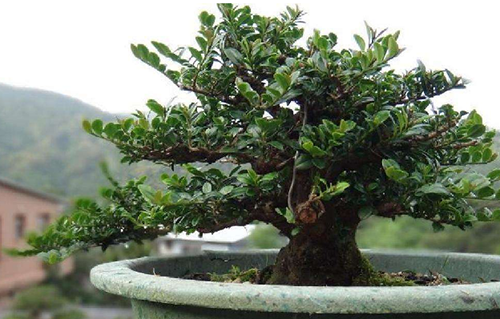
The Value of a Pterocarpus santalinus Bonsai
Pterocarpus santalinus is the raw material for rosewood furniture and is a scarce resource. Many people invest in growing Pterocarpus santalinus. Mature Pterocarpus santalinus has an outstanding reputation and a very high market valuation. As a flower enthusiast, if you are growing Pterocarpus santalinus purely for ornament, it is also a fully deserving first choice. Pterocarpus santalinus is one of many tree species, with dense, deep green foliage and a very evident feeling of spring. It gives people a suddenly open and clear state of mind.
Have you now learned how to deal with a Pterocarpus santalinus bonsai that is dropping leaves? If your Pterocarpus santalinus shows signs of leaf drop, please deal with it promptly. We cherish our plants, and plants will repay you with their beauty.
Appreciating Peony Bonsai
Bonsai is a unique and beautiful treasure of Chinese garden art, with a history of 1500 years in China. It is a clever combination of pot cultivation techniques and shaping art, an organic unity of scenery, pot and stand, and ranks alongside traditional arts such as painting, calligraphy, sculpture and music. It has been described as “a silent poem, a three-dimensional painting.”
Peony bonsai is a newly emerging flowering bonsai category. It combines the magnificent peony with the simple, elegant art of bonsai, forming an artistic form with a distinctive Central Plains regional style, and has been praised by experts and scholars in China's bonsai circles. Chinese bonsai master Chen Sifu praised it: “Peony bonsai displays the charm of bonsai and the poetry of painting.” Chinese bonsai artist He Quansun said: “Looking at peony bonsai works as a whole, they reflect beautiful shaping, appropriate material selection, and fitting, harmonious and unified arrangement, such as the well-matched stones of 'Fragrance' with their complementary hardness and softness; the ancient, weathered trunks of 'Competition' with their disciplined tension and release; the contest and response, the wild charm of 'Hometown'; the complete composition and noble elegance of 'Lingering Charm of Tang and Song'; the balance of decline and flourishing, of emptiness and substance, in 'Withered Wood Meets Spring', and so on. It reflects the artistic attainment of these peony bonsai. It is the sublimation of the artistic beauty of peony cultivation.” Chinese bonsai artist Meng Lanting called peony bonsai “an unprecedented pioneering achievement……”
The appreciation of peony bonsai is roughly the same as that of other bonsai. For example, first appreciate the scenery (the trunk and shape), second the pot, third the stand, and fourth the title of the scene (the given name).
Appreciating the Trunk and Shape
A peony trunk-and-shape bonsai can be appreciated in all four seasons. In spring and summer you view the flowers, in summer and autumn the leaves, in winter and spring the buds, and in winter the trunk. This provides a richer range of appreciation than ordinary peonies and breaks the centuries-old habit of viewing only the flowers.
Viewing the trunk: peony branches are thick and strong, with grayish-brown or blackish-brown, mottled bark. After shaping and artistic treatment, they have the bearing of a thousand-year-old pine, the bone of a century-old plum, whether upright, hanging, lying or slanting, “holding the intent to shelter the sky and cover the earth, possessing the momentum of a coiled dragon a hundred feet long.”
Viewing the flowers: peony bonsai is mainly appreciated for its flowers. The flower forms are varied, the colors run the full range of “red, orange, yellow, green, blue, indigo and violet,” and the fragrance spreads all around. A few graceful peony flowers in a pot will leave you with endless aftertaste.
Viewing the leaves: peony leaves are strikingly beautiful in form, being pinnately compound. In spring the leaves are emerald green, and after autumn frost they turn yellow, red, purple and other colors, very beautiful and eye-catching, with the charm of “layer upon layer of forest fully dyed.”
Viewing the buds: appreciated after leaf fall and in early spring, the buds vary in shape and color. Bud colors include red, pink and purple, and bud shapes include torch-shaped, eagle-beak-shaped and narrow, long and pointed, stirring the imagination.
Viewing the fruit: the fruit is of the unusual-fruit type, that is, about five oval fruits arranged in a radiating wheel shape; seen from a distance, they resemble a “starfish” in the sea or the “five-pointed star” on a national flag.
Viewing the roots: after “root exposure treatment,” people can directly appreciate the twisted, interlocking peony roots. This gives a strong sense of power and the beauty of nature, satisfying people's desire to return to nature.
Appreciating the Pot
The choice of pot for peony bonsai is very particular; the pot serves as the “ground color” that sets off the “peony” painting. Whether using a colored porcelain or blue-and-white porcelain landscape pot from Jingdezhen, or a purple clay (zisha) pot produced in Yixing, it must bring out the peony's noble magnificence. The best are antique, famous pots with simple, ancient elegance and a rich variety of styles, with those from the Ming and Qing dynasties being the finest.
Round shallow pots, ancient square seal pots, round peng pots and jian tube pots are most often chosen, and the most beautiful colors are antique bronze, agarwood, black-green, sesame, vermilion metallurgic, and grape purple. The best are those with “calligraphy” related to the peony carved on the body of the pot.
Appreciating the Stand
The placement of peony bonsai must be very carefully considered. It is meant to raise the spatial status of the bonsai, separate it from the ground and surrounding environment, make it stand out and catch the eye, and further set off the peony bonsai. The stand itself is a work of art. Nowadays, imitations of Ming and Qing styles are mostly used: Ming style is concise and generous, simple and substantial, mostly in yellow rosewood and red sandalwood, with lighter color and obvious wood grain. Qing style is finely carved and richly ornate, mostly in red sandalwood and rosewood; both Ming and Qing achieved relatively high craftsmanship.
Modern stands are mostly made of rosewood, red sandalwood and boxwood, with fine, hard wood and bright, glossy color. In addition, imitations made of faux rosewood and faux red sandalwood are also used, and because of their fine craftsmanship, the visual effect is quite good as well. Styles include the “scroll stand,” “fret-pattern stand,” “curio-display stand,” “small qin-table stand,” as well as the “root-carving stand,” “Tang Sancai drum stand” and so on. The best are those with a peony pattern carved on the stand.
Savoring the Title of the Scene
In the appreciation of bonsai, the title is very important; it can increase the ideological and artistic quality of the work and further express its artistic conception. Chinese painting values the artistic effect of the four-in-one unity of poetry, calligraphy, painting and seal, and the title of a peony bonsai, like the scenery, pot and stand, is an indispensable part. Concise, summarizing words and phrases express the content and spirit of the work, playing the role of the finishing touch. You can use “National Beauty and Heavenly Fragrance” to reflect the peony's place in the hearts of Chinese people; you can express the beauty of the peony and the beauty of the bonsai at the same time; you can use “Lingering Charm of Tang and Song” to express the peony's ancient history, making people look at the present and trace back to the past, seeking endless flavor. In short, through the limited scenery in the pot, infinite associations are produced, leaving the viewer with endless aftertaste.
In addition, the decoration of the pot surface is also very important, such as the matching of stones, dotting with moss, planting small patches of turf, and the treatment of terrain and landforms, as well as the placement of various accessories (pavilions, terraces, towers, chambers, pagodas, waterside pavilions, rafts, bridges, figures and various animals), and so on.
The matching of stones with peonies is very particular. In Chinese painting there is the “peony and stone picture,” and peonies are commonly accompanied by Taihu stones, Ying stones and bamboo-shoot stones, making the scenery vivid and varied, the composition more perfect, and adding more wild mountain charm. Laying moss or turf makes the pot surface a stretch of emerald green, full of vitality and closer to the natural landform. The placement of accessories makes the picture more poetic and picturesque.
Appreciating Fine Peony Bonsai Works
Peony bonsai “National Beauty and Heavenly Fragrance”: once won an award at the 2nd Henan Province Bonsai Art Competition and Exhibition in 1985.
This work uses the stone-attached style. In a rectangular shallow purple clay pot stands an exquisite, translucent Taihu stone; beside the stone, several peony branches pass through the holes in the stone, with ancient, gnarled, vigorous branches, and several peony flowers blooming at the tips; at the base of the stone, two more peony flowers are in bud. The whole work has clear layering, a perfect composition and a fresh picture, just like an ancient “peony and stone picture” in the freehand style.
Peony bonsai “Lingering Charm of Tang and Song”: once won the Outstanding Work Award at the 2nd China Bonsai Art Competition and Exhibition in 1989.
This work uses the single-trunk shaping method. In a round purple clay golden-bell pot with a small base is planted a tall, upright peony. The peony's branches and leaves are free and easy, with clear layering; the main trunk is thick and strong with mottled bark, and the roots are exposed and twisted and interlocking, just like an ancient tree a thousand years old. Beside the roots is a lying stone, with green moss dotting the soil at its edge, and beneath the pot is a drum stand with an antique Tang Sancai peony pattern. Several peony flowers bloom at the top of the trunk, reflecting local characteristics and artistic effect, hence it has the lingering style of Tang and Song peonies.