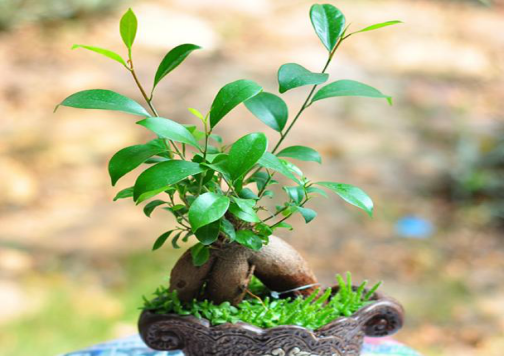
What are the reasons for a ginseng ficus losing its leaves?
1. Normal phenomenon:
If a newly bought ginseng ficus drops its leaves, there is no need to worry too much, because this is the ginseng ficus's way of adapting to a new environment and is a normal phenomenon; just let it slowly recover.
2. Growth habits:
The ginseng ficus originates from hot, rainy, humid tropical rainforest regions, where the temperature difference between day and night is small. When the temperature difference between day and night is greater than 10 degrees, the ginseng ficus will easily drop its leaves and may even die in the end.
3. Improper care, part one:
Watering the ginseng ficus when its potting soil is still not dry, or failing to water thoroughly, will cause waterlogging, which in turn leads to root rot and leaf drop.
4. Improper care, part two:
Applying too much fertilizer to the ginseng ficus, or at too high a concentration, causes fertilizer burn and leads to leaf drop.
5. Improper care, part three:
The ginseng ficus is placed in an area with insufficient sunlight, or is exposed to scorching sun during high summer temperatures.
6. Pest threat:
Damage from red spider mites and scale insects. Red spider mites cause the most serious damage from May to June each year; there are many kinds of scale insects, which mainly parasitize leaves and tender branches, sucking the plant's nutrients and causing great harm.
The flower language of Lantana
Cheerful, lively
Lantana blooms all year round, has a long flowering period, and comes in rich, varied colors; within the same inflorescence there are red, orange, yellow, pink, white and other colors. The flowers are yellow or pink when they first open, gradually turn orange-yellow or orange-red, and finally become red. Lantana flowers have an attraction that draws butterflies, and whenever the flowers bloom, many butterflies come fluttering over.
What to do when a money tree's leaves turn yellow: diagnosing ten major causes
Recently many friends have told us that the leaves of the money tree in their home are gradually starting to turn yellow bit by bit. There are many reasons that cause a money tree's leaves to turn yellow, including external factors such as climate, and also the possibility that the money tree itself is troubled by pests and diseases. So how do you diagnose the causes of a money tree's yellowing leaves? Let's look at them one by one below!
1. Improper watering: The money tree likes a warm, humid climate environment, and the potting soil should preferably be moist, but when grown indoors the potting soil is generally not watered until dry, and watered thoroughly when watered. This is because if you do not water thoroughly and only wet the top while the bottom stays dry, nutrient absorption will be affected, causing the leaves to become dull and lusterless and gradually turn yellow and drop from the bottom upward. In this situation, you need to water lightly and spray water often, so that it gradually recovers before returning to normal watering.
2. Unsuitable light: The money tree likes light, but cannot tolerate strong direct light, and prefers semi-shade or scattered light; only in winter does it need good light conditions to grow well. From late April onward, you can choose a clear, warm midday, move the pot outside or onto a balcony to receive direct sunlight for 1-2 hours, and gradually extend the time; this will give very good growing results. Being in a shady spot or a dim place for a long time will cause the leaves to turn yellow and drop, and in serious cases the plant may even wither and die.
3. Pest and disease control: Leaf spot disease is a common ailment of the money tree; the symptoms are that a few spots appear first, then the spots gradually expand and spread across the entire leaf, which then drops off. Garlic juice can be sprayed on to sterilize. As for pests, the main problems are red spider mites and scale insects. Red spider mites are small, with a body length of less than 1 mm, and can be effectively controlled with acaricides such as mancozeb-type miticides, clofentezine and dicofol. Scale insects vary in size depending on the species, and their colors differ greatly too, but they share one common feature: they are round or oval, generally do not move, and cling tightly to the plant's stems or leaf stalks and other places to suck sap. When there are few, they can be wiped clean with a cloth strip, because scale insects die as soon as they leave the plant; when there are many, you can spray a 0.2% solution of essential balm or laundry detergent for control.
4. Too much fertilizer: Generally, during the money tree's optimum growth temperature period, fertilizer should be applied regularly to ensure lush growth; usually a light fertilizer is applied once about every 20 days, and when repotting, well-rotted base fertilizer should be added. However, applying too much fertilizer, or applying fertilizer that has not been rotted, will cause the money tree's roots to burn, resulting in yellowing and dropping leaves.
5. Dust on the leaf surface: If the dust on the leaf surface is too thick, it not only affects the appearance but also affects the plant's respiration and photosynthesis, thus causing the leaves to turn yellow. The dust should be wiped clean promptly.
6. Incorrect soil-changing operation: When changing the soil, incorrect operation can also cause a money tree's leaves to turn yellow. When changing the soil for a money tree, try to damage the roots as little as possible; the added medium should be sterile, breathable, fertile and slightly acidic, and the potting soil should be pressed firm with no gaps left. If gaps are left, no matter how much water is poured, the plant will still suffer from water shortage, thus causing the leaves to turn yellow.
7. Low ambient temperature: The money tree likes a warm, humid environment, and its optimum growth temperature is 20-30°C. When the air temperature is below 18°C, the money tree stops growing; it can also adapt to temperatures as low as 10°C, but the temperature must never drop below 5°C, otherwise frost damage will occur, with light cases showing yellow, scattered leaves and severe cases resulting in death.
8. Hot, high temperatures: For a money tree that likes a warm, humid environment, if it is placed in high temperatures under scorching sun, the plant's transpiration will be excessive, and the roots will not be able to supply enough water and nutrients, very easily causing leaf tips to scorch or leaves to turn yellow and drop. It needs to be moved promptly to a well-ventilated, shady place.
9. Too dense and unventilated: If the money tree's branches and leaves grow too luxuriantly, and it has not been pruned for a long time, the light inside the canopy will be insufficient, very easily causing leaves to turn yellow and drop. Pruning should be strengthened promptly to let in air and light.
10. Soil and water on the alkaline side: In most areas of the north, the soil and water contain more salt and alkali, and are not very suitable for growing the acid-loving money tree, because the soil lacks iron that it can absorb, so the money tree's leaves will gradually turn yellow. Therefore, when planting, pay attention to choosing acidic soil, and during the growing period often water with alum fertilizer water.
Based on the ten possible causes above that can lead to a money tree's leaves turning yellow, everyone can check them one by one against their own situation, and then treat the problem accordingly to solve the yellowing of the money tree's leaves. Different causes require different handling methods to be most effective!