How to grow Osmanthus fragrans 'Semperflorens'? Growing methods and precautions explained in one article
1. Temperature
Osmanthus fragrans 'Semperflorens' likes a growing environment of 18°C to 25°C best, and blooms abundantly at this time; if it is below 15°C, flowering will decrease; it can overwinter at 3°C to 5°C, but will not bloom. So if you want it to bloom more, you need to pay attention to controlling the temperature.
2. Humidity
While controlling the temperature, you also need to control the air humidity. Spray water on the leaf surface once each in the morning and evening every day to keep the leaves fresh.
3. Choosing potting soil
According to the characteristics of Osmanthus fragrans 'Semperflorens', you should choose a well-drained, fertile, slightly acidic soil for it.
4. Fertilizing
For Osmanthus fragrans 'Semperflorens', pig manure is the best fertilizer. It can be composted, dried in the sun, and then placed at the bottom of the pot. The amount used is about 1/4 of the pot height. Cover the fertilizer with soil about 2 cun thick, and then plant the Osmanthus fragrans 'Semperflorens'. In this way, no further fertilizing is needed for a year. What if you live in the city and cannot find pig manure? Then you can stir-fry raw peanuts, soybeans and sauce residue until cooked, grind them into powder, and bury them in the potting soil.
5. Pruning
In order to ensure the balance of water metabolism in Osmanthus fragrans 'Semperflorens', the crown must be pruned at the appropriate time.
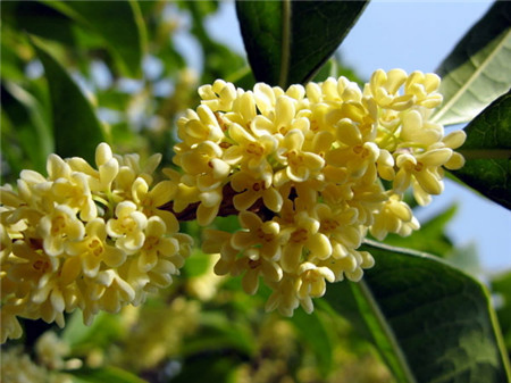
Growing methods for Osmanthus fragrans 'Semperflorens'
Osmanthus fragrans 'Semperflorens' is a precious flower of our country. It not only has a very wide range of admirers, but also has high economic value, and is deeply loved by people. However, growing it well is not so easy. How to grow Osmanthus fragrans 'Semperflorens' should start from the following five aspects.1. Choose the potting soil well
Osmanthus likes slightly acidic, well-drained, fertile sandy loam. In strongly acidic soil, Osmanthus grows slowly, with yellow and withered leaves and few branches; in soil with a pH value of 3-4, grafted two-year-old seedlings produce 2-3 branches that year, and the branches are only 6 cm long, with 2 times fewer branches and 1-2 times shorter than in soil with a pH value of 6. In alkaline soil, leaf blight appears in two or three months, and the plant gradually dies.
2. Vigorous flowering depends on fertilizer, and Osmanthus likes pig manure. It can be mixed into the potting soil, or composted, dried in the sun, and then applied at the bottom of the pot. The fertilizing amount is based on 1/4 of the pot height. The fertilizer should be covered with a layer of soil about 1 cun to 2 cun thick, and then plant the Osmanthus fragrans 'Semperflorens'. No further fertilizing is needed within a year. In cities where there is no pig manure, you can use the hooves of donkeys, horses and mules to compost into liquid, water once when sprouts appear in spring, and then before August, water once every 7 to 10 days. You can also stir-fry sauce residue and soybeans until cooked, stir-fry raw peanuts until cooked, grind them into powder, dig ring-shaped holes around the roots and bury them in the potting soil. According to observation: with sufficient fertilizer, the flowers are vigorous and fragrant, and there are 2 to 3 times more flowers. With insufficient fertilizer, there are few branches, few flowers, and the flowers are not fragrant.
3. Watering should be appropriate
Watering Osmanthus should follow the principle of two less and one more: water less for plants repotted before new shoots appear, water less on cloudy and rainy days, and water more on dry days in summer and autumn. After repotting and watering thoroughly, maintain a water content of about 50% regularly. During the dog days (July-September), the soil water content should be about 60%. Identification method: pinch the potting soil with your hand and it can form a ball, and when you let go it disperses. On cloudy and rainy days, pay attention to drainage to prevent waterlogging and root rot. Practice has proved that when the soil has more than 90% water accumulation, Osmanthus is likely to drown.
At the same time, air humidity must also be maintained. Place the Osmanthus in a shaded place, and spray water on the leaf surface once each in the morning and evening every day. Or place a water-filled fish tank or small basin beside it, and put the Osmanthus in the open air to receive night dew and increase humidity so as to keep the leaves fresh.
4. Flowering period control
The flower bud formation and differentiation of Osmanthus fragrans 'Semperflorens' through to flowering requires a process of high temperature - low temperature - high temperature. Differentiation begins at a high temperature of about 30°C, and flower buds form in 25 days to 31 days. After 3 days to 5 days of low-temperature dormancy at about 15°C, the flower buds begin to sprout. After the flower buds sprout, at a high temperature above 25°C, they bloom very quickly.
5. Shaping
Osmanthus is mainly valued for its leaves, shape and flowers. The flowers are small but fragrant, and it is mainly the beauty of the leaves and shape. The shaping should express an air of prosperity and wealth, solemnity, and elegance and innocence. You can choose privet as the rootstock. First move the large-leaf privet to a flowerpot. From the summer solstice to the autumn equinox, the approach grafting method can be used throughout this period, that is, graft the branches of Osmanthus onto the branches of privet, remove the tip of the privet branch, and after it survives, cut the Osmanthus from the parent plant to form a new Osmanthus plant. The survival rate can generally reach 100%. Some privet rootstocks are not beautiful in form, so you can first shape them, such as curved bow, twisted, etc., shape them according to personal preference, and then approach graft. Where there is no large-leaf privet, small-leaf privet can be used as the rootstock. After the Osmanthus is approach grafted, watering must not be neglected, and management should be the same as normal.
How to plant Osmanthus fragrans 'Semperflorens': growing methods for Osmanthus fragrans 'Semperflorens'
Osmanthus fragrans 'Semperflorens' is one of the famous flower varieties of our country. It can not only beautify the environment, but also green the air. The fragrance of Osmanthus captivates people, and it is indispensable to many fragrance lovers. Below is an introduction to the growing methods for Osmanthus fragrans 'Semperflorens'.
Growing methods for Osmanthus fragrans 'Semperflorens'1. What is Osmanthus fragrans 'Semperflorens'
Osmanthus fragrans 'Semperflorens' is a variety that blooms in all four seasons, so it can bring us fragrance in all four seasons. Among Osmanthus varieties, the excellent variety Osmanthus fragrans 'Semperflorens' blooms most abundantly in summer and autumn, and its floral fragrance is especially rich. In spring and winter, it blooms relatively less, producing a faint floral fragrance. So planting Osmanthus fragrans 'Semperflorens' can let us have fragrance in all four seasons.
2. Growing methods for Osmanthus fragrans 'Semperflorens' -- habits
This flower, Osmanthus fragrans 'Semperflorens', needs a warm and humid environment. It has a certain resistance to cold, but cannot accept extreme cold. Osmanthus fragrans 'Semperflorens' prefers light, but at the same time can tolerate appropriate shade. When the seedlings of Osmanthus fragrans 'Semperflorens' are being grown and developed, they should be shaded, and the soil can be slightly acidic soil with humus.
3. Growing methods for Osmanthus fragrans 'Semperflorens' -- watering
Osmanthus fragrans 'Semperflorens' grows more healthily in high temperature and dry conditions, so do not water too much. It is best to keep the soil in a semi-moist state. On cloudy and rainy days, water less to prevent the water accumulation in the soil from becoming even less.
4. Growing methods for Osmanthus fragrans 'Semperflorens' -- fertilizing
Osmanthus fragrans 'Semperflorens' likes fertile soil. During flower budding or bud formation, add more phosphorus and potassium, etc., to increase the sturdiness of the branches of Osmanthus fragrans 'Semperflorens'.