What are the daily care precautions for Paeonia rockii?
1. Water
Paeonia rockii has extremely strong drought resistance. After a newly planted Paeonia rockii plant has its certain water requirements met and grows to a relatively deep rooting level, it only needs watering 2 to 3 times a year thereafter, but always pay attention to drainage, as Paeonia rockii fears waterlogging.
2. Light
Paeonia rockii is a sun-loving plant, but it is not the case that the more sun the better. In July and August it must not be left in full sun; appropriate shading is needed, otherwise leaf scorch will occur. During the flowering period of Paeonia rockii, excessively strong light will also shorten the flowering period, so appropriate shading should also be provided.
3. Soil
Paeonia rockii is resistant to saline-alkali soil and has good adaptability, but fertile soil is of course better, and the flowers produced will be highly ornamental.
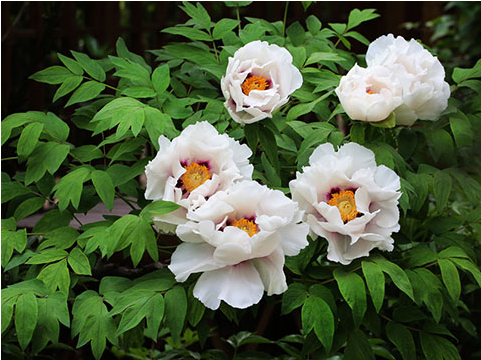
That is all for today's introduction. Thank you for reading. If you like it, bookmark and share Four Seasons Plants website!
How to grow Paeonia rockii and precautions
How to grow Paeonia rockii
Light
Paeonia rockii loves light and is a long-day plant. But in the hot July and August, shading and ventilation work must be done well, otherwise leaf scorch easily occurs. Note that during the flowering period of Paeonia rockii, excessively strong light will also shorten the flowering period, so a shade shed can be appropriately set up.
Water
It is drought-resistant and generally needs watering 2-3 times a year. It fears waterlogging, so timely drainage must be paid attention to.
Soil
Paeonia rockii has low requirements for soil, is resistant to saline-alkali soil, and has good adaptability to soil. Of course, it grows better in soil with good fertility, and the flowers produced are more ornamental.
Propagation methods
Propagation is often carried out by division, sowing, and grafting.
Precautions for growing Paeonia rockii
Paeonia rockii planted south of the Yellow River and in low-lying areas needs good drainage work, especially in the rainy season, to avoid waterlogging.
The soil in the Northeast region is relatively loose, so surface water infiltrates quickly. Therefore, for newly planted Paeonia rockii plants, sufficient water supply must be ensured. Generally, after two years, once the new roots of Paeonia rockii have taken root relatively deeply, there is no need to water excessively.
How to grow Campanula punctata and precautions for growing Campanula punctata
Campanula punctata is just as its name suggests: its bell-shaped flowers have speckled purple spots. It is not only ornamental, but its whole plant can also be used as medicine. Today we will talk about how to grow Campanula punctata and precautions for growing Campanula punctata.
How to grow Campanula punctata:
1. Sowing time: Campanula punctata is a cool-loving plant, and it is best to start sowing in late summer. After growing for several months in winter, it completes its entire growth process in the spring of the following year. During this process, the light duration must be at least 14 hours per day, and the ornamental period is longer. It takes about 30 days from the appearance of flower buds to flowering. If long-day treatment is carried out, sowing should be done in November; under natural conditions, sowing in January and February means it can grow to maturity in summer.
2. Propagation method: Campanula punctata is commonly propagated by sowing, with sowing time in August to September in autumn. Sow the prepared seeds in a shallow pot or wooden box and place it in a cool place. The seeds of Campanula punctata are tiny, so after sowing they must not be covered with too much soil; just ensure the seeds are not visible. When watering the seedlings, use a fine-nozzle pot or sprayer to spray water, so as to avoid overwatering that causes the seeds to be submerged and the roots to rot.
3. Seedling handling: Once the seedlings have grown roots, they can be transplanted, still using a shallow pot. During transplanting, be careful not to break the roots. When the seedlings grow to about 5 cm tall, they can be transplanted into 10 cm tall pots. After the seedling roots have filled the pot, repot again, carrying this out 2 to 3 times, until in the final flowering year they are transplanted into flower beds or the ground.
4. Fertilizing and watering: Before the radicle appears, Campanula punctata must maintain relatively high relative humidity, and the substrate should also be relatively moist. If necessary, a layer of coarse vermiculite can be covered over the new seedlings to retain moisture. If you want the seedlings to grow quickly, you can apply 30 to 50 PPM calcium nitrogen fertilizer, and then apply calcium fertilizer on that basis to make them grow quickly.
5. Light treatment: Campanula punctata loves long-day conditions and can flower naturally with 14 hours of light per day. If you want to advance the flowering period, only 4 hours of interrupted darkness treatment for 30 days is needed. Campanula punctata does not require growth regulation or pinching. In the early growth process, the appearance of Campanula is messy, but in the later growth process it will naturally adjust to be neat and compact, so no special regulation is needed.
Precautions for growing Campanula punctata:
Campanula punctata only blooms after going through two winters, so cultivation requires patience, especially in the hot summer weather, which can easily cause the plant to wilt. Potted Campanula punctata must not be placed on the shady side of high-rise buildings to prevent scorching, and leaf spraying and cooling should be appropriately strengthened in a timely manner. Campanula punctata is also a sun-loving plant, so it must not be placed in a shady place for a long time without light.