What are the propagation methods for Chinese fringetree (Loropetalum chinense var. rubrum)?
Chinese fringetree is mostly propagated by cuttings. Choose field soil that is well-drained, sunny and fertile, take stout, plump branches with clearly protruding buds from a healthy mother plant, and use them for cuttings. After inserting the cuttings, water the soil thoroughly, then cover with plastic film to seal it, keeping the shed at high temperature, high humidity with appropriate light and ventilation, and after about half a month they will take root and sprout.
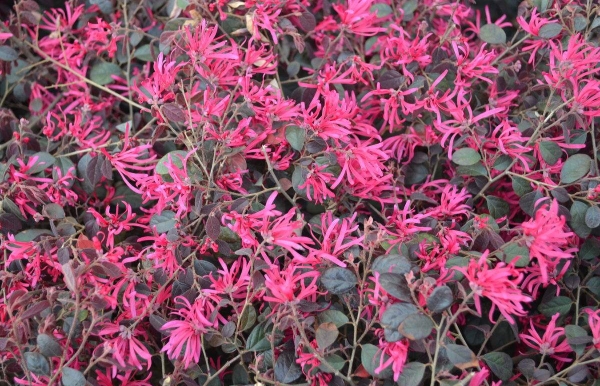
How to grow Chinese fringetree
Soil
Chinese fringetree is highly adaptable and can tolerate poor soil, but it grows better in moist, fertile, slightly acidic soil. Some decomposed organic fertilizer should be added to the soil as a base fertilizer.
Light and temperature
Chinese fringetree likes light and a warm climate, can tolerate cold, and is slightly shade-tolerant. It needs sufficient light to grow healthily with brilliant flowers and foliage, but in summer it needs shading to avoid direct sunlight; build a shade frame or place the potted Chinese fringetree somewhere out of direct sunlight, and take care that the leaf color does not turn green. A growing temperature of around 20°C is most suitable, but since winter temperatures are low, it is better to move it indoors for the winter, keeping the temperature above 5°C and paying attention to ventilation.
Water and fertilizer management
Chinese fringetree likes a moist environment. During the growing period, water it in moderation; the potting soil must not be too dry or too wet. Generally, more water is needed in summer, along with misting; in winter, because Chinese fringetree goes dormant, reduce watering, but do not let it get too dry. As for fertilizing, once every half a month during the growing period is enough; during dormancy, fertilize less or not at all. Note that Chinese fringetree likes acid, so you can spray some ferrous sulfate solution, and apply some potassium fertilizer before flowering.
How to grow Chinese fringetree
Chinese fringetree, also known as red fringetree, red zhizhi wood, red jihua and so on, is an evergreen shrub or small tree of the genus Loropetalum in the witch hazel family. Its bark is dark gray or light grayish brown, its leathery leaves are alternate, its branches are dense and its foliage lush, its form is graceful, it tolerates pruning and tolerates wiring, and it can be used for hedges or made into stump bonsai. When it blooms, the whole tree is covered in red flowers, an extremely spectacular sight. Now let us take a look at how to grow Chinese fringetree!
The growth habits of Chinese fringetree
Chinese fringetree is mainly distributed in the middle and lower reaches of the Yangtze River and areas to the south, and is also found in northern India. It is produced in Liuyang City and Changsha County in Hunan, and Suzhou, Wuxi, Yixing, Liyang, Jurong and other places in Jiangsu. It likes light and is slightly shade-tolerant, but in shade the leaf color easily turns green. It is highly adaptable and drought-tolerant. It likes warmth and tolerates cold. Its sprouting and branching ability is strong, and it tolerates pruning. It tolerates poor soil, but grows best in fertile, moist, slightly acidic soil.
Propagation methods for Chinese fringetree
1. Grafting: grafting mainly uses two methods, cut grafting and bud grafting, and can be done from February to October. Cut grafting is best done before sprouting in spring, while bud grafting is best in September to October. Using medium and small plants of white fringetree as rootstock for multi-head grafting, with strengthened water, fertilizer and pruning management, they can leave the nursery within 1 year.
2. Cuttings: cuttings can be taken from March to September. Use loose loess as the cutting medium, ensure the medium is airy and permeable with high air humidity, keep it warm but avoid direct sunlight, and also pay attention to ventilation around the cuttings. Under warm, moist conditions, the cuttings form a red callus in 20 to 25 days, and after 1 month they grow 3 to 9 new roots that are 0.1 cm thick and 1 to 6 cm long.
3. Sowing: sow in spring and summer; the seed germination rate is high. They sprout about 25 days after sowing, can grow to 6 to 20 cm tall in 1 year, and send out 3 to 6 branches. The new roots of seedlings are red and fleshy, so careful management is required in the early stage; only once the root system becomes lignified and turns brown can management be more extensive. Because sexual propagation has a long seedling stage, slow growth, and produces white fringetree seedlings (atavism), it is generally not used for nursery stock production, but rather for breeding research on Chinese fringetree.
Cultivation and management of Chinese fringetree
1. Fertilizing: before transplanting Chinese fringetree, choose a base fertilizer mainly of decomposed organic fertilizer, combined with broadcast or hole application of compound fertilizer, and be sure to mix it thoroughly to avoid root damage. During the growing season, use a neutral foliar fertilizer diluted 800 to 1000 times for foliar topdressing, spraying 2 to 3 times a month to promote new shoot growth.
2. Watering: in the plum rain season in the south, Chinese fringetree should be kept well-drained. In hot, dry seasons, ensure watering once each in the morning and evening, and mist at noon to cool it down. In northern regions, because the soil and air are dry, water promptly to keep the soil moist, and in autumn, winter and early spring pay attention to misting to keep the leaves clean and moist.
3. Pruning: Chinese fringetree has the characteristics of strong sprouting ability and tolerance of pruning. Carry out light to moderate pruning in growing seasons such as early spring and early autumn, and with normal water and fertilizer management, it can bloom after about 1 month, with the flowering period concentrated. This method can promote new branches and new leaves, make the tree form more beautiful, prolong the red period of the leaves, and can promote or control the flowering period. It is especially suitable when Chinese fringetree bonsai are entered in flower exhibitions and trade fairs, as it can enhance the exhibition effect and promote product sales.
4. Shaping
① Artificial spherical form: Chinese fringetree is extremely tolerant of pruning and wiring for shaping, and the tree form mostly adopts the artificial spherical type. During the growing season, remove the mature leaves and shoot tips of the Chinese fringetree, and after about 10 days of normal management it will send out young shoots again and grow bright red new leaves.
② Natural clumping form: Chinese fringetree has strong sprouting and branching ability and can naturally grow into a clumping form.
③ Single-trunk round-headed form: select one stout branch and train it as the trunk, thin out the remaining branches, and when the trunk reaches the set height, head it back, then choose one healthy, upright branch on it as the extension branch of the trunk, that is, train it as the central leader; afterward, on the central leader select and keep 4 to 5 strong main branches evenly arranged around it, with the branches distributed in a staggered way above and below.
How to grow Chinese fringetree
1. Specimen planting: choose a plant with a tall, full form and plant it alone in an important position or at a focal point of view, such as near an entrance, in a courtyard or on a lawn, forming a scene by itself, and pay attention to creating a strong contrast with the surrounding landscape to achieve the effect of “a single red among ten thousand greens”; it can serve as the central viewpoint of the landscape or guide the line of sight.
2. Group planting: intersperse Chinese fringetree balls and other plants in groups in garden green spaces, which both enriches the landscape colors and enlivens the garden atmosphere. If planted in groups with green tree species, it can add beauty to what is already beautiful. Planting mainly Chinese fringetree balls in groups and patches forms a scenic forest; its unique leaf color and form are beautiful in all four seasons, and its landscaping effect is far better than that of a purely green scenic forest.
3. Mass planting: use one-year-old small Chinese fringetree seedlings planted densely in green spaces to form color blocks. They can be combined with golden privet, spring-flowering azaleas, summer-flowering azaleas, golden-leaved elm, golden-edged boxwood and so on. This not only forms color contrast through the difference in leaf color, but the flowering periods can also be staggered. For this kind of use, it is best to choose the Tougu Hong series.
4. Spherical form: prune Chinese fringetree into spherical shapes and arrange them in green belts. There are mainly two types, rough balls and fine balls. Rough balls are mainly formed after 1 to 3 years of pruning and shaping and are mainly used in large green spaces with somewhat extensive management. Fine balls require at least 3 years of pruning and shaping and are mainly used in refined gardens such as villa courtyards. For this kind of use, it is best to choose the Tougu Hong series.
5. Colored hedge: plant Chinese fringetree densely into colored hedges to serve as enclosure and space separation. The seedling specifications should be selected according to the specific use of the colored hedge. For example, in green spaces, a 70 to 80 cm colored hedge can be used to separate spaces, while colored hedges higher than 2 m are mostly used around the outer edge of green spaces to serve as a green wall.
6. Colored sculpture: train or shape Chinese fringetree in a targeted way into green sculptures such as animals or geometric shapes, and place them in green spaces as garden features. For this kind of use, it is best to choose the Tougu Hong series.
7. Stump landscape: taking advantage of the characteristics of the Shuangmian Hong series of Chinese fringetree, such as fast growth, large leaves and sparse branches, train them in a targeted way into large stump landscapes for use in the greening of high-end gardens, and they can also be used as the focal point of a flower bed in the layout.
8. Street trees: by controlling pruning, train Chinese fringetree into a small colorful-leaved tree, or train it by grafting onto white fringetree. It is mostly used as a street tree in residential communities. For this kind of use, it is best to choose the Tougu Hong series.