Propagation Methods and Cultivation Management Techniques for the Chenille Plant
1. Propagation method.
The chenille plant is commonly propagated by cuttings. In April, when the temperature is suitable, select newly grown branches from vigorous plants, cut them into 10 to 15 cm lengths as cuttings, keep two leaves on each cutting, then insert them into a substrate made of river sand. After inserting the cuttings, water them thoroughly, then set up a plastic film tent to keep them warm and humid, and give them extra care. Once the cuttings have rooted, they can be taken out of the nursery for planting.
2. Cultivation method.
For cultivating the chenille plant, choose a sandy loam that is fertile, well-drained, and rich in humus. If growing it in a pot, you can use a mix of garden soil, leaf mold, fine sand, and a small amount of base fertilizer as the substrate, and water promptly after planting. During the chenille plant's growing season, apply a decomposed liquid fertilizer once every 10 to 15 days.
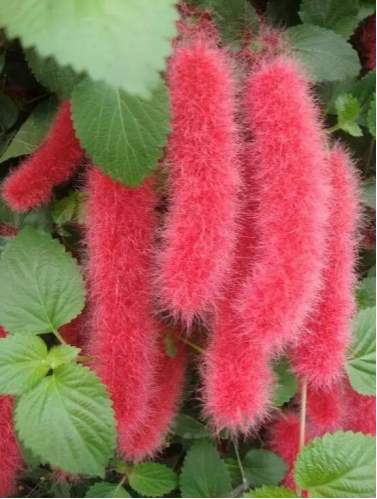
The chenille plant's flowers are bright and vivid in color and have a festive appearance, so it is also called "suisui red," taking the meaning of "every spike red." I believe that after reading the above introduction, everyone has learned about the benefits of the chenille plant and has also gotten some help on how to care for it. Thank you all for reading.
How to Grow the Chenille Plant: The Complete Guide to the Chenille Plant
The chenille plant (Acalypha hispida Burm. f.) has the Chinese scientific name Hongsui Tiexiancai and is also known as Cimao Tiexian, Luye Tiexiancai, Changsui Tiexian, and others. It is a woody plant in the genus Acalypha of the family Euphorbiaceae, native to tropical regions of Asia. The plant is shrub-like, with a height of 0.5-3 m. The leaves are alternate and ovate, 12-15 cm long, bright green, slightly paler on the underside; the petioles are downy, 5-6 cm long. The spike inflorescences grow in the leaf axils, are cylindrical and drooping, 30-60 cm long, bright red or dark red, with small flowers lacking petals and unisexual. The flowering period is from February to November.
It is now widely cultivated as an ornamental garden plant in tropical and subtropical regions. In northern China, it is usually grown as a greenhouse potted flower, and when potted it generally does not exceed 1 meter in height.
There are weeping cultivars in cultivation that are heavily branched and suitable for use in hanging baskets.
Chenille Plant Picture Gallery
Flowers such as peonies and Chinese roses may be national beauties, but after looking at them for a long time, don't you feel a bit of aesthetic fatigue? This strangely shaped chenille plant might give you a different kind of feeling.
The Flower Meaning of the Chenille Plant
The flower meaning of the chenille plant is yearning for nature. Seeing this peculiar chenille plant growing in the forest, blending with its surroundings and forming a natural whole, it yearns for nature and can also merge into nature, which truly makes people love it.
Chenille Plant Picture Appreciation
The large, deep green leaves are lush and verdant, making people feel a cool, refreshing sensation rushing toward them. The cleverest part is that among the layer upon layer of green leaves, several thin, long red tails poke out their heads, just like the drooping tail of a little dog. It also has quite the feeling of a few streaks of red among a vast expanse of green!
Some people like to use the chenille plant as a hanging basket flower. Just like in the picture, the hanging pot tilts down with rich green and a few traces of vivid red, dainty and lovely.
A little dog wagging its tail gives the impression of being playful and excited. You almost worry that the chenille plant's "tail" will also start wagging, getting excited at the slightest provocation.
The flower spikes of the chenille plant are long and fuzzy, very endearing, and feel just like the dogtail grass swaying by the roadside. They look very similar, but the chenille plant is even more brightly colored.
Even though the flower spikes of the chenille plant look so strange, they still look quite striking when hung up. A patch of fiery red, a patch of fresh green, each bringing out the best in the other and adding charm to each other. When the wind blows, the flowers sway, truly beautiful.
The main ornamental part of the chenille plant is that peculiar dog's tail, but looking at the big green leaves, they are also very lovely. You can appreciate both the leaves and the tail, endless fun!
The chenille plant's "dog tail" has a similar appeal to the common dogtail grass by the roadside. Its fuzzy little appearance is so attractive that you can't bear to put it down.
The flower spikes of the chenille plant do not feel very hard, but rather soft and fluffy, just like a soft and gentle girl.
How to Grow the Chenille Plant and Points to Note
The chenille plant is a very interesting plant with a unique flower shape that is extremely endearing. In the process of growing the chenille plant, what work needs to be done well, and what points need attention?
How to Grow the Chenille Plant
Temperature and Light
The chenille plant likes a warm environment, is not cold-tolerant, and requires ample sunlight. Its suitable growing temperature is between 20°C and 30°C. Because it is not cold-tolerant, its overwintering temperature in winter must not be lower than 15°C; below 10°C, cold damage will occur, and the leaves will turn yellow or even drop.
The chenille plant likes ample sunlight and needs sufficient direct light every day. If the light is insufficient, the chenille plant will become leggy. In summer, when the sunlight is intense, shading is needed.
Water and Fertilizer Management
In terms of water and fertilizer, the chenille plant has quite high demands. The chenille plant is relatively intolerant of drought, so water must be sufficient. During the growing season, keep the potting soil moist and water frequently. In summer, when temperatures are high, appropriately increase the amount of watering, and in winter, watering needs to be controlled. To maintain relatively high air humidity, mist the chenille plant frequently.
During the growing season, pay attention to fertilizing, applying a decomposed dilute liquid fertilizer or a fertilizer containing potassium once a week to promote flowering.
Potting Soil
The chenille plant likes fertile soil and needs to be repotted and given fresh soil every spring. Dig out the plant, remove excess soil, replace it with new soil, water thoroughly, and place it in a shady spot for a week before returning to normal care.
Propagation Method
The chenille plant is mainly propagated by cuttings, which is relatively quick.
Points to Note When Growing the Chenille Plant
Pruning
During the growth of the chenille plant, to keep its shape attractive and ensure healthy growth, it needs frequent pruning. Because the chenille plant grows quickly, it needs frequent pruning and pinching back, which can promote more branching, control the plant shape, and make it full. Generally, excessively dense branches as well as dead and diseased branches need to be cut off to promote healthy growth.
Pest and Disease Control
Common pests and diseases of the chenille plant include damage from aphids and red spider mites.
The Benefits and Effects of the Chenille Plant
The scientific name of the chenille plant is Hongsui Tiexiancai. It has a certain ornamental value, is relatively widely cultivated, and also has certain medicinal effects.
The Ornamental Value of the Chenille Plant
The chenille plant grows between half a meter and 3 meters tall. Its leaves are ovate, deep green in color, and graceful in shape. Its long flower spikes are red and slightly drooping, just like a little dog's tail, with a cute and very interesting appearance. The lovely chenille plant actually has great ornamental value. If not grown indoors, it can be planted in parks, gardens, or courtyards, and whether planted in masses or individually, it has a very good ornamental effect.
The chenille plant's long, bright red tails have a unique ornamental effect. Planted in masses, they can form a small grove of chenille plants. When the red tails droop from the branches and sway in the wind, it is also a very beautiful scene. A single planted chenille plant can be paired with some other flowers, and the effect is also excellent. As a flowering ornamental plant for courtyards, the chenille plant has an obvious ornamental effect.
In northern regions, due to differences in climate, the chenille plant is mostly used as a small to medium-sized potted plant. Potted chenille plants are placed in living rooms, bedrooms, studies, and other indoor places where people commonly spend time, such as on desks, on cabinets, or as hanging basket flowers. Hung up, they are all very beautiful, greatly enhancing their ornamental appeal.
The Medicinal Effects of the Chenille Plant
The scientific name of the chenille plant is Hongsui Tiexiancai, and it has medicinal uses.
The entire plant can be used as medicine. The roots and bark have an expectorant effect and can treat asthma. Its leaves have an astringent effect, and the flower spikes clear heat and promote diuresis, cool the blood, and stop bleeding. They can be effective in treating conditions such as enteritis and dysentery. When used externally, they can treat scalds, burns, and so on.
Chenille Plant Acalypha hispida Burm. f. Chenille Plant Guide: How to Grow the Chenille Plant / How to Propagate the Chenille Plant
Chenille Plant ProfileChenille Plant Acalypha hispida Burm. f.
How to Grow the Chenille Plant and Points to Note: Introduction to the Chenille Plant
The Chinese scientific name of the chenille plant is Hongsui Tiexiancai, and it is a shrub in the genus Acalypha of the family Euphorbiaceae. The plant height is 0.5-3 m. The leaves are ovate, 12-15 cm long, bright green, slightly paler on the underside, and the petioles are downy, 5-6 cm long. The flowers are bright red, borne on tail-shaped long spike inflorescences, and the inflorescences are 30-60 cm long. The flowering period is from February to November.
The chenille plant is now widely cultivated as an ornamental garden plant in tropical and subtropical regions. In northern China, it is usually grown as a greenhouse potted flower.
The fruit of the chenille plant is cylindrical, hanging and long, with brownish-yellow down, like a dog's tail, hence the name chenille plant.
Morphological Characteristics of the Chenille Plant
The chenille plant is a shrub, 0.5-3 meters tall; the young branches are covered with gray short down, the hairs gradually fall off, and the branchlets are hairless.
The leaves are papery, broadly ovate or ovate, 8-20 cm long and 5-14 cm wide, with the apex gradually pointed or sharply pointed, the base broadly wedge-shaped, rounded-obtuse, or slightly heart-shaped, nearly hairless on the upper surface, with sparse hairs along the midvein and lateral veins on the lower surface, and coarsely serrate margins; 3-5 basal veins; petioles 4-8 cm long, with short soft hairs; stipules narrowly triangular, 0.6-1 cm long, with sparse soft hairs.
Dioecious; female inflorescences axillary, spicate, 15-30 cm long, drooping, the inflorescence axis covered with soft hairs; female flower bracts ovate-rhombic, scattered, about 1 mm long, entire, with soft hairs outside, with 3-7 female flowers clustered in the bract axils; female flowers: sepals 4(-3), nearly ovate, about 0.8 mm long, apex sharply pointed, with short hairs; ovary nearly spherical, densely covered with grayish-yellow coarse hairs, styles 3, 6-7 mm long, split into 5-7 lobes, red or purplish red; male inflorescences not seen.
The flowering period of the chenille plant is autumn and winter, from February to November; capsules not seen.
Ecological Habits of the Chenille Plant
The chenille plant likes a warm, humid environment with ample sunlight. However, it is not cold-tolerant, and in northern China it is usually grown as a greenhouse potted flower.
The chenille plant likes fertile soil. The overwintering temperature should be above 18°C; below 12°C the leaves droop, and prolonged low temperatures will cause leaf drop.
Cultivation Techniques for the Chenille Plant
The suitable growing temperature for the chenille plant is 20°C to 30°C. It can be placed outdoors in a sunny, well-ventilated spot for care. In summer, appropriately shade it to prevent scorching by the hot sun.
Because the chenille plant likes a humid air environment, it should be watered frequently to keep the soil moist. When it is hot and dry, you can also spray water on the plant and its surroundings to increase air humidity.
During the growth period of the chenille plant, apply a low-nitrogen, high-phosphorus, high-potassium compound fertilizer or a decomposed dilute liquid fertilizer once a week to promote the formation of inflorescences. In winter, it can be moved indoors to a sunny spot, and the temperature is best kept above 15°C. If it is below 10°C, the plant will drop its leaves, and in severe cases it can cause the plant to die.
How to Grow the Chenille Plant: Key Growing Points
To propagate the chenille plant in the Jiangnan region, you can take the terminal 10 cm to 15 cm in mid-April each year, perform ring-barking, and use air layering. After 20 to 30 days, it can be potted. After the air-layered seedling is potted, the remaining branches can be used for cutting propagation. Insert the cuttings into a pot, soak thoroughly with water, cover with a plastic bag, open it for ventilation for one hour around noon each day, and after 30 days they will root and can be potted for growing and care.
Place the potted seedlings in a semi-shady, ventilated spot, avoiding direct sunlight. When the plant grows to 40 cm, the terminal shoot can be tied and bent to change its growth vigor and encourage it to produce more red inflorescences. In late September, remove the ties and let it grow naturally for a week, then re-tie and shape it as desired.
Propagation Methods of the Chenille Plant
The chenille plant is propagated by cuttings, carried out in spring, and roots easily. Pay attention to fertilizing during the growing season. It grows well in a hot and humid greenhouse.
Variety Classification of the Chenille Plant
There are about 200 species in the same genus, distributed in tropical regions.
Horticultural varieties include striped copperleaf, golden-edged copperleaf, spotted-leaved copperleaf, colorful copperleaf, golden-edged curly-leaved copperleaf, and others, all of which are beautiful and rare foliage plants.
Distribution Range of the Chenille Plant
The chenille plant is native to Malaysia. It is cultivated in Guangdong, Fujian, Guangxi, and other places in China, and is now widely cultivated around the world.
It is now widely cultivated as an ornamental garden plant in tropical and subtropical regions; in the parks or gardens of Taiwan, China, Fujian, Guangdong, Hainan, Guangxi, and southern Yunnan, it is often cultivated, with its green leaves and red inflorescences serving as ornament.
The Role and Uses of the Chenille Plant: Ornamental Value
The chenille plant is an ornamental plant in the genus Acalypha of the family Euphorbiaceae, native to New Guinea and distributed in Guangdong, Fujian, Guangxi, and other places in China. The plant height is 0.5 meters to 3 meters, and the leaves are ovate, 12 cm to 15 cm long, bright green, and slightly paler on the underside. The spike inflorescences are bright red, axillary, 30 cm to 60 cm long, up to 2.5 cm in diameter, drooping, and tail-shaped. It can be used as a medium-sized potted plant to decorate halls, living rooms, and so on.
Garden Uses of the Chenille Plant
The chenille plant has an excellent ornamental effect when planted in parks or courtyards in warm regions. Its flower shape is peculiar, long and drooping, making it an excellent flowering ornamental plant for southern courtyards, and it is grown as a greenhouse potted ornamental in northern regions.
Cultural Background of the Chenille Plant: Origin of the Name
The "chenille plant" is evergreen year-round, and its dogtail-shaped flowers are brightly colored. It is native to New Guinea and is now widely cultivated around the world. Because its appearance is festive, merchants also call it "suisui red," taking the meaning of "prosperous year after year."
These not-very-tall plants reveal one red spike inflorescence after another among the green branches and leaves, fuzzy like little dog tails that have been dyed.
Among the green leaves, one coffee-colored "cat tail" after another pops out. Just how many kittens are playing in the tree? It turns out that this is just a peculiar plant, the cat-tail tree. It is said that the cat-tail tree is a deciduous tree up to 10 meters tall, with grayish-yellow bark. It grows at an altitude of 200 meters to 300 meters at the edge of open forests and on sunny slopes. Its fruit is cylindrical, hanging and long, with brownish-yellow down, like a cat's tail, hence the name cat-tail tree.
Legend
Long ago, rats caused disaster in the human world, so the heavenly court ordered cats to descend to the mortal world immediately. At first, the cats worked quite hard at catching mice, but over time they became a bit slack and often accepted the mice's "sugar-coated bullets." In the end, they spent all day eating and lazing about. After the heavenly court learned of this, it sent envoys down to punish the cats. To hide, the cat used its magic power to transform into a tree, but because its power was limited, it could not change the shape of its tail no matter what. In the end, the cat had no choice but to turn its own tail into the tree's fruit. Because it feared punishment, the cat never dared to reveal its true form, and ultimately became the "cat-tail tree."
The Flower Meaning of the Chenille Plant
The flower meaning of the chenille plant: yearning for nature.
Chenille Plant Pictures