How to grow Acalypha hispida? Detailed guide to cultivation methods and precautions
1. Light and temperature.
Acalypha hispida is not cold-tolerant, requires ample light, and prefers growing in a warm environment, with an ideal temperature between 20 and 30 degrees. Because it is not cold-tolerant, it must be moved indoors in winter with the temperature kept above 15 degrees, otherwise it will suffer cold damage, and the leaves will turn yellow and drop.
2. Watering and fertilizing.
Acalypha hispida cannot tolerate drought, so sufficient moisture must be maintained during cultivation. Water frequently during the growing season to keep the potting soil moist. In summer when temperatures are high, increase the amount of watering, and you can also spray the Acalypha hispida plant to increase air humidity, while in winter reduce watering. Pay attention to regular fertilizing during the growing season, applying a diluted, well-rotted light liquid fertilizer or a potassium-containing fertilizer once a week, which can promote more flowering.
3. Soil.
Acalypha hispida likes rich, fertile soil, so the pot and soil should be changed once every spring. When changing the pot and soil, dig out the plant, carefully remove excess useless old soil, and place it in a new pot with new soil in a cool place; after one week, normal care can be resumed.
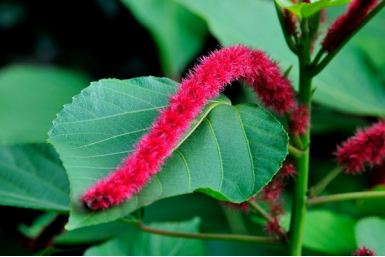
Acalypha hispida Acalypha hispida Burm. f. Acalypha hispida illustrated guide: how to grow Acalypha hispida / how to propagate Acalypha hispida
Acalypha hispida profileAcalypha hispida Acalypha hispida Burm. f.
Cultivation methods and precautions for Acalypha hispida Introduction to Acalypha hispida
The Chinese botanical name of Acalypha hispida is red-spike copperleaf, a shrub in the genus Acalypha of the Euphorbiaceae family. Plant height 0.5-3 m. Leaves ovate, 12-15 cm long, bright green, slightly paler on the underside, petioles pubescent, 5-6 cm long. Flowers bright red, borne on tail-like long spike inflorescences, inflorescence 30-60 cm long. Flowering period February to November.
Acalypha hispida is now widely cultivated as an ornamental garden plant in tropical and subtropical regions, and in northern China it is usually grown as a greenhouse potted flower.
The fruit of Acalypha hispida is cylindrical, pendulous and long, with brownish-yellow hairs, like a dog's tail, hence the name dog's-tail red.
Morphological characteristics of Acalypha hispida
Acalypha hispida is a shrub, 0.5-3 m tall; young branches covered with gray short hairs, the hairs gradually falling off, branchlets hairless.
Leaves papery, broadly ovate or ovate, 8-20 cm long, 5-14 cm wide, apex acuminate or acute, base broadly cuneate, rounded-obtuse or slightly cordate, nearly hairless above, sparsely hairy along the midvein and lateral veins below, margin coarsely serrate; basal veins 3-5; petioles 4-8 cm long, with short pubescence; stipules narrowly triangular, 0.6-1 cm long, sparsely pubescent.
Dioecious, female inflorescences axillary, spicate, 15-30 cm long, pendulous, inflorescence axis pubescent; female flower bracts ovate-rhombic, scattered, about 1 mm long, entire, pubescent outside, with 3-7 female flowers per bract axil, clustered; female flowers: sepals 4 (-3), nearly ovate, about 0.8 mm long, apex acute, short-hairy; ovary nearly spherical, densely covered with grayish-yellow coarse hairs, styles 3, 6-7 mm long, torn into 5-7 strips, red or purplish-red; male inflorescences not seen.
Acalypha hispida flowers in autumn and winter, February to November; capsules not seen.
Ecological habits of Acalypha hispida
Acalypha hispida likes a warm, humid environment with ample sunlight. However, it is not cold-tolerant, and in northern China it is usually grown as a greenhouse potted flower.
Acalypha hispida likes fertile soil. The overwintering temperature should be above 18°C; below 12°C the leaves droop, and prolonged low temperatures will cause leaf drop.
Cultivation techniques for Acalypha hispida
The optimal growing temperature for Acalypha hispida is 20°C to 30°C. It can be placed outdoors in a sunny, well-ventilated spot for care, with appropriate shading in summer to prevent scorching by the sun.
Because Acalypha hispida likes a humid air environment, it should be watered frequently to keep the soil moist; when hot and dry, water can also be sprayed on the plant and its surroundings to increase air humidity.
During the growth period of Acalypha hispida, apply a low-nitrogen, high-phosphorus-potassium compound fertilizer or well-rotted dilute liquid fertilizer once a week to promote the formation of inflorescences. In winter it can be moved indoors to a sunny spot, with the temperature preferably kept above 15°C; if below 10°C, the plant will drop its leaves, and in severe cases the plant may die.
Cultivation methods for Acalypha hispida Key cultivation points
To propagate Acalypha hispida in the Jiangnan region, each year in mid-April take the terminal shoot at 10 cm to 15 cm for ring barking and air layering; after 20 to 30 days it can be potted. After the air-layered seedling is potted, the remaining branches can be used for cutting propagation; insert the cuttings in a pot, soak thoroughly with water, cover with a plastic bag, open it for ventilation for one hour around noon each day, and after 30 days they will root and can be potted for cultivation and care.
Place the potted young seedlings in a semi-shaded, ventilated place, avoiding direct sunlight. When the plant grows to 40 cm, the terminal shoot can be tied and bent to change its growth vigor, prompting it to grow more red inflorescences; in late September remove the ties and let it grow naturally for one week, then re-tie and shape it as desired.
Propagation methods of Acalypha hispida
Acalypha hispida is propagated by cuttings, carried out in spring, and roots easily. Pay attention to fertilizing during the growing season. It grows well in a hot and humid greenhouse.
Variety classification of Acalypha hispida
There are about 200 species in the same genus, distributed in tropical regions.
Horticultural varieties include striped copperleaf, golden-edged copperleaf, variegated copperleaf, colorful copperleaf, golden-edged curly-leaf copperleaf, etc., all of which are elegant and rare foliage plants.
Distribution area of Acalypha hispida
Acalypha hispida is native to Malaysia, and is cultivated in Guangdong, Fujian, Guangxi and other places in China; it is now widely cultivated around the world.
It is now widely cultivated as an ornamental garden plant in tropical and subtropical regions; it is often cultivated in parks or gardens in Taiwan, China, Fujian, Guangdong, Hainan, Guangxi, and southern Yunnan in China, where its green leaves and red inflorescences are enjoyed for ornament.
Uses of Acalypha hispida Ornamental value
Acalypha hispida is an ornamental plant in the genus Acalypha of the Euphorbiaceae family, native to New Guinea, and distributed in Guangdong, Fujian, Guangxi and other places in China. Plant height 0.5 m to 3 m, leaves ovate, 12 cm to 15 cm long, bright green, slightly paler on the underside. Spike inflorescences bright red, axillary, 30 cm to 60 cm long, up to 2.5 cm in diameter, pendulous, tail-shaped, and can be used as a medium-sized potted plant to decorate halls, living rooms, etc.
Garden uses of Acalypha hispida
Acalypha hispida has an excellent ornamental effect when planted in parks or courtyards in warm regions. Its flower shape is unique, long and pendulous, making it an excellent flowering plant for southern courtyards, and it is grown as a greenhouse potted ornamental in northern regions.
Cultural background of Acalypha hispida Origin of the name
"Dog's-tail red" is evergreen all year round, and its dog-tail-shaped flowers are brightly colored. It is native to New Guinea and now widely cultivated around the world. Because its shape is festive, merchants also call it "suisui (spike by spike) red," taking the meaning of "prosperous year after year."
These not-so-tall plants reveal one red spike inflorescence after another among the green branches and leaves, fuzzy like little dog tails that have been dyed.
Among the green leaves, one coffee-colored "cat tail" after another emerges. Just how many kittens are playing in the tree? It turns out this is just a peculiar plant - the cat-tail tree. It is understood that the cat-tail tree is a deciduous tree, up to 10 m tall, with grayish-yellow bark. It grows at an altitude of 200 m-300 m at the edge of open forests and on sunny slopes. The fruit is cylindrical, pendulous and long, with brownish-yellow hairs, like a cat's tail, hence the name cat-tail tree.
Legend
Long ago, rats caused disaster in the human world, so the Heavenly Court ordered cats to descend to the mortal world immediately. At first, the cats worked quite hard catching mice, but over time they became a bit slack, and often accepted the mice's "sugar-coated bullets," ultimately becoming lazy and gluttonous all day. After the Heavenly Court learned of this, it sent envoys down to punish the cats. To hide, the cat used its magical power to transform into a tree, but because its power was limited, it could not change the shape of its tail no matter what; in the end the cat had no choice but to turn its tail into the tree's fruit. Afraid of being punished, the cat never dared reveal its true form, and ultimately became the "cat-tail tree."
Flower language of Acalypha hispida
Flower language of Acalypha hispida: longing for nature.
Acalypha hispida pictures
Setaria viridis Setaira viridis (L.) Beauv Setaria viridis illustrated guide: how to grow Setaria viridis / how to propagate Setaria viridis
Setaria viridis profileSetaria viridis Setaira viridis (L.) Beauv
Cultivation methods and precautions for Setaria viridis Introduction to Setaria viridis
Dog's-tail grass, Chinese botanical name: Setaria viridis, Latin scientific name: Setaira viridis (L.) Beauv. Other names: green foxtail, valley foxtail, dog's-tail grass. An annual herb in the grass family. Dog's-tail grass is highly adaptable and widely distributed in China, and has certain medicinal value. Its flower language is endurance, being misunderstood by others, difficult love, and secret love.
Setaria viridis, an annual herb. Culms erect or geniculate at the base, 10-100 cm tall, up to 3-7 mm in diameter at the base.
Leaf sheaths loose, margins with rather dense cottony cilia; ligule very short, margins ciliate; leaf blades flat, long triangular-lanceolate or linear-lanceolate, apex long-acuminate, base obtuse-rounded, almost constricted or gradually narrowed, 4-30 cm long, 2-18 mm wide, usually hairless or sparsely verrucose-hairy, margins rough. Panicle dense, cylindrical or slightly loose at the base, straight or slightly curved and pendulous, main axis covered with longer soft hairs, 2-15 cm long, 4-13 mm wide (excluding bristles), bristles 4-12 mm long, rough, straight or slightly twisted, usually green or brownish-yellow to purplish-red or purple; spikelets 2-5 clustered on the main axis or more spikelets borne on short branchlets, elliptic, apex obtuse, 2-2.5 mm long, lead-green; first glume ovate, about 1/3 the length of the spikelet, 3-veined, second glume nearly as long as the spikelet, elliptic, 5-7-veined; first lemma as long as the spikelet, 5-7-veined, apex obtuse, its palea short and narrow, second lemma elliptic, with fine dotted wrinkles, margins involute, narrow; lodicules wedge-shaped, apex slightly concave; styles basally separate. Caryopsis grayish-white. Flowering and fruiting period May-October [1].
Leaf sheaths rather loose, hairless or pubescent; ligule with cilia 1-2 mm long; leaf blades flat, 5-30 cm long, 2-15 mm wide, apex acuminate, base slightly rounded or gradually narrowed, usually hairless. Panicle dense, cylindrical, 2-15 cm long, slightly curved and pendulous or erect, green, yellow or turning purple; spikelets elliptic, apex obtuse, 2-2.5 mm long; first glume ovate, 3-veined, second glume 5-veined; first lemma as long as the spikelet, 5-7-veined, with a narrow palea. Grain oblong, apex obtuse, with fine dotted wrinkles. Flowering and fruiting period between summer and autumn.
Grows in wilderness and by roadsides. Distributed in most areas of China.
The Setaria viridis growing in the Tibet region is the whole plant of golden foxtail.
Also called "you" or "valley foxtail." Grass family. Annual herb. Leaf blades linear, narrowly lanceolate or linear-lanceolate. Panicle cylindrical, bristles rough, usually green or brownish-yellow. Shaped like a dog's tail, flowering in summer; spikelets in two to several clusters on shortened branches. Grows in wasteland. Distributed across almost all temperate and subtropical regions of the Eastern Hemisphere. A common weed, can be used as forage. Culms erect or geniculate at the base, 10-130 cm tall; common plants in the same genus also include: golden foxtail (S. glauca (L.) Beauv.), bristles golden-yellow to purplish-red; giant foxtail (S. faberii Herrm.), also known as: you foxtail; the main differences are: culms thicker and sturdier, panicle larger, usually curved downward and pendulous, spikelets noticeably swollen after maturity.
Distributed throughout the country. A common major weed, occurring extremely widely. It mainly harms dryland crops such as wheat, millet, corn, cotton, beans, peanuts, tuber crops, vegetables, sugar beets, potatoes, nurseries, and fruit trees. When severe, it can form dominant populations densely covering fields, competing strongly for fertilizer and water, and causing crop yield reductions.
Dog's-tail grass is a host for many pests such as leafhoppers, thrips, aphids, and cutworms, and has strong vitality.
Morphological characteristics of Setaria viridis
Setaria viridis is an annual herb in the grass family, 30-100 cm tall. Culms loosely tufted, erect or geniculate and ascending at the base. Leaf blades linear-lanceolate; leaf sheaths loose, smooth, sheath mouth hairy; ligule hairy. Panicle cylindrical, erect or slightly curved and pendulous, bristles green or turning purple; spikelets elliptic, 2-2.5 mm long, 2 to several clustered, separating from the bristles and falling off after maturity; first glume ovate, about 1/3 the length of the spikelet; second glume nearly equal to the spikelet; first lemma equal to the spikelet, 5-7-veined, palea narrow. Grain oblong, apex obtuse, with fine dotted wrinkles. Caryopsis elliptic, slightly flattened on the ventral side.
Leaf sheaths rather loose, hairless or pubescent; ligule with cilia 1-2 mm long; leaf blades flat, 5-30 cm long, 2-15 mm wide, apex acuminate, base slightly rounded or gradually narrowed, usually hairless. Panicle dense, cylindrical, 2-15 cm long, slightly curved and pendulous or erect, green, yellow or turning purple; spikelets elliptic, apex obtuse, 2-2.5 mm long; first glume ovate, 3-veined, second glume 5-veined; first lemma as long as the spikelet, 5-7-veined, with a narrow palea. Grain oblong, apex obtuse, with fine dotted wrinkles. Flowering and fruiting period between summer and autumn.
Grows in wilderness and by roadsides. Distributed in most areas of China.
The Setaria viridis growing in the Tibet region is the whole plant of golden foxtail.
Also called "you" or "valley foxtail." Grass family. Annual herb. Leaf blades linear, narrowly lanceolate or linear-lanceolate. Panicle cylindrical, bristles rough, usually green or brownish-yellow. Shaped like a dog's tail, flowering in summer; spikelets in two to several clusters on shortened branches. Grows in wasteland. Distributed across almost all temperate and subtropical regions of the Eastern Hemisphere. A common weed, can be used as forage. Culms erect or geniculate at the base, 10-130 cm tall; common plants in the same genus also include: golden foxtail (S. glauca (L.) Beauv.), bristles golden-yellow to purplish-red; giant foxtail (S. faberii Herrm.), also known as: you foxtail; the main differences are: culms thicker and sturdier, panicle larger, usually curved downward and pendulous, spikelets noticeably swollen after maturity.
Setaria viridis is an annual herb in the grass family, 30-100 cm tall. Culms loosely tufted, erect or geniculate and ascending at the base. Leaf blades linear-lanceolate; leaf sheaths loose, smooth, sheath mouth hairy; ligule hairy. Panicle cylindrical, erect or slightly curved and pendulous, bristles green or turning purple; spikelets elliptic, 2-2.5 mm long, 2 to several clustered, separating from the bristles and falling off after maturity; first glume ovate, about 1/3 the length of the spikelet; second glume nearly equal to the spikelet; first lemma equal to the spikelet, 5-7-veined, palea narrow. Grain oblong, apex obtuse, with fine dotted wrinkles. Caryopsis elliptic, slightly flattened on the ventral side.
Ecological habits of Setaria viridis
In northern China, seedlings emerge in April-May, and later emergence peaks occur with watering or rainfall; June-September is the flowering and fruiting period. One plant can produce thousands to over a thousand seeds. Seeds are spread by wind, irrigation water, and harvest materials. Seeds germinate after overwintering dormancy. Highly adaptable, drought-tolerant and barren-tolerant, and can grow in both acidic and alkaline soils. Grows in farmland, roadsides, and wasteland.
Propagation methods of Setaria viridis
Seed propagation.
The "dog's tail" of dog's-tail grass is made up of its seeds; beneath each "dog's-tail hair" is one seed.
The suitable temperature for seed germination is 15-30°C. The suitable depth for seed emergence is 2-5 cm; ungerminated seeds deep in the soil can survive for more than 10 years. In northern China, seedlings emerge in April-May, and later emergence peaks occur with watering or rainfall; June-September is the flowering and fruiting period. One plant can produce thousands to over a thousand seeds. Seeds are spread by wind, irrigation water, and harvest materials. Seeds germinate after overwintering dormancy. Highly adaptable, drought-tolerant and barren-tolerant, and can grow in both acidic and alkaline soils. Grows in farmland, roadsides, and wasteland.
Disease and pest control of Setaria viridis
Dog's-tail grass is a host for many pests such as leafhoppers, thrips, aphids, and cutworms, and has strong vitality.
Uses and value of Setaria viridis
Dog's-tail grass is a plant that cattle, donkeys, horses, and sheep love to eat. Whether old, tender, fresh, or dried, it is a very good livestock feed. Autumn dry grass can also be used as fuel to light fires for boiling water and cooking, for warmth, and for bedding; more artistically, it sometimes appears in articles by poets and writers, or in works by painters and photographers, turning such a lowly dog's-tail grass into a treasure with artistic vitality.
Harm
Dog's-tail grass is distributed all over the world. A common major weed, occurring extremely widely. It is also a bad thing, mainly harming dryland crops such as wheat, millet, corn, cotton, beans, peanuts, tuber crops, vegetables, sugar beets, potatoes, nurseries, and fruit trees. When severe, it can form dominant populations densely covering fields, competing for fertilizer and water, and causing crop yield reductions. At autumn harvest time, dog's-tail grass spreads its next generation, while the old fuzzy grass slowly waits for winter to arrive, and also waits for its children to grow up early next spring.
Medicinal or dietary therapeutic value of Setaria viridis
The medical information and health dietary information on Huahua Network is for reference only and cannot be used as a basis for diagnosis or medical treatment. Any health problem should be consulted with professional medical staff, and any disease treatment should follow a doctor's advice.
Ultimate flower-protecting task: to love yourself, start from reality and strictly follow a doctor's advice. Toward illness, do not be careless, do not delay, do not give up hope, face it bravely, warm the silent world with love, and care for the flower field in your heart with your heart.
Medicinal value
Scientific name: Setariaviridis (L.) Beauv.
Shaped like a dog's tail, flowering in summer, a common weed in fields and forests.
Family and genus: Grass family, Setaria genus
Main indications: clearing heat, removing dampness, reducing swelling.
Treats carbuncles and swelling, sores and ringworm, and red eyes [4].
① "Gangmu": Treats wart-like growths; thread a hair through them and they dry up and disappear. For those with red eyes and ingrown eyelashes, turn over the eyelid and use one or two stems dipped in water to scrape away the bad blood.
② "Gangmu Shiyi": Treats boils, carbuncles, and ringworm. For ringworm on the face, take the effective stems of the grass, knead them soft, and rub them on from time to time.
③ "Guizhou Folk Prescription Collection": Relieves fever, treats eye diseases. Also used to treat measles (warts).
④ "Luchuan Materia Medica": Removes dampness, reduces swelling. Treats impetigo.
⑤ "Chongqing Herbal Medicine": Treats eye diseases with tearing and blurred vision.
[Collection] Harvest in summer and autumn, sun-dry.
[Usage and dosage] Internal use: decoct in water, 2-4 qian (1-2 liang if fresh).
External use: decoct in water and wash, or pound and apply (sweet in taste).
[Selected prescriptions] ① To treat long-standing poor vision: grind Setaria viridis into powder, steam with sheep liver and take.
("Classification of Herbal Properties") ② To treat wool rash (also called wool sha): decoct Setaria viridis in water for internal use, and externally use a silver needle to prick open the red lumps, then use hemp thread to squeeze out the white threads in the lumps that look like wool; otherwise the swelling will be fatal.
("Zhou Yisheng Family Treasure Prescriptions")
Latin name: Setaria viridis (L.) Beauv.
Pattern:
Seed propagation. The suitable temperature for seed germination is 15-30°C. The suitable depth for seed emergence is 2-5 cm; ungerminated seeds deep in the soil can survive for more than 10 years. In northern China, seedlings emerge in April-May, and later emergence peaks occur with watering or rainfall; June-September is the flowering and fruiting period. One plant can produce thousands to tens of thousands of seeds. Seeds are spread by wind, irrigation water, and harvest materials. Seeds germinate after overwintering dormancy. Highly adaptable, drought-tolerant and barren-tolerant, and can grow in both acidic and alkaline soils. Grows in farmland, roadsides, and wasteland. The seeds are also used medicinally. Harvest in autumn, sun-dry separately.
[Nature, flavor, and meridian entry] Bland, neutral [Functions and main indications] Dispels wind and brightens the eyes, clears heat and promotes urination. Used for wind-heat common cold, trachoma, red and painful eyes, jaundice hepatitis, and difficult urination; external use treats cervical lymph node tuberculosis
[Usage and dosage] 0.5-1 liang [Excerpt] "National Collection of Chinese Herbal Medicines"
Cultural background of Setaria viridis Flower language and meaning
Endurance, being misunderstood by others, difficult love, secret love
There was a very pretty little girl's birthday, and many boys gave her flowers, all kinds, but all very beautiful. One boy from a poor family gave the girl a bunch of dog's-tail flowers; at the time the girl was very angry and drove him out. Later, thinking it over carefully, she wanted to know the reason. The boy told her that dog's-tail grass symbolizes love that is not understood by others, but that he could silently give for her...
Represents
Everlasting friendship
Ring
Braid three dog's-tail grasses into a braided pattern, make it into a single strand, according to the size of the finger, then bend it into a loop and tie a knot, and put it on the finger, representing a private pledge of lifelong commitment.
Myth and legend
1: It is said that dog's-tail grass came to the human world from heaven, and at first everyone liked it very much.
In ancient times, grain could grow without being planted; millet and rice each had seven ears per stalk, and people had more than enough to eat, so they developed the habit of extravagance and laziness, throwing away rice and scattering flour, and not working. Seeing this, Heaven ordered the Wind Earl and Rain Master to send heavy rain; the flood lasted nine years, and the world became a vast ocean for a thousand li. People could not find grain to fill their stomachs, and the starving dead lay everywhere.
A spirit dog, seeing the living beings of the Nine Provinces in dire suffering, swam through the surging flood to the Southern Heavenly Gate and slipped into the Heavenly Palace. The Heavenly Palace was covered with immortal grasses and fine grains; the spirit dog disguised itself and played around, deliberately rolling on the seedlings of the five grains, secretly filling its tail with seeds. Then it left the Heavenly Palace by the old route. Just as the flood was receding, it swam back to the human world.
After the flood receded, the spirit dog traveled throughout the Nine Provinces and scattered the grain seeds from its tail in all directions. From then on, the ears of rice and grain were all shaped like dog's tails covered with seeds.
When the divine dog stole the grain, it accidentally got some seeds of a wild grass stuck to it and brought them down to the mortal world - and that was foxtail grass. If this grass is not cut down early, it will affect the grain harvest, and people have no choice but to work hard and live by their own labor. Seeing foxtail grass, people are reminded of the sin of past laziness, the kindness of the divine dog, and the importance of labor.
2: A very, very long time ago, there was a beautiful and peaceful kingdom called the Kingdom of Red Sandalwood. This country was named for its abundance of purple sandalwood, and some also say it was named because a fairy in purple robes once descended to earth here, took away some sandalwood, and thus the name came about. But no matter the reason, sandalwood calms the spirit, so all things here more or less possess spirituality. The surnames of the people of the Kingdom of Red Sandalwood are all related to colors; even the strangest ones would not be questioned, but this country has an unwritten rule: only members of the royal family may bear the surname Zi. The king of the Kingdom of Red Sandalwood was named Zi Ran, and the queen was originally a commoner named Lan Xun, later renamed Zi Xun. The king and queen had a son named Zi Yi. Though this only child was not extremely handsome, he had a kind heart and an innate melancholy. The prince had a large garden filled with rare flowers and exotic plants from everywhere; stepping into the garden was like being in nature itself. The little prince's greatest pleasure was to stroll in the garden in spring and admire the flowers; in summer, to set up gauze curtains in the garden, place a bed there, and sleep in the garden watching the stars at night; in autumn, to wander the garden and sigh with a sorrowful mood; in winter, to view the snowy scenery in the garden. The king and queen knew the prince
Foxtail grass
Foxtail grass
loved his garden very much, so they instructed the servants to clear all the weeds from the garden at the beginning of each spring, leaving only the prince's flowers blooming in the garden through all four seasons. Of course, the prince never knew about these things, and likewise, the prince had never seen grass. But in this early spring, things took a turn. One morning, as the prince strolled along the garden path, beneath a white rose he discovered a tiny foxtail grass. The little prince was very curious, because he had never seen grass before, so the prince called for the maids and the gardener. The gardener and the maids thought the prince would blame them for not clearing the grass away, so the gardener hurried to pull up the foxtail grass, but the prince grabbed the gardener's hand and signaled him not to do so, showing great interest in this little grass and repeatedly asking the gardener questions about foxtail grass. The gardener and the maids finally breathed a sigh of relief. Since this foxtail grass was now the only grass in the vast garden, the prince instructed the gardener not to remove it and to let it live or die on its own. But no one knew that this little grass was a foxtail grass with thoughts and spirituality; it simply could not make sounds or move. Prince Zi Yi came to the garden for a walk every day as usual, and when passing by the foxtail grass, the prince would always pause for a while, gazing with deep feeling and pondering. The poor foxtail grass thought the prince was looking at it, and so it fell in love with the prince. But the little grass did not know that after a nap, the prince had long forgotten its existence; what the prince gazed at was only the white rose in front of it, a gift from the princess of the neighboring kingdom. Every day the little grass gazed at the prince's face and fell in love with him. Though it could not speak, for it, being able to silently watch the prince was already happiness enough. Day by day passed, and autumn was approaching. The garden was desolate; the tall parasol trees began to shed leaves, the birches began to wither, and the foxtail grass did not have many days left. The plants were destined to all die before winter; this was the law of nature and the decree of heaven. But the foxtail grass refused to die just like that; it loved the prince. It also did not want to die; it feared the prince would be sad. But all of this was only its own wishful thinking, only its beautiful dream. The prince in fact never remembered it, but the foxtail grass did not know any of this. So the grass decided to defy fate, for the sake of its dream, to defy heaven and nature in order to see the prince every day. It would live on regardless of the seasons! Throughout autumn, the foxtail grass endured pain, living under the oppression of the autumn wind. Finally, autumn passed, and in the entire garden there remained only the withered remnants of chrysanthemums and the gaunt foxtail grass. Soon winter came again, and in the garden there remained only plum blossoms and the weak foxtail grass. The prince came to the garden every day as usual, but what attracted him was merely the plum blossoms that braved the snow, not the dying foxtail grass. And under the devastation of wild wind and raging snow, what sustained the grass in living on was the prince's every smile and frown as he admired the plum blossoms. Sometimes the snow was too heavy and the prince could not go out, so the little grass would strain to push out of the snow layer, just to catch a glimpse of the prince's palace..... Winter finally passed amid the little grass's tears of blood, and the foxtail grass faced spring, summer, autumn, and winter again and again with renewed vigor....... Unknowingly several more years passed, the little prince had grown up, and the foxtail grass was no longer the same tiny blade of grass as before, but what remained unchanged was still the little grass's love for the prince. Winter came again. After a light snowfall, even the snow-defying plum blossoms were gone from the garden, and in the lonely garden there remained only the green foxtail grass. The little grass suddenly felt that this winter was colder than any winter before. The snow melted, and the garden became lively again, but it was people who were lively; spring had not come. Hundreds of maids and guards, holding colored ribbons and red silk, decorated the garden with lanterns and streamers. The lonely, cold garden became extraordinarily bustling, but because the people were too happy, they did not notice that by the roadside they had just paved, there was a green foxtail grass. The foxtail grass was very curious, not knowing why people were so happy, but instinct told it that something was about to happen. For the first time, the grass suddenly panicked. The little grass was surprised, because it had no heart, yet just now it had indeed felt panic. The foxtail grass did not know that it was an anomaly among all plants, because not only did it have thoughts and spirituality, but more importantly, at the center of its seed head there was a very, very small blue dot - that was the heart of the foxtail grass. Because it had a heart, the foxtail grass had emotions and independent thought. Another 8 days passed. On that morning, no one came to the garden again, and the garden had long since been decorated like paradise. Time passed little by little, and the foxtail grass panicked again, and its little heart slowly began to beat. By noon, light snow began to fall from the sky, and the foxtail grass was astonished to discover that the snowflakes were actually a pale purple, though the color was very, very faint, visible only to tiny living things. Strangers in splendid clothing came to the garden one after another. Toward evening, music began to play, and those nobles all put down what they held and looked together toward the end of the path. Snowflakes were still drifting. The foxtail grass saw the prince; he looked happier than on any other day. But beside the prince, a girl who looked like a fairy had her arm linked through the prince's, her face full of smiles. "What beautiful clothes they wear, just like......." As the foxtail grass silently sighed, it suddenly realized that this was the prince's wedding, and this girl was the prince's bride...... The snow grew heavier and heavier. The prince and his bride, that is, the princess of the neighboring kingdom who had given him the white rose, walked along the path covered with red carpet, getting closer and closer to the foxtail grass by the roadside, and the foxtail grass gradually truly awakened: "I am only a tiny foxtail grass, ordinary. I should not have entertained wild hopes of loving the prince. After all, he is human, and the prince's companion in the end could only be a princess. So all I can do is bless them........ Why is this winter so cold? I seem unable to hold on anymore..." The foxtail grass suddenly felt unprecedented
Foxtail grass
Foxtail grass
cold. Yes, originally it had relied on its love for the prince to resist the severe cold, but now the protective defense was gone, and the foxtail grass had only one last bit of consciousness left. The prince and princess stopped beside the foxtail grass. This time it was the princess's wish. "Zi Yi, look! There is actually foxtail grass still surviving in winter. This must be God's blessing upon us!" The princess was overjoyed. The prince said in confusion, "It seems a very small foxtail grass grew here in the garden a few years ago. I do not know how it is now; perhaps it died long ago." "Then, could you weave this foxtail grass into a ring and give it to me? It seems quite unique." "Of course! If a foxtail grass can bring you happiness, that should be its pride!" With that, the prince went to pick the foxtail grass. At that moment, with a faint "pop," the blue heart of the foxtail grass shattered. "My prince?! I am that same little grass from before! Have you never remembered me? Zi Yi, Zi Yi, it seems all of this really was just my purple dream talk! My last wish is..." The prince pulled up the foxtail grass, and the foxtail grass's life ended at that very moment. It did not even finish silently blessing its final wish, "I hope the prince can be happy," before its life ended. That night, the princess wore the ring woven from foxtail grass by the prince and completed the wedding. And until the prince died, he never knew that the dream of a foxtail grass that had once silently loved him had been ended by his own hand. And that foxtail grass ring, though withered, was buried in the princess's tomb, because this ring was woven by the prince himself at the wedding of the prince and princess.........
3: Some say that foxtail grass was transformed from the beloved dog that a fairy brought down from heaven when she descended to the mortal world. The fairy fell in love with a scholar in the human world, but was obstructed by the Queen Mother of the West. In order to be together, the fairy and the scholar did not hesitate to defy the Queen Mother of the West. At the final moment of the confrontation, the fairy's beloved dog did not hesitate to sacrifice its own life to save people. In the end, the fairy and the scholar transformed into two jade pendants, one yin and one yang, which circulated in the mortal world. It is said that if two people in love each obtain one of these two jade pendants, they can be united as lovers in the end. After the fairy's beloved dog died, it transformed into foxtail grass, generation after generation bearing witness to love.
4: Two families were neighbors. The one to the east had the surname Li, and the one to the west had the surname Zhang. As the saying goes, distant relatives are not as good as near neighbors, and the two families got along even more closely than relatives. The Li family had a son named Shuan'er, who had already married. The Zhang family had a son named Zhu'er, who was still young, just eleven years old.
Shuan'er was clever, and Zhu'er was simple and honest. Shuan'er's family had a strong plowing ox, and Zhu'er's family had a loyal yellow-haired dog. In previous years, both families used Shuan'er's plowing ox to plow. Later, the elders of both families passed away one after another, and the young Zhu'er had no choice but to support the household himself. Shuan'er was a person who loved to take advantage. Every time Zhu'er came to lead the ox to plow, Shuan'er felt terribly pained, while little Zhu'er helped him plant and harvest, carry water, and split firewood, and whenever there was something good to eat, he always shared it with him, yet Shuan'er never thought anything of it.
That spring, it was time to plow again. Zhu'er went to lead the ox, and Shuan'er said, Zhu'er, my family's plowing ox is old and cannot work anymore. From now on, you should plow your family's field yourself. How could young Zhu'er plow the land alone? Watching the weeds in the field grow taller and denser while the seeds still lay in the bag, Zhu'er was so worried that he cried.
One day, as Zhu'er was digging the ground and shedding tears again, that yellow dog, which never left his side, suddenly spoke. It said, Zhu'er, do not cry. Just use me to plow the land; I can plow. Zhu'er hurriedly wiped his tearful eyes and stared at the yellow dog in disbelief. Whose dog can plow the land? But the yellow dog nodded vigorously. From then on, in spring the yellow dog helped Zhu'er plow, and in autumn it helped Zhu'er pull the cart. Not only did Zhu'er not miss the farming season, his harvest was even greater than Shuan'er's. Shuan'er looked on with envy. When it was time to plow again, he put on a very pitiful look and said to Zhu'er with a bitter face, Zhu'er, my family's old ox is too old to plow. Zhu'er, lend me your dog for a while.
Who would have thought that when the yellow dog reached Shuan'er's field, it refused to pull the plow. Shuan'er was so angry that he beat it hard with a stick, but it still refused to work. In a fit of rage, Shuan'er finally beat the yellow dog to death! After the dog died, Shuan'er buried it on the spot, leaving only a length of its tail exposed above the ground, and then ran to tell Zhu'er, Oh no, Zhu'er, this is terrible! Your dog not only refused to work at my place, it also plunged headfirst into the ground and would not come out! Zhu'er hurried over to look, and sure enough, in Shuan'er's field there was a yellow dog's tail swaying in the wind. Zhu'er cried bitterly in grief. He ran over, grabbed that dog's tail, and pulled outward, but that dog's tail had already turned into a grass. He pulled out the grass transformed from the dog's tail and planted it in his own field.
Summer came, and the grass transformed from the dog's tail bloomed with small pale green flowers. Autumn came, and the small flowers turned into a string of seeds, just like millet. The next year, in the place where Zhu'er had planted the dog's tail, patches and patches of green grass grew, just like planted crops, swaying in the wind.
That night, Zhu'er dreamed that his dog had come back wagging its tail. The dog said, This year you do not need to plow the land. The grass growing in the field will all bear seeds, and they will be enough for you to eat for a year.
That year, Zhu'er neither plowed nor planted. The ground was covered with green grass. By autumn, these green grasses indeed bore strings of seeds, golden and bright...... Later, when Shuan'er saw that Zhu'er had a harvest every year without farming, he secretly went to Zhu'er's field, pulled up those grasses transformed from dog's tails, and planted them in his own field. These grasses grew and grew in Shuan'er's field, spreading everywhere and covering everything, and Shuan'er was overjoyed.
Later still, the grasses all over the ground bore golden seeds, just like millet, and Shuan'er was even happier. Even later, Shuan'er could no longer be happy, because those things he harvested that looked like millet had seeds but no kernels......
Because these grasses that looked like millet were transformed from dog's tails and looked very much like dog's tails, people all called them "foxtail grass."
Poetry description
Foxtail grass
A foxtail grass
On my honest and sturdy mother donkey
Trembling and swaying
The chord played together by birds and flowing water
Makes it like a god familiar with music
Drunkenly reeling in June
In the grove of sunflowers bathed in morning sun
--I firmly believe that world
Has some noble cycle
It seems about to die
And yet seems just reborn
In my hometown weathered by vicissitudes
On the sand dune grows a deformed willow
Let the gently warm breeze of early summer softly caress
It cries out with a sorrowful voice
It praises with a comforted smile
Little foxtail grass
The spirit of my past life
The flesh of my next life
What you gain will ultimately all be lost
And what you lose will eternally be gained
Songs
Foxtail grass is also called dog's tail grass. The following are related songs.
Foxtail Grass Lyrics: Fu Ke Vocals: An Xu
Where on earth did that feeling from the beginning go
We held tightly, tightly held heartbeats
Soft whispers, beautiful heavenly sounds
Even a cup of water had the most beautiful taste in the world
The sky is incredibly blue, the heart floats on a hot-air balloon
The blush on your face is the omen of my happiness
How did everything suddenly change
I became a foxtail grass in your eyes
You say these days are getting more and more boring. Could this be a dangerous signal
The spring outside the wall is not that good
Temptation is illusion, you should know
Your age is not that young either
Stop thinking nonsense, stop disrupting my position
Where on earth did that feeling from the beginning go
We held tightly, tightly held heartbeats
Soft whispers, beautiful heavenly sounds
Even a cup of water had the most beautiful taste in the world
The sky is incredibly blue, the heart floats on a hot-air balloon
The blush on your face is the omen of my happiness
How did everything suddenly change
I became a foxtail grass in your eyes
You say these days are getting more and more boring
Could this be a dangerous signal
The spring outside the wall is not that good
Temptation is illusion, you should know
Your age is not that young either
Stop thinking nonsense, stop disrupting my position
Related knowledge
Foxtail grass and Chinese fountain grass: before, I only knew foxtail grass, and called all fluffy grasses foxtail grass. Yesterday I looked up these two grasses in Illustrated Plants of the Book of Songs and checked their differences:
Differences in leaves:
1. The shapes are different: the dog's is linear-lanceolate, the wolf's is linear, that is, the dog's is not the same thickness from top to bottom, while the wolf's is the same thickness from top to bottom.
2. The lengths are also different: the dog's is 4-30 cm, the wolf's is 30-60 cm.
Differences in bristles:
1. The lengths are different: the dog's bristles are 0.4-1 cm long, the wolf's bristles are 1-1.5 cm long.
2. The colors are different: the dog's are mostly green and yellowish brown, the wolf's are mostly purple.
Summary: foxtail grass has short and thick leaves and short fuzz, while Chinese fountain grass has slender leaves and long fuzz.
Modern poetry
Foxtail Grass by Yu Guangzhong
In short, in the end no one can outargue the grave
Death is the only permanent address
For example, after the mourners have dispersed, the back door of the funeral parlor
Faces south - so what?
Faces north - so what?
That hearse always looks as if it is about to travel far
In short, no one can defy this matter
As for immortality and such
Perhaps it is merely a kind of code, for walking at night
Whether it works or not, whether you believe or not
In the end, no one is taller than foxtail grass
Unless a name rises, aligning with the constellations
To join Rilke or Li Bai
Besides that
Everything remains beneath the grass
Names return to names, skulls return to skulls
Stars return to stars, earthworms return to earthworms
Under the night sky, if someone calls
Above, there is a kind of light
Below, there is a cricket
Faintly, as if about to answer
The flower language of foxtail grass
The flower language is endurance, being misunderstood, difficult love, secret love.
Endurance, being misunderstood, difficult love, secret love
Foxtail grass pictures