What are the care precautions for the flame tree (Delonix regia)?
1. Temperature
The flame tree is a tropical tree species that loves high temperatures and is not cold-tolerant. It can only overwinter smoothly in winter if the temperature does not drop below 10°C.
2. Watering
The flame tree has low requirements for soil, but the soil must be well-drained, because its roots have rhizobia that can fix nitrogen and increase soil fertility, but waterlogging will kill the rhizobia and affect its growth. Therefore, you must master the amount of watering well to ensure there is no waterlogging.
3. Seedling transplanting and field planting
After growing for 1-2 years, seedlings need to be transplanted once, and transplanting is best done in early spring. The spacing between plants is about 60 cm, and only 3-year-old seedlings can be used for field planting. After field planting, the soil needs to be loosened and weeds removed 2-3 times each year, and topdressing should be applied once each in spring and autumn.
4. Pruning
The trunk of the flame tree will continuously grow new branches and leaves. If allowed to grow naturally, the plant shape will change greatly and it cannot better maintain its vitality, so it needs to be pruned frequently.
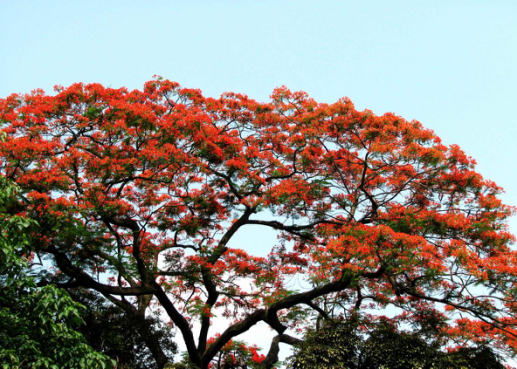
Pay attention to and do well the above four points, and you can keep the flame tree forever gorgeous, making everyone who sees it stop for it and marvel at its magnificent beauty! Such beauty has made many people around the world develop a deep affection for it, honoring it as a national tree, city tree, city flower, or school flower. Next, the editor will list a few examples for everyone, and after reading them you will know that so many people around the world actually like it!
1. The country that honors it as its national tree: the Republic of Madagascar in Africa
2. The regions that honor it as their city tree: Xiamen City, Fujian; Tainan City, Taiwan, China; Panzhihua City, Sichuan (the flame tree was once the city tree of Panzhihua City, Sichuan, but because the flame tree suffered severe pest outbreaks for many consecutive years in the mid-to-late 1990s and was cut down in large numbers, its position as the city tree was later replaced by the kapok tree)
3. The region that honors it as its city flower: Shantou City, Guangdong
4. The universities that honor it as their school flower: Xiamen University, National Cheng Kung University
Flame tree Delonix regia (Boj.) Raf. Flame tree illustrated guide: how to grow the flame tree / how to propagate the flame tree
Flame tree profileFlame tree Delonix regia (Boj.) Raf.
How to grow the flame tree and precautions; introduction to the flame tree
The flame tree is named for "leaves like the feathers of a flying phoenix, flowers like the crown of a vermilion phoenix." Also known as golden phoenix flower, red flower phoenix tree, fire tree, foreign phoenix tree, etc. Because of its bright red or orange flowers combined with bright green bipinnate leaves, the flame tree is hailed as one of the most colorful trees in the world. It is the national tree of the Republic of Madagascar in Africa, the city tree of Xiamen City, Tainan City in Taiwan, China, and Panzhihua City in Sichuan, the city flower of Shantou City in Guangdong Province, the city flower of Zhanjiang City in Guangdong during the Republic of China period, and the school flower of Shantou University and Xiamen University.
The flame tree plant is tall and can reach more than 20 meters. Because its crown spreads horizontally and droops, is dense and broad, and catches the wind, it plays the role of a shade tree in tropical regions. It likes high temperatures and sunny environments, and must grow luxuriantly only in places with sufficient sunlight. It is distributed in southern and southwestern China, its place of origin Madagascar, and various tropical regions of the world.
The flame tree is a plant of the genus Delonix in the Fabaceae family. Native to Madagascar in Africa. In the wild it is an endangered species. It has now been introduced and cultivated by humans and is widely planted as an ornamental tree. In Hong Kong, China it is a common introduced variety of deciduous tree, and in Taiwan it was introduced in 1897, and Tainan City even designated it as its city flower to match the alias "Phoenix City." The flame tree is also the city tree of Xiamen.
Because of its bright red or orange flowers combined with bright green bipinnate leaves, the flame tree is hailed as one of the most colorful trees in the world. Because its crown spreads horizontally and droops, is dense and broad, and catches the wind, it plays the role of a shade tree in tropical regions. It is distributed in southern and southwestern China, its place of origin Madagascar, and various tropical regions of the world. In the United States, the flame tree only grows in Florida, the Rio Grande Valley in southern Texas, the desert regions of Arizona and California, Hawaii, Puerto Rico, the U.S. Virgin Islands, and Guam. The flame tree also grows widely in the Caribbean region.
The flame tree plant is tall and can reach more than 20 meters. It likes high temperatures and sunny environments, and must grow luxuriantly only in places with sufficient sunlight. The flowers are large and red, and even the inner side of the calyx is blood-red. Four petals spread out about 8 cm long, and the fifth petal is upright, slightly larger, and has yellow and white spots. The stamens are red, the ventral side of the calyx is dark red, and the dorsal side is green. The inflorescence is a raceme, arranged in a corymb-like pattern, with 5 sepals and 5 petals, gathered into clusters. After flowering, it produces long pod fruits one by one, which can reach 60 cm long. When mature they are dark brown and woody, containing 40-50 tiny seeds, each weighing only 0.4 grams on average. The seed coat has markings and is toxic, so it must not be eaten by mistake. The leaves are bipinnately compound, with opposite pinnae, 15-30 pairs, and each pinna has 20-40 pairs of leaflets. The leaflets are oblong-elliptic, with a skewed base, entire margins, and rounded obtuse tips. The leaves are thin and papery, smooth and thin on the surface, blue-green, and only the midrib is obvious among the veins. The tree shape is a broad umbrella shape, and when it sheds its leaves in winter, countless small leaflets fall like snowflakes. Like many leguminous plants, the roots of the flame tree also have rhizobia. To adapt to rainy climates, buttress roots appear at the base of the trunk. The flame tree adapts to tropical climates, is drought-tolerant, and can grow in saline environments.
The flame tree is regarded as an introduced species in many areas where it currently grows, and in Australia it is even regarded as an invasive species, partly because its broad crown and dense roots hinder other species from growing beneath it. In India the flame tree is called Gulmohar. The pods of the flame tree are used as percussion instruments in the Caribbean region, called shak-shak or maracas.
Morphological characteristics of the flame tree
The flame tree is a tall deciduous tree, thornless, more than 20 meters tall, with a diameter at breast height of up to 1 meter; the bark is rough and grayish brown; the crown is oblate, with many spreading branches; the branchlets are often covered with short pubescence and have obvious lenticels.
The leaves are bipinnately even-compound, 20-60 cm long, with stipules; the lower stipules are obviously pinnately divided, and the upper ones are bristle-like; the petiole is 7-12 cm long, smooth to short-pubescent, grooved above, and swollen at the base into a cushion-like shape; the pinnae are opposite, 15-20 pairs, up to 5-10 cm long; the leaflets are 25 pairs, densely opposite, oblong, 4-8 mm long, 3-4 mm wide, silky-hairy on both sides, obtuse at the apex, skewed at the base, with entire margins; the midrib is obvious; the petiolules are short.
The corymbose raceme is terminal or axillary; the flowers are large and beautiful, 7-10 cm in diameter, bright red to orange-red, with pedicels 4-10 cm long; the receptacle is disc-shaped or shortly top-shaped; there are 5 sepals, red inside and greenish yellow at the margins; there are 5 petals, spatulate, red, with yellow and white blotches, 5-7 cm long and 3.7-4 cm wide, curling backward toward the calyx after flowering, with a slender claw about 2 cm long; there are 10 stamens; red, of unequal lengths, 3-6 cm long, curved upward, with thick filaments, the lower half covered with cottony hairs, and red anthers about 5 mm long; the ovary is about 1.3 cm long, yellow, pubescent, sessile or shortly stalked, and the style is 3-4 cm long, with a small truncate stigma.
The diameter at breast height can reach 1 meter; the bark is rough and grayish brown; the tree shape is a broad umbrella shape, with many spreading branches; the branchlets are often covered with short pubescence and have obvious lenticels. When it sheds its leaves in winter, countless small leaflets fall like snowflakes. It likes high temperatures and sunny environments, and must grow luxuriantly only in places with sufficient sunlight.
The leaves are bipinnately compound, with opposite pinnae, 15-30 pairs, and each pinna has 20-40 pairs of leaflets. The leaflets are oblong-elliptic, with a skewed base, entire margins, and rounded obtuse tips. The leaves are thin and papery, smooth and thin on the surface, blue-green, and only the midrib is obvious among the veins.
After flowering, it produces long pod fruits one by one, which can reach 60 cm long. When mature they are dark brown and woody, containing 40-50 tiny seeds, each weighing only 0.4 grams on average. The seed coat has markings and is toxic, so it must not be eaten by mistake.
Like many leguminous plants, the roots of the flame tree also have rhizobia. To adapt to rainy climates, buttress roots appear at the base of the trunk. The flame tree adapts to tropical climates, is drought-tolerant, and can grow in saline environments.
The pod is strap-shaped, flat, 30-60 cm long, 3.5-5 cm wide, slightly curved, dark reddish brown, blackish brown when mature, with a persistent style at the apex; there are 20-40 seeds, transversely oblong, smooth, hard, yellow stained with brown spots, about 15 mm long and about 7 mm wide.
Because of its bright red or orange flowers combined with bright green bipinnate leaves, the flame tree is hailed as one of the most colorful trees in the world. Because its crown spreads horizontally and droops, is dense and broad, and catches the wind, it plays the role of a shade tree in tropical regions.
The flowering period is June-July, and the fruiting period is August-October.
Ecological habits of the flame tree
The flame tree is a tropical tree species and begins to bloom 6-8 years after planting. It likes high temperatures, high humidity, and a sunny environment. The suitable growth temperature is 20-30°C, and it is not cold-tolerant. The winter temperature should not be lower than 10°C. Deep, fertile sandy loam rich in organic matter is suitable; it fears waterlogging, so drainage must be good, and it is relatively drought-tolerant; it tolerates poor soil. It has a shallow root system, but the root system is well developed and its wind resistance is strong. It resists air pollution. It has strong sprouting ability and grows rapidly. Generally, a 1-year-old plant can reach 1.5-2 meters in height, a 2-year-old plant can reach 3-4 meters in height, and it begins to flower after 6-8 years of planting. In South China, winter buds sprout in early February each year, and the growth peak is from April to July. In late July, growth decreases due to excessively high temperatures. After mid-to-late August, temperatures drop and growth accelerates. After October, growth slows down, and leaves fall from December to January of the following year.
The flame tree begins to bloom 6-8 years after planting. It likes high temperatures and sunny environments, and must grow luxuriantly only in places with sufficient sunlight, so it grows faster in the tropical south. Generally, a 1-year-old plant can reach 1.5-2 m in height, and a 2-year-old plant can reach 3-4 m in height. The tree body is tall and the crown width is large. The flame tree likes light and has a shallow root system. The average suitable temperature is 20-24°C. Winter buds sprout in early February each year, and the growth peak is from April to July. In late July, growth decreases due to excessively high temperatures. In mid-to-late August, temperatures drop to accelerate growth. After October, growth slows down, and leaves fall from December to January.
It likes light and loves a high-temperature, humid climate. Cultivation sites with full sun or partial sun are both acceptable. The soil must be fertile, organic-rich sandy loam, and drainage must be good. It is not tolerant of drought or poor soil, is not cold-tolerant, resists wind, and resists air pollution. It is used as a garden landscape tree, shade tree, and street tree. The flame tree is suitable for planting in sandy soil with sufficient sunlight, some shade, and good drainage. The flowering period is June to July. For propagation and cultivation, seed propagation requires first soaking in 90° hot water for 5-10 minutes, which gives a higher germination rate.
Cultivation techniques for the flame tree
It should be planted in a sunny place with fertile, deep soil and good drainage. After growing for 1-2 years, seedlings need to be transplanted once, and transplanting should be done in early spring. The spacing between plants and rows is about 60 cm, and 3-year-old seedlings can be used for field planting.
The planting site should be an open, sunny place, and during dry weather it should be watered sufficiently. The flame tree has low soil requirements and can grow well even in relatively poor soil, because its roots have rhizobia that can fix nitrogen and increase soil fertility, but waterlogging will kill the rhizobia and affect plant growth. The trunk of the flame tree will continuously grow branches and leaves. If allowed to grow naturally, the plant shape will change greatly, so it needs to be pruned frequently. The flame tree is not cold-tolerant, and in northern regions it can only be cultivated and maintained in greenhouses.
For transplanting, the survival rate is higher before sprouting in spring. It can also be planted in the rainy season, but some branches and leaves should be cut off to ensure survival. The plant has strong sprouting ability, so the trunk-cutting method can be used to cultivate large seedlings. After field planting, loosen the soil and remove weeds 2-3 times each year, water in a timely manner, apply topdressing once each in spring and autumn, and promptly remove root suckers to ensure good tree growth.
Propagation methods of the flame tree
Seed sowing is commonly used for raising seedlings. The thousand-seed weight is about 400 grams. The seed coat absorbs water with difficulty, so the seeds need to be scalded with 80°C warm water to promote germination, then after natural cooling, continue soaking for 24 hours, and drain before use. Sow by the drill or spot sowing method. Seedlings are relatively sensitive to frost. Early on, a compound fertilizer can be applied, with less nitrogen fertilizer. After autumn begins, fertilization should be stopped to promote early lignification. In winter, if the leaves have not yet fallen, they can be cut off manually, and plastic film can be used for covering or individual plants can be wrapped to prevent frost. One-year-old seedlings can be lifted from the nursery for field planting.
Sowing propagation
The flame tree is mainly propagated by sowing.
The seeds mature in December. Collect the pods, take out the seeds, and store them dry, then sow in the following spring. Before sowing, soak the seeds in boiling water, and after cooling continue soaking for 1-2 days, changing to clean water 1-2 times in between. After sowing, germination begins in 6-7 days, and full emergence can occur in more than 20 days. One-year-old seedlings can reach about 1.5 meters.
The thousand-seed weight is about 400 grams. The seed coat absorbs water with difficulty, so the seeds need to be scalded with 80°C warm water to promote germination, then after natural cooling, continue soaking for 24 hours, and drain before use. Sow by the drill or spot sowing method. Seedlings are relatively sensitive to frost. Early on, a compound fertilizer can be applied, with less nitrogen fertilizer. After autumn begins, fertilization should be stopped to promote early lignification. In winter, if the leaves have not yet fallen, they can be cut off manually, and plastic film can be used for covering or individual plants can be wrapped to prevent frost. One-year-old seedlings can be lifted from the nursery for field planting.
Disease and pest control for the flame tree; common pests
The flame tree pest discovered is an insect of the "noctuid moth" type. This insect damages plants by having its larvae feed on leaves, often eating all the host leaves, seriously affecting tree growth and ornamental value. Flame tree pest damage is most severe in July, August, and September. The flame tree noctuid moth is not harmful to humans, but some people will develop allergic symptoms because of it.
Control methods
Seize the period when the larvae gather to cause damage, and dust powder in the early morning before the dew has dried. You can dust with 2.5% trichlorfon powder or 1.5% parathion (1605) powder or 1.5% dimethoate powder, 1.5-2 kg per mu.
Distribution range of the flame tree
Distribution range: southern and southwestern China, its place of origin Madagascar, and various tropical regions of the world. Native to Madagascar in Africa. Widely introduced and planted in tropical and warm subtropical regions around the world. It has been introduced and cultivated in Taiwan, China, Hainan, Fujian, Guangdong, Guangxi, Yunnan, and other provinces and regions of China. In the United States, the flame tree can grow in Florida, the Rio Grande Valley in southern Texas, the desert regions of Arizona and California, Hawaii, Puerto Rico, the U.S. Virgin Islands, and Guam, and it also grows widely in the Caribbean region.
Madagascar, widely cultivated in tropical regions of the world. It has been introduced and cultivated in Taiwan, China, Hainan, Fujian, Guangdong, Guangxi, Yunnan, and other provinces and regions of China. Its place of origin is Madagascar and various tropical regions of the world. In the United States, the flame tree only grows in Florida, the Rio Grande Valley in southern Texas, the desert regions of Arizona and California, Hawaii, Puerto Rico, the U.S. Virgin Islands, and Guam. The flame tree also grows widely in the Caribbean region.
It is distributed in southern and southwestern China, its place of origin Madagascar, and various tropical regions of the world. In the United States, the flame tree only grows in Florida, the Rio Grande Valley in southern Texas, the desert regions of Arizona and California, Hawaii, Puerto Rico, the U.S. Virgin Islands, and Guam. The flame tree also grows widely in the Caribbean region.
Native to Madagascar in Africa, it is distributed in Taiwan, China, Hainan, Yunnan, Guangdong, Guangxi, Fujian, and other places [1]. In the wild it is an endangered species [2]. It has now been introduced and cultivated by humans and is widely planted as an ornamental tree. In Hong Kong, China it is a common introduced variety of deciduous tree.
The flame tree is regarded as an introduced species in many areas where it currently grows, and in Australia it is even regarded as an invasive species, partly because its broad crown and dense roots hinder other species from growing beneath it. In India the flame tree is called Gulmohar. The pods of the flame tree are used as percussion instruments in the Caribbean region, called shak-shak or maracas.
In Malaysia, you can also see yellow flame trees, which are truly beautiful.
Medicinal or dietary therapeutic value of the flame tree
The medical information and healthy dietary therapy information on Hugarden.com is for reference only and cannot be used as a basis for diagnosis or medical treatment. Any health problem should be consulted with professional medical staff, and the treatment of any disease should follow a doctor's advice.
Ultimate flower-care mission: love yourself, and start from reality and follow a doctor's advice carefully. For illness, do not be careless, do not delay, do not give up hope, face it bravely, use love to warm the silent world, and use your heart to care for the flower field within.
Medicinal value
Nature and flavor: bark: sweet, bland, cold.
Effects: bark: calms the liver and subdues yang, reduces fever. Treats dizziness and restlessness; root: treats rheumatic pain.
Usage and dosage: internal use: decocted in water, 3-10 grams; or washed into the eyes with boiled water.
Toxicity: the flowers and seeds are toxic. After children mistakenly eat the seeds and are poisoned, they have gastrointestinal symptoms such as dizziness, salivation, abdominal bloating, abdominal pain, and diarrhea. The water extract of the stem bark has emetic effects on cats and monkeys and inhibitory effects on the central nervous system. The alcohol and water extracts of the flowers have an effect against roundworms. The toxic components are unknown. The flowers contain carotenoids. The seeds contain phospholipid compounds such as lysolecithin. The stem bark contains erythritol and leucocyanidin. Accidental ingestion can cause symptoms such as abdominal pain, abdominal bloating, diarrhea, dizziness, and salivation.
Toxicity
The flowers and seeds are toxic. After children mistakenly eat the seeds and are poisoned, they have gastrointestinal symptoms such as dizziness, salivation, abdominal bloating, abdominal pain, and diarrhea. The water extract of the stem bark has emetic effects on cats and monkeys and inhibitory effects on the central nervous system. The alcohol and water extracts of the flowers have an effect against roundworms. The toxic components are unknown. The flowers contain carotenoids. The seeds contain phospholipid compounds such as lysolecithin. The stem bark contains erythritol and leucocyanidin.
Uses and purposes of the flame tree; ornamental value
The flame tree has a tall crown, with red flowers and green leaves during the flowering period, and the whole tree is like fire, magnificent. Because "leaves are like the feathers of a flying phoenix, flowers are like the crown of a vermilion phoenix," it is named the flame tree. It is a famous tropical ornamental tree species.
Landscape uses of the flame tree
It is planted quite extensively in botanical gardens and parks in southern Chinese cities, as an ornamental tree or street tree.
Street tree
Street greening trees have a microclimatic effect of cooling and humidifying in summer, and are landscape trees for greening, beautifying, and scenting the environment.
Shade tree
In midsummer, a flame tree with a diameter at breast height of 7-8 cm can have a maximum crown width of 8-10 meters, and its shading rate is between 50% and 70%. The flame tree has many branches, and there is little difference between the middle and edge of the crown, so the shading effect is relatively uniform and ventilation conditions are relatively good. The relative temperature inside the crown is 3°C lower than in exposed places outside, and at most 6°C lower. In summer, the planting site generally remains at around 23-28°C, and the relative humidity inside the crown is 10%-20% higher than in exposed ground outside.
Cultural background of the flame tree; plant culture
The flame tree (Delonix regia) is named for "leaves like the feathers of a flying phoenix, flowers like the crown of a vermilion phoenix."
The flame tree is the national tree of the Republic of Madagascar in Africa, the city flower of Shantou City, Guangdong, China, and the city tree of Xiamen City, Fujian, Tainan City in Taiwan, China, and Panzhihua City, Sichuan.
In Taiwan, it was introduced in 1897. Because the flame tree blooms abundantly in June, it is often listed alongside the sound of cicadas as a symbol of graduation.
The flame flower is the city flower of Tainan City, Taiwan, China, to match the alias "Phoenix City"; National Cheng Kung University uses the flame tree as its school flower.
The flame tree is the city tree of Xiamen City, Fujian Province, mainland China. Xiamen University uses the flame tree as its school flower.
In Shantou, the flame tree is also called "golden phoenix flower," and it is also the city flower of Shantou City.
The flame tree was once the city tree of Panzhihua City, Sichuan Province, but because the flame tree suffered severe outbreaks of inchworm pests for many consecutive years in the mid-to-late 1990s and was cut down in large numbers, its position as the city tree was later replaced by the kapok tree.
Related literary works
Flame Tree - Aili
I met you in the winter of Lingnan.
Beside you, the acacia trees are lush and verdant,
Burying themselves in writing dense, countless thoughts.
You, with open and upright branches, fix the clear sky in place.
Nobility needs no words.
In March I made a special trip to see you.
Goose-yellow and pale green, a young phoenix newly crying.
Thread by thread, bit by bit.
With a slender brass pen,
I depict them one by one, remember them one by one.
In June, your red and abundant flowers,
Transform into pieces of colorful butterflies in the sunlight.
The cuckoo cries blood, calling to break the southern scenery.
I stand on the other side of the mountain gazing from afar;
Spring is at its fullest.
In the dusty lanes of the mortal world, how many return roads have been lost.
Now, Cold Dew has arrived.
How much fragrance has faded, how much jade has been damaged.
Memories about spring
Have long since fallen and turned to mud.
I will choose a bleak and lonely day,
To sit quietly by your side.
Listen to the drifting sound of the heart;
Watch the late-autumn sunset off,
Spreading over the riverbed of the seasons.
National flower and city flower of the flame tree
The flame tree is the national tree of Madagascar.
The flame flower is the city flower of Tainan City, Taiwan, China.
The flame tree is the city tree of Xiamen City, Fujian Province, mainland China. Xiamen University uses the flame tree as its school flower.
In Shantou, the flame tree is also called "golden phoenix flower," and it is also the city flower of Shantou City.
Flower language of the flame tree
Flamboyant Tree flower language: parting, longing, passionate youth
The flamboyant tree flower is the flower of the flamboyant tree (Delonix regia). The flamboyant tree has a tall, broad crown and blooms from May until late summer. Its flowers have five petals and are large and beautiful. During the blooming period, the flowers are red and the leaves green, the whole tree ablaze like fire, magnificent and resplendent. It is hailed as one of the trees with the most brilliant colors. Because "its leaves are like the feathers of a flying phoenix, and its flowers like the crest of a red phoenix," it is named the phoenix tree (flamboyant tree). It is a famous tropical ornamental tree species.
Flamboyant tree pictures
How to grow Dracaena fragrans (corn plant) _ Care methods for Dracaena fragrans
Dracaena fragrans, also called Brazilian iron tree, Brazilian millennium tree, or golden-edged fragrant dragon tree, belongs to the genus Dracaena in the family Liliaceae. Its scientific name is Dracaena fragrans, and it is also an evergreen tree plant of the family Liliaceae. It is a very famous indoor foliage plant, generally over 6 m in height, while potted specimens are 50 cm-150 cm tall. It produces branches, with leaves clustered at the top of the stem, 40-90 cm long and 6-10 cm wide, curved in an arch shape. The leaves are bright green and glossy. Although its flowers are inconspicuous, they carry a faint fragrance. Its plant form is very elegant and neat, making it a highly beloved indoor foliage plant. Therefore, many people want to know the care methods for Dracaena fragrans. Below, the editor will introduce how to grow Dracaena fragrans, as well as its care methods.
[Growth habits of Dracaena fragrans]
Dracaena fragrans likes to grow in a hot and humid climate. It is highly adaptable to light and can grow normally under slightly shaded sunlight. In spring, autumn, and winter, it should receive plenty of photosynthesis, while in summer it should be properly shaded or placed in a ventilated spot indoors for care. Dracaena fragrans has very strong vitality. With only sunlight, air, and a little water, it can grow very well relying on its own stored energy. It is drought-tolerant but not waterlogging-tolerant, and during the growing season it should be watered thoroughly. Dracaena fragrans fears cold and freezing. In winter, it should be kept indoors or in a sunny place, and it can grow normally at temperatures between 5-10°C. It is native to western Africa and is also distributed in Yunnan, Hainan, and Guangxi in China, as well as Thailand, Indonesia, the Americas, and other places.
[How to grow Dracaena fragrans]
The propagation methods for Dracaena fragrans include cuttings and water culture, generally carried out from May to August. When a Dracaena fragrans plant grown for many years becomes too large, the leaves on the lower part of the stem will fall off, reducing its ornamental value. You can cut off about 10 cm of stem from the pot and use it as a cutting. Place coarse sand or vermiculite in a flower pot or wooden bucket to make a cutting bed, then insert the cutting into it. Spray water frequently to maintain the humidity of the cutting bed. A temperature of 21-24°C is very favorable for the sprouting of Dracaena fragrans cuttings. Generally, they will take root and become potted plants in 3-4 weeks.
[Care methods for Dracaena fragrans]
Step one: Temperature and light
In the care methods for Dracaena fragrans, be sure to pay attention to temperature and light. The temperature should generally be 20-28°C. If the temperature is below 13°C, Dracaena fragrans will enter a dormant state. If the temperature is below 5°C, yellow-brown spots will appear on the leaf tips and leaf margins, or the plant may even die. If caring for Dracaena fragrans indoors, place it in a spot with sunlight.
Step two: Water and humidity
In the care methods for Dracaena fragrans, be sure to pay attention to water and humidity. Dracaena fragrans does not require much water during growth, but it does have some requirements for humidity. When caring for it, we should keep the potting soil moist and can frequently spray water on the leaves to increase air humidity. However, water must not accumulate in the potting soil, otherwise root rot will occur.
Step three: Soil and fertilizer
In the care methods for Dracaena fragrans, be sure to pay attention to soil and fertilizer. Dracaena fragrans is suitable for growing in loose, fertile river sand soil. During care, it needs to be repotted once every year to keep the soil sufficiently nutrient-rich. During the growing season, organic fertilizer can be applied at the base or edges, and liquid fertilizer should be applied once every half month, so as to keep the branches and leaves of Dracaena fragrans growing more luxuriantly.
Step four: Pest prevention
In the care methods for Dracaena fragrans, be sure to pay attention to pest prevention. During growth, due to poor conditions, low temperatures, excessive water, or improper fertilizing, some leaves may become scorched and withered. We should improve our care methods, control temperature and humidity well, remove pests promptly, and spray some diluted insecticide.
Summary: Dracaena fragrans is a very popular modern large indoor potted foliage plant. It generally appears in spacious living rooms, studies, and sitting rooms, giving people an elegant and simple impression with a touch of southern charm. Its plant form is very elegant and neat, and it is a very famous new-generation indoor foliage plant in the world. The above is what the editor has introduced about how to grow Dracaena fragrans and its care methods. I hope everyone can learn its care methods and live every day in an elegant and clean environment. Thank you for reading.
More related information: Bletilla striata pictures What varieties of Hypericum are there Flamboyant tree pictures How to plant Magnolia coco Caesalpinia pulcherrima pictures