What are the propagation methods for the dolphin flower?
For dolphin flower cuttings, you can choose the relatively tender branches from the upper part. Of course, older branches can also be used for cuttings, but they root more slowly than tender branches. The rooting medium has no high requirements, as long as it is loose; whether you use ordinary garden soil, leaf mold, pure perlite, or perlite + peat soil, it can all root. The main factor affecting the rooting speed of dolphin flower cuttings is temperature. When the temperature exceeds 20°C, the rooting speed is very fast; when it is below 10°C, the rooting speed is extremely slow.
The above is an introduction to dolphin flower propagation. Next, let's look at what requirements there are for growing dolphin flowers.
How to grow dolphin flowers: How to cultivate dolphin flowers
The dolphin flower, a plant with a quiet, elegant appearance that can bloom all year round when cultivated properly, is very suitable for beginner flower lovers to grow. But beginner flower lovers are not very familiar with growing dolphin flowers, so today let's learn together how to grow dolphin flowers~
I. Basic knowledge about the dolphin flower
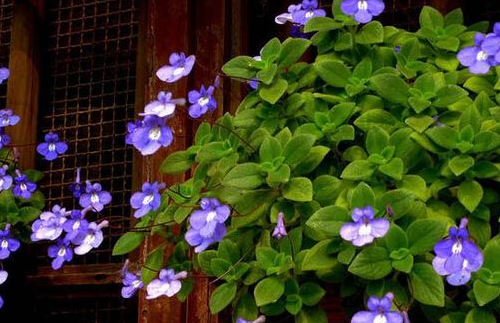
The leaves of the dolphin flower are succulent, round or long oval-shaped, light green in color, and there are also variegated-leaf varieties. The leaves are opposite or whorled, and the plant height is 15-45 cm; the flower stems grow from the leaf axils, the flower diameter is about 2.5 cm, with 5 petals fused at the base into a tube shape, and the flower color is mostly blue, with white-flowered varieties as well; the flower stems of the dolphin flower are slender, and the flowers stretch out in all directions in a thousand postures. When the flowers are in full bloom, it is as if a group of little blue elves are happily having a party in midair, very interesting and spectacular!
II. How to grow dolphin flowers
The dolphin flower is native to South Africa and is a perennial herbaceous plant in the Gesneriaceae family. The dolphin flower is suitable for a semi-shaded growing environment, preferably a shaded and well-ventilated place. Choose a soil medium with good drainage for cultivation. In a warm climate it can bloom all year round, but spring and autumn are still the main flowering seasons. Although a semi-shaded environment is most suitable for their growth, a moderate amount of sunlight is needed. It is best to choose a cool but bright environment, receiving scattered light through curtains or gaps between leaves, and the soft direct sunlight of spring and autumn is also fine.
Because the dolphin flower is originally a plant from the mountainous areas of southern Africa, it likes a cool climate. In summer, when it is hot and stuffy, pay attention to keeping it cool and ventilated, and it is best to avoid direct glaring sunlight. In winter, prevent low temperatures below 10°C, which can easily cause cold damage, because it can be grown both indoors and outdoors. It is recommended to move it indoors to a ventilated and bright place when it is too cold outdoors in winter and too hot outdoors in summer. Spring and autumn are the main growing and flowering periods. In addition to moderate watering, regular fertilizing is also needed. In winter and summer, pause fertilizing, and reduce watering in winter as well.
The dolphin flower is very easy to survive successfully by stem cuttings. For stemless varieties of orchids, the thick-veined part of the leaf can be used for leaf cuttings propagation.
III. Growing requirements for dolphin flowers
The dolphin flower is actually very easy to grow. In coastal subtropical regions such as Guangdong Province, the flowering period of the dolphin flower is from November each year to May or June of the following year. Because the dolphin flower has thick leaves and its flowering branches stretch outward, it is suitable for growing in hanging pots (as shown in Figure 1). The dolphin flower likes shade and dislikes sun. Apart from occasionally needing some sunlight in winter, even if there is no direct sunlight all summer, it will not have any problems. Because in Guangdong, this southern land without winter, this plant goes dormant in summer, and you can almost ignore its existence.
1. Choosing a pot
I chose a hanging pot, which can be tied to a thick water pipe and also hung in a corner of the balcony for care. This corner gets no sun in summer, and in winter it gets two or three hours of direct sunlight, which dolphin flowers love very much.
2. Soil
The dolphin flower does not have high requirements for soil. I have tried garden soil, potting soil, and that cheap peat soil, and it accepts them all without complaint. However, it does not like heavy clay soil, and its roots do not like an overly moist environment either, so everyone should try to choose potting soil for growing dolphin flowers, loose and breathable.
3. Fertilizing
I have never fertilized it. At most, during the one or two months of the flowering period, it gets a bit of extra fertilizer such as Bloom Booster along with the other herbaceous flowers, and it does not care at all. Fertilizing does not necessarily have any special effect either, because it already performs very well on its own.
4. Light
Actually, as said earlier, it does not like intense sunlight, especially in summer, when the leaves will be scorched, turn yellow, and curl. Anyway, a dolphin flower that has been exposed to the sun is extremely ugly. During the year, it can go seven or eight months with no sunlight at all. In winter in Guangdong, which it loves most, which is also its growing season, a few hours of sun is no problem. Once you notice yellow patches appearing on its leaves, you should move it out of the sunlight.
5. Water control
The dolphin flower plant has a fairly high water content, so its water demand is not small. Try not to let it dry out, or it will curl its leaves and look listless. I do not like spraying water on plants, so I always water directly into the pot, trying not to water the plant itself, and the amount should not be too large. This amount is really hard to say; anyway, if the soil is breathable, everyone can just water freely.
IV. Key care points for dolphin flowers
If you want to grow dolphin flowers beautifully, you need to pay attention to the following points: be sure to plant new cuttings every year! Generally, early October each year is the best time. You can also determine your cutting time based on when your dolphin baby starts growing.
Use new branches, new branches that have not been topped or pinched, about 10 cm long, and plant them as densely as possible. In my pot, I inserted ten cuttings and just let them grow without managing them, and they will grow into a big ball on their own. If you cannot bear to part with those old plants that have been growing for a long time, then you cannot have a good potted plant. Because the old branches of the dolphin flower will become woody, and it is very difficult for them to sprout new buds, and the old root system is also not enough to support the rapid growth of new branches. If you want to see a flower ball, pull out the old plants and insert new cuttings every year, and try not to top or pinch. Because whether you pinch or not, it will branch however it wants to branch, and it will not produce two extra branches because of your pinching. Pinching will only leave a big scar on that branch, and there will be a pit at the position of that branch. If you must pinch, do it as early as possible, and then let it grow new branches on its own to cover that scar. If you are afraid of pits, pinch it into a spherical shape. As long as the growth rate is consistent, it can ultimately still form a ball.
How to grow dolphin flowers
1. Plenty of sunlight
After the dolphin flower cuttings have survived, that is, after confirming that the roots have grown well, give them more sun. Before autumn turns to winter, place it on a west-facing security window. After the temperature drops below 5°C, move it back to a south-facing enclosed balcony, and leave it the best sunny spot. After it warms up in spring, place it on the west-facing security window again. Of course, avoid summer sunlight as much as possible. Dolphin flowers are rather afraid of high temperatures and intense sun, and surviving the summer is a victory.
2. Keep the soil moist
Dolphin flowers are very afraid of drying out, so the soil must be kept in a certain moist state. For example, keep a little water in the saucer at the bottom of the pot. If the soil is too dry, the leaves will curl, and even watering afterward will not help them recover. Moreover, after the roots are damaged, it is very easy for them to turn black and die. In winter, just keep a tiny bit of water in the saucer at the bottom of the pot.
3. Topping in autumn makes winter fuller
The dolphin flower grows very vigorously in autumn, but if you want it to burst into a full pot in winter, you need to top it. Give it a haircut, and the cut branches can be used for cuttings. After topping, the dolphin flower grows more vigorously in winter and blooms better in spring.
The above is an introduction to the question of how to grow dolphin flowers. Next, let's look at the precautions for dolphin flowers!