Maintenance and Care Methods and Techniques for Hawthorn Bonsai
Location
Hawthorn trees love light; insufficient sunlight will cause weak, thin branches, thin leaves, and pale color. Therefore, place them in a location with ample sunlight and good air circulation.
Watering
Hawthorn trees are drought-tolerant; trees that have not yet fruited have low water requirements, but bonsai that have fruited must have an ample water supply. Keep the soil in the pot moist, but do not let water accumulate. In autumn, control the amount of watering, and in winter do not let the soil stay moist.
Fertilizing
Hawthorn trees are not particularly fond of fertilizer. Apply fertilizer once in winter, but not too much. After flowering, apply a phosphorus-potassium fertilizer once; do not apply nitrogen fertilizer. In autumn, apply an appropriate amount of fertilizer.
Preserving Flowers and Fruit
During the full bloom period of the hawthorn tree, ring-barking can be performed on the branches, and gibberellin can be sprayed.
Pest and Disease Control
Pay attention to preventing and controlling the common powdery mildew, red spider mite, and aphid problems.
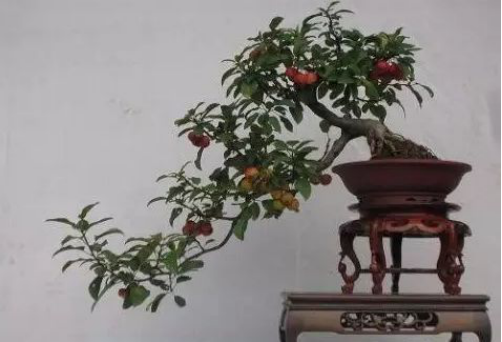
That's all there is to the method of making a hawthorn bonsai. Isn't it much simpler than you imagined? I hope the editor's introduction has been helpful to you!
Making and Caring for Hawthorn Bonsai
Hawthorn, also known as shanlihong or hawthorn fruit, is a deciduous shrub or small tree of the genus Crataegus in the rose family (Rosaceae). The plant is much branched, with dark brown bark; the branches are thornless or have few thorns. The leaves are triangular-ovate or rhombic-ovate, dark green and glossy on the surface, with sparse, irregular serrations along the margins. The corymbose inflorescence emerges from the branch tips or upper leaf axils; the small flowers are white and open from May to June. The fruit is nearly spherical or flattened-spherical, turning dark red, orange-red, or yellow when ripe from September to October, with numerous small pale spots.There are many varieties of hawthorn, and their plant size, leaf shape and size, and fruit size all differ. The smallest fruits are only 0.8 cm in diameter, while the largest reach 3 cm to 4 cm. For making bonsai, choose hawthorn varieties that are not large in plant size but are rugged and ancient-looking, with small leaves, easy fruiting, bright fruit color, and suitability for pot cultivation, such as 'Wild Hawthorn', 'North Hawthorn', 'South Hawthorn', 'Hubei Hawthorn', 'Shandong Dajinxing', 'Yan Guohong', 'Fuli Hong', and others.
Transplanting hawthorn into a pot is carried out from after leaf fall in autumn to before bud break in spring. Because it has few fibrous roots, the roots should be dipped in mud slurry during transplanting to keep them fresh and moist. Before planting, prune heavily according to the tree shape and cut off the taproot. For stumps that have been dug out for too long and have severely lost water, soak them in clean water for a period to replenish moisture. First plant them in sandy soil to "nurse the stump"; plant them deeply and do not expose the roots. After planting, water thoroughly and frequently mist the plant, or cover it with a plastic bag to retain moisture. In the first year after the stump survives, apart from necessary pruning and pulling, generally do not do much shaping, in order to promote the formation of new roots. In the second spring, move it into a pot and gradually shape it to cultivate a beautiful canopy.
The shaping of hawthorn bonsai can be based on the form of the stump, taking advantage of its natural tendency, and working it into different styles of bonsai such as large-tree style, upright style, cliff-hanging style, waterside style, and slanting-trunk style. Because its leaves are relatively large, the canopy is mostly made into a naturally sparse and airy form, with consideration given to a natural balance among the canopy, branches, leaves, and fruit; the layers between branches should not be too dense, so as to express the natural scene of abundant fruit covering the branches. The shaping methods should combine pruning, wiring, and pulling. Wiring and pulling are best done during the growing season; because hawthorn branches are hard and brittle, the bending amplitude during wiring should not be too great. Pruning is mostly done during the dormant season; since hawthorn has strong sprouting ability, heavy pruning can be carried out while maintaining a beautiful tree shape. During the shaping process, the roots can gradually be raised so that they hang and the claws are exposed, to enhance ornamental value.
Hawthorn is naturally robust, liking a sunny, warm, and humid environment; it is slightly shade-tolerant and tolerant of cold, drought, and poor soil. It is not demanding about soil, but grows better in fertile, loose sandy soil with good drainage and aeration. During the growing season, keep it outdoors in a ventilated, well-lit place for care. Water according to the principle of "do not water until dry, and water thoroughly when you do." From March to April before flowering, apply 1 to 2 topdressings of a liquid fertilizer mixing phosphorus and nitrogen. During the fruit-development period, apply a liquid fertilizer with relatively high phosphorus and potassium content once every 15 days.
Because its root system is well developed and its sprouting ability is strong, pay attention in normal times to thinning out overly dense branches and leaves. For vigorous new shoots, when they grow to about 20 cm, pinch them back, leaving 4 to 6 leaves, to encourage the growth of short fruiting branches.
During the dormant period, carry out pruning and shaping: cut off thin, weak branches, overly dense branches, and water sprouts that disrupt the tree shape; retain thick, sturdy medium and short branches; cut back overly long branches extending outward to encourage the rear branches to become thick and strong. Also pay attention to reducing the canopy, cutting off branches on the upper part of the canopy and retaining branches on the lower part, cultivating them into a shorter new canopy. In winter, keep it in a wind-sheltered, sunny place for care, pay attention to soil moisture, and replenish water in time. Repot once every other spring or autumn to increase its fruiting rate.
How Should Hawthorn Bonsai Be Cared For and Made
Hawthorn is generally grown as a fruit tree, but it can actually also be used as an ornamental fruiting plant for pot cultivation. Hawthorn, also known as shanlihong or hawthorn fruit, is a deciduous shrub or small tree of the genus Crataegus in the rose family (Rosaceae). The plant is much branched, with dark brown bark; the branches are thornless or have few thorns. The leaves are triangular-ovate or rhombic-ovate, dark green and glossy on the surface, with sparse, irregular serrations along the margins. The corymbose inflorescence emerges from the branch tips or upper leaf axils; the small flowers are white and open from May to June. The fruit is nearly spherical or flattened-spherical, turning dark red, orange-red, or yellow when ripe from September to October, with numerous small pale spots.There are many varieties of hawthorn, and their plant size, leaf shape and size, and fruit size all differ. The smallest fruits are only 0.8 cm in diameter, while the largest reach 3 cm to 4 cm. For making bonsai, choose hawthorn varieties that are not large in plant size but are rugged and ancient-looking, with small leaves, easy fruiting, bright fruit color, and suitability for pot cultivation, such as 'Wild Hawthorn', 'North Hawthorn', 'South Hawthorn', 'Hubei Hawthorn', 'Shandong Dajinxing', 'Yan Guohong', 'Fuli Hong', and others.
Transplanting hawthorn into a pot is carried out from after leaf fall in autumn to before bud break in spring. Because it has few fibrous roots, the roots should be dipped in mud slurry during transplanting to keep them fresh and moist. Before planting, prune heavily according to the tree shape and cut off the taproot. For stumps that have been dug out for too long and have severely lost water, soak them in clean water for a period to replenish moisture. First plant them in sandy soil to "nurse the stump"; plant them deeply and do not expose the roots. After planting, water thoroughly and frequently mist the plant, or cover it with a plastic bag to retain moisture. In the first year after the stump survives, apart from necessary pruning and pulling, generally do not do much shaping, in order to promote the formation of new roots. In the second spring, move it into a pot and gradually shape it to cultivate a beautiful canopy.
The shaping of hawthorn bonsai can be based on the form of the stump, taking advantage of its natural tendency, and working it into different styles of bonsai such as large-tree style, upright style, cliff-hanging style, waterside style, and slanting-trunk style. Because its leaves are relatively large, the canopy is mostly made into a naturally sparse and airy form, with consideration given to a natural balance among the canopy, branches, leaves, and fruit; the layers between branches should not be too dense, so as to express the natural scene of abundant fruit covering the branches. The shaping methods should combine pruning, wiring, and pulling. Wiring and pulling are best done during the growing season; because hawthorn branches are hard and brittle, the bending amplitude during wiring should not be too great. Pruning is mostly done during the dormant season; since hawthorn has strong sprouting ability, heavy pruning can be carried out while maintaining a beautiful tree shape. During the shaping process, the roots can gradually be raised so that they hang and the claws are exposed, to enhance ornamental value.
Hawthorn is naturally robust, liking a sunny, warm, and humid environment; it is slightly shade-tolerant and tolerant of cold, drought, and poor soil. It is not demanding about soil, but grows better in fertile, loose sandy soil with good drainage and aeration. During the growing season, keep it outdoors in a ventilated, well-lit place for care. Water according to the principle of "do not water until dry, and water thoroughly when you do." From March to April before flowering, apply 1 to 2 topdressings of a liquid fertilizer mixing phosphorus and nitrogen. During the fruit-development period, apply a liquid fertilizer with relatively high phosphorus and potassium content once every 15 days.
Because its root system is well developed and its sprouting ability is strong, pay attention in normal times to thinning out overly dense branches and leaves. For vigorous new shoots, when they grow to about 20 cm, pinch them back, leaving 4 to 6 leaves, to encourage the growth of short fruiting branches.
During the dormant period, carry out pruning and shaping: cut off thin, weak branches, overly dense branches, and water sprouts that disrupt the tree shape; retain thick, sturdy medium and short branches; cut back overly long branches extending outward to encourage the rear branches to become thick and strong. Also pay attention to reducing the canopy, cutting off branches on the upper part of the canopy and retaining branches on the lower part, cultivating them into a shorter new canopy. In winter, keep it in a wind-sheltered, sunny place for care, pay attention to soil moisture, and replenish water in time. Repot once every other spring or autumn to increase its fruiting rate.