What are the key points for making a hawthorn bonsai?
Seedling source
Most hawthorn seedlings are grafted seedlings. Small seedlings can be used directly as rootstock. You can also directly dig up small-crowned, short and beautiful stumps from the mountains.
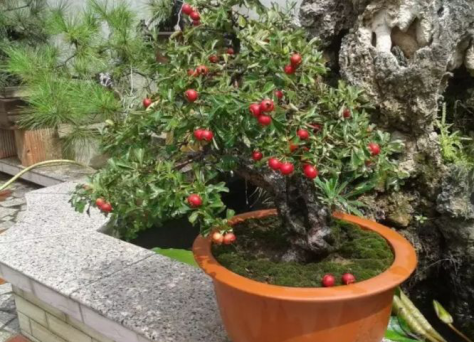
Shaping
Potting
It is recommended to pot in spring and autumn. It is best to use purple clay pots or unglazed pots. The soil should be kept at proper moisture. Make sure the soil is fertile, and fertilizer can be added appropriately according to the situation.
Physiological characteristics and shaping
First, you need to understand the physiological characteristics of the hawthorn tree. During the young tree stage, the top growth of the hawthorn tree is relatively strong and there are few side shoots, so you can begin pruning the shape during the young tree stage to promote branching, but be careful not to damage the plant when pruning; at best it affects growth, and at worst the plant dies. During the flower bud differentiation stage, the tree body can be cut to promote flower bud differentiation in the hawthorn tree. Finally, the plant shape can be created and cultivated in many ways and can be shaped according to personal experience and preferences. You need to observe the growth of the hawthorn tree more, think more, and repeatedly carry out operations such as pruning, shaping, pinching, and bud removal to keep the tree shape beautiful.
Fruit tree bonsai production techniques and care
Fruit tree bonsai is a product that combines fruit tree cultivation techniques with traditional bonsai art, integrating flower appreciation, fruit viewing, and scenery viewing into one, so that beauty of form and abundance are displayed at the same time. In spring the flowering branches are delicate and gorgeous like brocade; in summer they are full of vitality, and the crisp, dripping fruits grow from small to large, changing with each passing day; in golden autumn the abundant fruits are brilliantly colorful.
Production and care management:
Choose a healthy fruit tree and keep several relatively strong branches. Cut off the relatively thin and small ones. Then use lead wire to shape it and create the appearance you want. It is actually this simple, and after that you just need to pay attention to management!
1. Choose the best grafting time
Fruit tree bonsai grafting includes early spring grafting, summer grafting, and autumn grafting. Early spring grafting is carried out before the fruit tree bonsai sprouts; summer grafting is carried out after the scion buds mature; autumn grafting is carried out in late summer and early autumn. For grafting to improve fruit tree bonsai varieties, except for fruit tree bonsai such as grapes that must be grafted with green shoots and therefore must be grafted in summer, general fruit trees can all be grafted in early spring; for fruit trees whose buds have premature maturity, that is, fruit trees that have the characteristic of sprouting multiple times in one year, autumn grafting can be used, but attention must be paid to cold protection for young branches in winter. For general fruit tree bonsai, choosing early spring grafting for improvement is more conducive to young branch growth and crown formation.
2. Pruning branches and retaining rootstock
Pruning branches and retaining rootstock refers to cutting back fruit tree bonsai that need grafting improvement, removing most of the original branches of the fruit tree bonsai, retaining branches suitable for grafting (which can also be called rootstock branches), and cutting them into short stubs of appropriate length. The following points should be noted during operation:
1. Remove the upper and keep the lower, reduce wounds. Try to cut off upper or distal branches as much as possible, retain branches on the lower part and near the main trunk as grafting rootstock, and reduce wounds caused directly on the main trunk and rootstock stubs, while also preventing the rootstock stubs from peeling and splitting.
2. Pay attention to the orientation of retained stubs. Retain stubs according to the tree and according to environmental conditions, and at the same time make operation convenient. If the orientation of the main branch is not ideal, a side branch or a strong auxiliary branch can be used instead as the retained rootstock. In short, lower the height and contract the crown.
3. The number and length of retained stubs depend on the original tree shape and tree age. In general, the lower main branches should be retained as rootstock. For taller tree shapes, it is suitable to retain the first and second layers of main branches from bottom to top and the retracted part of the main trunk. The length of retained stubs should be longer on the lower part, with the cut end 30-50 cm from the main trunk; the upper part should be shorter, 25-35 cm from the main trunk. For trees within 5 years old, retain 3-5 stubs; for trees around 10 years old, retain about 10 stubs. For vining fruit trees, retain 1-2 rootstock stubs per main vine. If the original crown is large, more stubs should be retained; if the original crown is small, fewer stubs should be retained.
3. Variety selection and scion collection
1. Variety selection. For grafting improvement of fruit tree bonsai, it is suitable to choose varieties that suit the local climate conditions, have good fruit market prospects, and have strong grafting compatibility with the fruit tree bonsai to be improved, and to achieve a reasonable combination of different maturity periods, different flavors, different colors, different fruit types, as well as fresh-eating, storage, and processing varieties.
2. Scion collection. Scions should be selected from healthy, pest- and disease-free, plump-budded, upright-growing one-year-old branches. For early spring grafting, the terminal buds can be fully used for branch grafting, and flower buds should be removed. For summer and autumn grafting improvement, scion collection should pay attention to the degree of bud maturity. Darker branch color and dark green, enlarged leaves indicate that the axillary buds are relatively well matured.
4. Grafting methods
1. Cleft grafting. This method is suitable for early spring branch grafting of rootstock stubs with a diameter below 3 cm and for summer grape grafting. The split opening on the rootstock stub should be 3-5 cm long. The "wedge head" cut on the insertion part of the scion should be 2-3 cm long, required to be flat and smooth, with the two slanted surfaces equal in length or slightly different. When inserting, the cortex on one side of the scion should align with the cortex of the rootstock stub; the insertion depth of the scion is based on aligning one cut edge of the scion with the cut edge of the rootstock stub, and 2-3 buds should be retained on the scion. After insertion, the binding must be tight; you can first wrap it closed with plastic tape and then tie it tightly with fine string; or after fixing the main parts, apply grafting wax.
2. Bark grafting. There are two methods: branch insertion grafting and single-bud insertion grafting. In branch insertion grafting, the "wedge head" cutting method of the scion branch is the same as in cleft grafting; the difference is that the "wedge head" is shorter and steeper, with the longer slant about 2 cm and the shorter slant 1 cm. When inserting, the longer slant faces the xylem of the rootstock stub. The method for cutting a single bud for single-bud insertion grafting is: cut obliquely upward 1 cm below the bud, cutting together with the xylem up to above the bud, then make a horizontal cut 1 time above the bud and remove the single bud. The common opening method on the rootstock for bark grafting is a "t"-shaped opening. For branch insertion grafting, the rootstock opening method also includes the "one dot and one horizontal" style, as well as the method of directly making 1 vertical cut at the cut end of the rootstock stub to open it. After insertion, the binding is the same as in cleft grafting; for single-bud grafting, the bud eye must be exposed.
3. Summer bark grafting. In summer bark grafting, the bud cutting method is the same as for single-bud insertion grafting. After the bud is cut off, the bud piece needs to be peeled off and the xylem removed. When peeling the bud, prevent "hollowing out the core." For grafting peach, pear, and apple trees, the bud can be grafted with xylem after cutting. The rootstock openings in bark grafting include "h" shape, "t" shape, and so on. When grafting, make sure the bud piece and rootstock fit flatly and tightly, and prevent the bud piece from curling. The binding method is the same as for single-bud insertion grafting. In addition, summer can also use patch budding, whistle grafting, and other methods.
4. Cut care. Following the order of grafting, the rootstock cuts and the upper end cuts of the grafted branches should all be wrapped closed with plastic tape or coated with grafting wax. In case of drought, whitewash the main trunk and large branches with limewater to protect the tree body's moisture and improve the success rate of grafting improvement.
5. Management after grafting
1. Check and regraft in time. The survival rate can be checked 15-25 days after early spring grafting, 7 days after summer grafting, and 10 days after autumn grafting. If the scion or grafted bud turns black or brown, it indicates that grafting was unsuccessful. If the survival rate is too low, timely regrafting can be carried out.
2. Apply sufficient fertilizer and water enough to accelerate grafted branch growth. After grafting fruit tree bonsai, according to tree size, bury and apply 5-25 kg of farmyard manure and 0.50-2.50 kg of diammonium phosphate as appropriate. Use a ring-shaped or star-shaped fertilization method, with trench depth 20-40 cm, and combine with root pruning to thin out some aged side roots. After fertilizing, water thoroughly to keep the root zone moist. Fertilization can also be done in advance, that is, spring grafting improvement can be fertilized in the previous autumn, and summer grafting can be fertilized in early spring.
3. Strengthen young branch care for fruit tree bonsai to prevent strong winds from breaking them. When the grafted branch begins to grow after grafting, slightly loosen the binding material, but do not completely loosen it. When the young branch grows to 10 cm long, take some wooden sticks or crop stalks, fix half on the main trunk or main branch, and gather the other half around the young branch, then wrap with fine string to protect the young branch. After the young branch is firmly fixed, use a small knife to cut all the binding material from grafting at once to facilitate its growth.
4. Remove rootstock sprouts in time to reduce nutrient competition with the grafted branch. However, fruit trees facing regrafting should be treated differently: one situation is that grafting in the previous season was unsuccessful and regrafting is needed in the next season, in which case rootstock sprouts should be allowed to grow; the other situation is that summer grafting was unsuccessful, and regrafting would have too great an impact on the fruit tree root system, so regrafting should be abandoned and rootstock sprouts allowed to grow.
5. Pruning grafted branches. For grafted branches that grow too vigorously, "pinch the top" at an appropriate height, which can promote the sprouting and growth of secondary branches; for densely growing vigorous branches and competing branches, use methods such as bending branches and pulling them to fill gaps, and use little or no heading back or thinning pruning methods.
Pruning techniques for fruit tree bonsai
Pruning fruit tree bonsai should master the principles of the "five observations" and "three sparse and three dense." "Five observations." Observe tree age: for young trees, in order to increase the amount of branches and leaves, expand the crown, and form a good structure as early as possible, winter pruning should be carried out in November-December. For vigorous trees of suitable fruiting age, winter pruning time can be appropriately postponed to early spring sprouting. For weak trees in full fruit stage, in order to promote their vegetative growth and quickly restore a healthy tree vigor, the winter pruning task should be completed before the end of December.
For vigorous trees in full fruit stage, in order to weaken their tree vigor and form more flower buds, winter pruning can be carried out in January-February; observe tree vigor strength: the degree of pruning should be grasped from both the whole and the part, and overall the tree vigor should be kept balanced. The crown should be full and compact, with clear primary and secondary relationships, dense on the plane, and the upper scaffold branches clearly shorter than the lower scaffold branches; subordinate branches should make way for dominant branches, and the growth vigor of scaffold branches at the same level should be approximately consistent. As long as the goals of firm and compact framework, ventilation and light penetration, and early fruiting and high yield can be achieved, it can be organized and guided according to its original tree shape and tree vigor. Do not overemphasize shaping, especially for young trees, because it often causes them to fail to bear fruit early;
Observe branch appearance:
(1) Fruit tree bonsai that are strong on top and weak below: cut back the upper strong branches at the flower buds and replace with weak leaders, or even saw off the upper strong part, while the lower weak branches should be heavily cut back from the base at plump buds toward the main branch leader.
(2) Fruit tree bonsai in which the growth vigor of the basal main branches is inconsistent: prune the strong main branches at the flowers, and heavily cut back the thin and weak main branches from the top at plump buds.
(3) Fruit tree bonsai with no side branches or interior branches to speak of: choose the best upright branch and pull it with rope to a reasonable position, and thin out the overly dense ones.
(4) Fruit tree bonsai with no tree shape to speak of: saw off some obviously redundant large branches, open the spacing between layers, select scaffold branches for key cultivation, make long-term plans, and use methods such as "pulling, propping, and pressing" to make the tree structure as reasonable as possible. If there are very few or no flower buds, there should be more light pruning, more thinning, and less heading back;
Observe pruning response:
If the one-year-old branches on the 3-year-old branch section have a large number of medium and short branches that are thick and strong, with plump buds, and their growth length is significantly less than the extension leader, and some leaf cluster branches are also formed, it indicates that the pruning amount in previous years was appropriate and the same can continue to be used that year. If the length of the one-year-old branches on the 3-year-old branch section is similar to or exceeds that of the extension leader, it indicates that the pruning amount in previous years was too large, and light pruning should be done appropriately that year. If the 3-year-old branch section does not produce medium and short branches, but only bears some leaf cluster branches with very small leaves, it indicates that the pruning amount in previous years was too light, and heavier pruning should be done appropriately that year; observe the number of flower buds: fine work should be done locally so that flower bud branches and leaf bud branches have an appropriate ratio, generally 1:2-3.
"Three sparse and three dense" means: large branches sparse, small branches dense; peripheral branches sparse, interior branches dense; upper branches sparse, lower branches dense.
"One large and one small" means: lower part large, upper part small.
Treatment of branch groups and small branches in fruit tree bonsai. Fruiting branch groups should be promptly retracted, rejuvenated, and renewed to maintain strong fruiting potential. For other branches, new branch groups should be formed after treatment. Vigorous trees and vigorous branches should be left unpruned more and cut less, and retracted after fruiting becomes weak. For branches left unpruned for too long, promptly retract and rejuvenate them and cultivate them into fruiting branch groups. For back branches, do not remove all of them; use them as appropriate. Young trees have strong vigor, and back branches tend to grow vigorously, so they can be controlled by methods such as repeated pinching in summer pruning, branch pulling, and branch bending, turning useless ones into useful ones; trees in full fruit stage have stable vigor, and back branches do not easily grow vigorously, so they can be kept or removed according to space and position; for old trees after the full fruit stage, all back branches should be used in order to renew tree vigor and extend the fruiting years.
Methods for thinning branches in fruit tree bonsai:
First, do not remove small ones and fail to remove large ones. That is, when thinning branches, first consider removing large branches, and then consider removing small branches, to prevent the phenomenon of the whole plant becoming a "bare stick."
Second, for trees with too many large branches, do not thin too many at one time; it can be done year by year and in batches, and no more than two at a time.
Third, do not thin two opposite large branches at the same time, causing opposite wounds, so as to avoid weakening the upper tree vigor.
Fourth, wounds should be disinfected and protected. They can be disinfected with 2% copper sulfate solution or original liquid lime sulfur, and coated with paraffin or anti-rust paint to prevent the invasion of pathogens and the evaporation of tree body moisture.
Disinfection of pruning tools. Tools often come into contact with diseased scars due to carelessness. At this time, they should be promptly disinfected with 3-5 degrees Baume lime sulfur or 50 times asafetida solution to prevent the spread of pathogens.
About fruit tree bonsai care
Fruit tree bonsai is simple and easy to learn. As long as you follow the methods below, you can learn how to take care of it and make it bloom every year and bear fruit every year, with beautiful scenery accompanying you for as long as several decades.
1. Key points of fruit tree bonsai care techniques
1. Watering: Fruit tree bonsai need more water. The potting soil should be "dry when it should be dry and wet when it should be wet," that is, when the potting soil becomes dry and turns white, water thoroughly again. If watering is not timely or if you do not water for several days, causing the root system to be in a water-deficient state for too long, the leaves will wilt or even dry up. If for a long time you water before the potting soil becomes dry, and the interval between waterings is too short, the pores of the potting soil become filled with water, and a large amount of air is expelled from the soil, thereby affecting root respiration, causing difficulty in root growth or even browning and rotting. In summer and autumn, watering time should avoid the high-temperature period at noon. When the weather is cold, watering time should be at noon on sunny days. Fruit trees are not very strict about water quality; clean fresh water without salinity or alkalinity is best. Water from washing rice or vegetables or water replaced from fish keeping can also be used for irrigation.
2. Topdressing: Fruit tree bonsai have strong adaptability to fertilizers. General organic fertilizers, inorganic fertilizers, and "flower fertilizers" sold in flower shops can all be used, but fully decomposed organic liquid fertilizer is best. Commonly used ones include cake fertilizer such as sesame paste residue and animal hooves and horns. Note that they must be soaked and decomposed, diluted more than 50 times, and then watered in. Inorganic chemical fertilizers should be mixed with multiple elements such as nitrogen, phosphorus, and potassium, first dissolved in water, and then applied by watering the potting soil or spraying on leaves, but the concentration should not exceed 5 per mille. Flower fertilizers sold in flower shops are clean and hygienic, come in many brands, and can be used according to their instructions. During the growing season, organic liquid fertilizer should be applied 1-2 times per month. In this way, the fruit of the fruit bonsai can be large and colorful, and vigorous growth can be maintained the following year.
3. Light: Fruit bonsai like light. During the growing period, they should be placed in open ground or on a balcony in a bright place. If placed indoors during the ornamental period, it is best to place them in a spacious hall, under a window, or another ventilated and bright place. July-August is the peak period of flower bud differentiation for most fruit tree species. During this period, sufficient light is conducive to flower bud formation.
2. Management characteristics of various tree species:
1. Apple bonsai (pear, crabapple, and sand pear can refer to apple)
1) Pruning: Winter pruning should be carried out in January-February (before sprouting). First, correctly identify flower buds. Most apple flower buds are borne at the tips of healthy medium and short branches. The buds are plump, with tightly wrapped scales. Vegetative branches are often relatively thick and long, and their terminal buds and side buds are all leaf buds. If they are too dense or too long and affect the tree shape, they can be cut flat from the base. If there is space around them, leave 1-2 cm and cut flat, and short branches will sprout that year to form flower buds. In apples, Otome (a small-fruited apple variety), and in crabapples, Donghongguo, etc., can form strings of axillary flower buds. The buds on the middle and upper parts of their healthy branches are often all axillary flower buds. For pruning axillary flower buds, more than 1/2 of the flower quantity should be cut off, so that the density is appropriate and the tree shape is full.
2) Summer pruning: pinching, branch pulling. From May to July, pinch the fruit-bearing secondary shoot (the branch growing from the base of the fruit stalk) after retaining 4 leaves to reduce nutrient competition and benefit fruit development. For upright new shoots, pinch 1-2 times. For upright perennial or current-year branches, pull them flat and slanting; the greater the horizontal angle, the more conducive to flower formation.
3) Pollination: Apples and pears have low self-fruitfulness and high cross-pollination fruit set, that is, mutual pollination between different varieties of the same tree species (for example, Red Fuji with Yellow Banana, and Snow Pear with Ya Pear). Artificial pollination can be carried out during the flowering period. When the flowers open, use a clean brush from 8-10 a.m. to pollinate different varieties' flowers with each other. If there is only a single variety, you can contact this base, or before flowering, purchase dried fresh pollen from the specialty store set up by this base.
4) Flower and fruit thinning, so that nutrients are concentrated in supply, can lay a good foundation for fruiting. For trees with many flowers, thin the inflorescences. Each inflorescence can produce 5-6 flowers. Before flowering at the bud stage, retain 2 flowers and remove the rest. After flowering, poorly pollinated young fruits will drop. The remaining young fruits gradually swell, and due to nutrient competition, some young fruits will still drop. This period until early June is normal. After mid-June, fruit no longer drops, and then fruit setting can be carried out. According to crown diameter, for example, for a fruit tree with a crown diameter of about 40 cm, retain about 10 fruits, 1 fruit per inflorescence. For small-fruited fruit trees such as Otome, sand pear, and crabapple, retain about 25 fruits at 40 cm, about 3 fruits per inflorescence.
2. Hawthorn bonsai: Hawthorn is self-fruitful and does not require artificial pollination. Hawthorn inflorescences are borne on 1-3 bud positions at the top of branches. During winter pruning, do not thin branches; just shorten overly long branches to keep the tree shape compact. In May, when vigorous upright new shoots grow to 20 cm, pinch after retaining 4-6 leaves; earlier is better than later. In addition, spraying 3 parts per 100,000 urea during the flowering period can increase the fruit set rate.
3. Peach bonsai (plum and apricot can refer to peach): Peaches include both flower-viewing and fruit-viewing types. Flower-viewing peach types have gorgeous petals, many are double-petaled, and do not bear fruit or bear small inedible fruit. Fruit-viewing peach types have pale flowers, single petals, and strong ornamental and edible value. This base has all fruit-viewing fruit trees. Peaches have a very large flower quantity, and a large number of side buds grow in strings. During winter pruning, cut off 1/2-1/3, and cut off overly long vigorous branches. Select 3-5 branches on the lower part of the crown, remove the flower buds, and keep them as reserve branches for fruiting the next year. Upper fruiting branches are cut off after fruiting to keep the tree shape compact. Peaches are self-fruitful. If different peach varieties are combined for mutual pollination, the fruit set rate can be even higher.
4. Grape bonsai
1) Pruning: Grape pruning should be carried out after leaf fall, preferably from mid-October to early November. Most buds at the middle and base of healthy one-year-old branches are flower buds. Leave the lower 4 buds and cut. This can be determined according to vigor. For relatively weak branches, leave 2-3 buds at the base and cut. Grapes must be pruned in winter; otherwise flower buds cannot sprout or nutrients cannot be concentrated in supply to the flower buds, and good fruit will not be produced. There are mainly two reasons: first, there is no reasonable pruning or no pruning; second, nutrient supply is insufficient and the plant is too weak. Courtyard grapes are basically the same as this.
2) Bud removal: This can be carried out in spring after the buds begin to move. Among the double buds or triple buds sprouting on the fruiting mother branch, keep 1 strong bud per node and remove the rest.
3) Pinching: Pinching can turn nutrients from vegetative growth to reproductive growth, which is conducive to concentrating nutrient supply to the fruit. Generally before flowering, pinch after retaining 4 leaves above the inflorescence. After pinching, growth will continue, and pinching can be repeated. Tendrils should be removed as early as possible to avoid consuming nutrients.
4) Thinning fruit clusters: Each fruiting branch can retain only 1 fruit cluster, and excess ones should be thinned early. Before flowering, part of the flower cluster should also be pinched off so that nutrients are concentrated in supply. Only in this way can a foundation be laid for producing good fruit.
5. Persimmon bonsai: Self-fruitful. Persimmons often produce 1-2 strong developmental branches in the current year. During winter pruning, they can be shortened to keep the tree shape compact. Persimmon flower buds are borne in the middle of the persimmon crown, on 1-3 lateral bud positions at the top of strong branches, and can be left unpruned. After fruiting branches grow in spring, large-fruited varieties retain one fruit per branch, and small-fruited varieties retain 2-3 fruits per branch, with the rest thinned early.
3. Repotting fruit tree bonsai
Repotting can be done once every 3 years, using the original pot or a slightly larger pot. After fruit trees grow in the pot for several decades, a thick root mat will form close to the bottom and walls of the pot. When repotting, remove the net-like root mat. In this way, the distance for roots to transport nutrients to the tree body is shortened. If the pot is changed during the growing period, then too many roots must not be damaged; the whole root ball can simply be placed into the new pot.
4. Overwintering fruit tree bonsai: Their characteristics are generally spring flowering, summer fruit gradually enlarging, and autumn ripening. For late-maturing varieties such as apple, pear, and persimmon, after ripening in autumn, the fruit can remain on the tree until about February of the following year. If placed indoors for viewing in winter and during the Spring Festival, note that the ambient temperature where they are placed should not be too high. Apple, pear, and hawthorn can resist -20°C low temperatures without freezing. It is best to create an environment of -10°C-10°C for them to overwinter. For peach, grape, persimmon, jujube, etc., -5°C-10°C is better. If placed outdoors for overwintering, wrap the pot with newspaper or plastic bags, place it in a wind-protected, sunny place, and check the dryness and wetness of the potting soil once a month. 5. Fruit tree bonsai pests and diseases: Because the bonsai cultivation base strictly controls fruit tree pests and diseases, after they are distributed to urban users, there is no source of infection around them, so the possibility of pests and diseases is extremely small. If they occur, they can be sprayed and brushed with laundry detergent water.
Five major bonsai schools and their artistic styles
The artistic style of Sichuan school bonsaiTree stumps are characterized by being ancient and rigorous, with twisted and varied forms; landscape stone bonsai win by their majestic momentum, high, suspended, steep, and deep, typically expressing the natural features of the Bashan and Shushui regions.
Due to the unique natural conditions, Sichuan school tree stump bonsai generally use golden bullet, June snow, Buddhist pine, ginkgo, crape myrtle, Chaenomeles speciosa, plum blossom, firethorn, camellia, rhododendron, etc.; landscape stone bonsai use sandstone slabs, stalactite, mica stone, sandy limestone, turtle-vein stone, and newly developed varieties as production stones.
Yangzhou school tree stump bonsai
It requires that "the stump must be ancient, with age valued; the pads must be flat, with skill valued." "Two bends and a half" is also called "lion style" bonsai. There are 5 key points in making lion style: first lift roots, second pause nodes, third bend, fourth make pads, fifth close the top. The first two show antiquity and elegance, while the latter three are wonderful in conveying spirit. The top should be large and round; avoid pointed or ram-horn shapes, so that it has the charm of a lion's head. "Knot style" is another form of Yangzhou school bonsai in tree stump shaping. Production must begin when the tree is young, that is, tie a dead knot at the base of the main trunk, or wind it in a circle to form a knot shape, making it appear strange and unique. It can be divided into "single knot," "double knot," and "multiple knots." Yangzhou school landscape stone bonsai is mainly flat-and-distant style, containing the Jiangnan sentiment of "the tide is flat and the two banks are broad, the wind is right and a single sail hangs." Common tree species used in Yangzhou school tree stump bonsai include: pine, cypress, elm, boxwood (melon-seed boxwood), and five-needle pine, Buddhist pine, June snow, ginkgo, ornamental peach, pomegranate, goji, plum, camellia, etc. In addition to locally produced axe-cut stone, landscape stone bonsai also uses sand deposition stone, reed tube stone, Yingde stone, etc. from other provinces.
Suzhou school tree stump bonsai
Suzhou school tree stump bonsai is divided into two major categories: regular (that is, the rules of the Sichuan school) and natural. The main form of the traditional regular category is called "six platforms, three supports, one top." The trunk is coiled into 6 bends, and at each bend one side branch is retained, with 3 branches each in the left, right, and back directions, tied into 9 round branch pads. The 6 symmetrical pads on the left and right are the "six platforms," the 3 pads on the back are the "three supports," and then a large branch pad is tied at the top of the tree, namely the "one top," uneven and interesting, with clear layers. When displayed, they are generally placed in two symmetrical pots, meaning "perfect in every way." The landscape stone bonsai of the Suzhou school also greatly reflects the painting ideas of the ancients and is rich in strong poetic sentiment. The layout is concise and the composition rigorous, vividly reproducing Jiangnan scenery. Commonly used stones include axe-cut stone, Kunshan white stone, Taihu stone, Ying stone, etc.
Common tree species used in tree stump bonsai include pine, cypress, plum, large-leaved elm, boxwood, trident maple, pomegranate, bird-not-perching, etc.
Shanghai school bonsai
Shanghai school bonsai is not confined to one pattern and is not limited by any formula, but in layout it strongly emphasizes theme, layering, and variability. In the production process, it strives to embody the wild charm of mountains and forests, values the forms of ancient trees in nature and the individuality of tree species, guides according to circumstances, applies color according to category, and according to the requirements of Chinese painting theory, strives to make it both spiritual and formal. Although it, like all northern schools, also pays attention to branch pad shaping, the branch pads are not only more numerous and without fixed specifications, but also vary in size, shape, density, and freedom of gathering and scattering, with thriving vitality as the primary goal. Therefore, in technique it takes a different path, emphasizing both wiring and pruning, not using palm fiber but using metal wire wrapped around branches and trunks for bending and shaping, and then fine pruning and fine cutting to maintain a beautiful form: hardness and softness complement each other, smooth and natural.
At present, Shanghai school landscape stone bonsai has two major types: one is to use hard landscape stones to express close-range scenery, with steep peaks and lush trees in the pot; the other is to use soft stones such as sea mother stone and pumice, carefully carving out mountain patterns and stone textures, and planting small trees (small grass) to express a flat-and-distant and deep-and-distant artistic conception. However, in terms of overall style, both types of landscape stone bonsai are relatively vast.
In terms of overall artistic style, it can be summarized in 8 words: vigorous and forceful, smooth and natural.
Lingnan school
Kong Taichu, one of the founders of the Lingnan school style, devoted himself to bonsai art from the age of 19 and pioneered the "accumulate branches and truncate trunk" method. The specific operation method is: when the first section branch of the tree (that is, the side branch on the main trunk) grows to the required thickness, carry out strong pruning; at the same time, select and retain the second section branch (or bud) with suitable angle and position, and when the second section branch has been grown to the required thickness, cut it again, and the third section, fourth section below ... all proceed by this method. Generally, about two small branches (or buds), one long and one short, are retained on each section branch. After years of pruning, the proportion of branches and trunk is well balanced, twisted and powerful, and its branch supports "turn up like deer antlers, hang down like chicken claws," ancient and clumsy like a painting, with distinctions among leaping branches, floating branches, and spreading branches. The second, third, and fourth layers of branch claws of each branch support are required to gradually become thinner and be evenly distributed. Branch supports (equivalent to the branch pads, cloud pads, and branch sheets of the northern schools) are the basic technique of Lingnan school shaping and have very high aesthetic value.
Although landscape stone bonsai is not the specialty of the Lingnan school, it also has considerable achievements, mainly expressing the bright and beautiful natural scenery of southern China, with no lack of dangerous cliffs and strange peaks, high gorges and deep valleys, rich in Lingnan painting style. Commonly used stones include Yingde stone, sandy limestone, reed tube stone, pumice, sea mother stone (coral stone), stalactite, etc.
Common tree species used in tree stump bonsai mainly include: orange jasmine, Fujian tea, elm, plum, banyan, boxwood, Buddhist pine, five-needle pine, rhododendron, water gardenia, plum, ginkgo, etc.
Other bonsai schools and their artistic styles
Huizhou school bonsai
Huizhou school bonsai is a bonsai art school named after Huizhou in Anhui Province. It is represented by Maihua Yucun in She County (Hongling Village, Xiongxing Township), including vast areas such as Jixi, Xiuning, and Yi County.
Huizhou school bonsai has a unique style and diverse forms. Its shaping techniques are influenced by the Yangzhou, Suzhou, and Shanghai schools. It is mainly characterized by ancient, proud, vigorous, strange, and varied forms, and is especially famous for plum stumps, called "Huizhou plum." Varieties include red plum, Erhong, Gulihong, green calyx, jade butterfly, plain white, and Taige; Taige is further divided into silver-red Taige and fragrant-flower Taige, etc. In shaping, it is divided into regular and natural categories. The regular category mainly includes "wandering dragon style" (mostly seen in plum stumps), "twisted spiral style," "three-platform style," "screen style," "knot style," etc. The natural category learns from nature and expresses painting ideas, not confined to one pattern, with unique craftsmanship and a distinct regional personality. Since reform and opening up, Huizhou school tree stump bonsai, especially plum stump bonsai, has become more natural in shaping. Its landscape stone bonsai takes the flat-and-distant style as the keynote: the mountains are not high but elegant, the water is not deep but broad, with white sails dotting and sparkling waves, truly a Jiangnan picture of "autumn water shares the same color with the long sky."
Zhejiang school bonsai
Zhejiang school bonsai is centered on Hangzhou and Wenzhou in Zhejiang Province.
According to traditional division, bonsai in the Hangzhou area belongs to the Jiangnan school. It uses a shaping technique combining palm fiber and metal wire coiling with fine pruning, gradually forming an artistic style different from other Jiangnan schools: mainly pine and cypress, especially five-needle pine, inheriting the freehand tradition since the Song and Ming dynasties with "high trunk" and "combined planting" as the shaping keynote, with thin pads tied and clear layers. It is good at straight trunks or planting three to five plants in one pot to express the special artistic effect of dense forests. The main trunks of cypress types are appropriately twisted and the bark peeled off to express an ancient charm, and it is good at using dead trunks and dead branches to set off flourishing branches and leaves, greatly creating the wonderful state of seeming to enter the depths of tree shade, making people forget the summer heat in June. In addition to pine and cypress, other miscellaneous wood types and flower-viewing, fruit-viewing, and foliage-viewing types total about more than 100 species.
Fujian school bonsai
Fujian school bonsai is centered on Fuzhou and Quanzhou in Fujian Province; therefore Fujian school bonsai is especially prosperous with banyan trees and excels with banyan trees, enjoying the reputation of "banyan tree uniquely transmitted." In shaping techniques, it absorbs the strengths of both the southern and northern schools. While using branch accumulation and trunk truncation and deer-antler and chicken-claw forms, it also pays attention to twisted trunks and tied pads and tops. In the processing method for banyan trees, it uses the tuberous roots and aerial roots of the banyan tree to gradually "lift the roots," forming an integrated "trunk," merging trunk and root into one, showing a unique artistic style: free and natural, elegant and graceful.
Most landscape stone bonsai express Lingnan scenery. The stones mainly include sea pumice, sandy limestone, Taihu stone, etc.
Guangxi bonsai
Although Guangxi bonsai was once a branch of the Lingnan school, it also has its own unique personality. In particular, landscape stone bonsai and stone appreciation bonsai show different characteristics from Lingnan bonsai centered on Guangzhou.
Guangxi school landscape bonsai has the advantage of expressing the natural scenery of scenic spots such as Guilin, Yangshuo, and the Li River. It emphasizes clear, connected, dangerous, and broad, that is, clear and beautiful, round and smooth, steep and deep, and magnificent in landscape. Commonly used stones include: limestone, stalagmite, Ying stone, reed tube stone, etc. Tree stump bonsai is mainly based on ancient stumps, using materials according to circumstances and learning from nature. In shaping, it is divided into two major categories: one is the short stump type, with strangely ancient root crowns, intertwined roots, smooth branch supports, and forming a scene independently; the other is the elegant and unrestrained type, with ancient and elegant tree heads, upright branches and trunks, well-proportioned density, and much wild charm. Overall, it can be called the "Bagui style." The commonly used tree species are largely the same as those of the Lingnan school, mainly including elm, orange jasmine, Fujian tea, boxwood, June snow, Buddhist pine, five-needle pine, crape myrtle, banyan, etc.
Beijing school bonsai
In shaping, it absorbs the strengths of both the southern and northern schools, mainly using pruning, supplemented by wiring, combining pruning and wiring. In layout, it suits measures to materials, seeking simplicity within complexity, fineness within coarseness, and concealment within exposure, achieving uneven height and irregular arrangement, seeking change within unity and unity within change. Side branches mostly appear in horizontal branch form, and tree crowns are mostly fan-shaped or semicircular, to show a majestic and vigorous momentum. The artistic style of the bonsai is expressed as honest and steady, ancient and elegant, plain and simple.
Commonly used tree species include: hornbeam, Chinese hackberry, vitex, Huashan pine, buckthorn, maple, elm, hawthorn, sabina, spruce, and as many as more than 40 species. Commonly used stones include: axe-cut stone, sandy limestone, thousand-layer stone, stalactite, chicken-bone stone, etc.