Care Methods and Precautions for the Golden Bullet Tree (Diospyros armata)
Placement
The Golden Bullet Tree likes warmth and humidity, so it is best placed in a spot with plenty of sunlight. In summer it can be given a little shade, and in winter it needs to be brought indoors.
Watering
The potting soil must always be kept moist and must not dry out. When temperatures are high, besides providing appropriate shade, it should also be sprayed with water frequently.
Fertilizing
During the growing season, it should be fertilized regularly; in summer and autumn, phosphorus fertilizer is best.
Repotting
Repot once every two to three years, preferably in early spring. The old soil should be replaced, filled with loose, fertile soil, and a layer of coarse sand or vermiculite placed at the bottom of the pot to aid drainage.
Pests and Diseases
The main pest is scale insects, which are usually dealt with by manual scrubbing or spraying with pesticide.
The above is an introduction to the pruning and care methods for the Golden Bullet Tree. We hope it solves your problem, and thank you for watching!
Daily Care of the Golden Bullet Tree
For shaping the Golden Bullet Tree, metal wire can be used to set the form of the trunk and main branches. Afterwards, management should focus mainly on pruning, with wiring as a supplement. For potting, a mix of river sand, leaf mold, and loess in a 4:4:2 ratio can be used. After planting, water thoroughly once, place in a cool spot for half a month, and then normal management can begin. After new buds emerge, apply a decomposed liquid fertilizer once a month, with a fertilizer-to-water ratio of 1:10. Fertilize more in spring and autumn, less in summer, and not at all in winter. Watering should keep the potting soil on the moist side; in summer, water thoroughly every evening. In spring, autumn, and winter, water only when the potting soil is dry, and water thoroughly when you do.
Fruit-Bearing Cultivation
Because the Golden Bullet Tree is dioecious, during its flowering period you should try to have a male plant flowering near the female plant so as to allow natural pollination and increase the fruit set rate. If there is no male plant flowering near the female plant, hand pollination can be carried out. When the female flowers fall, the fruit is already attached to the flower base; at this time, spray 1:800 monopotassium phosphate twice at half-month intervals to increase the fruit set rate. In the ninth lunar month, similarly spray 1:600 urea water twice, which can make the fruit large and glossy. With cultivation and management by this method, from October of the current year to February of the following year, the Golden Bullet Tree has luxuriant branches and leaves and red fruit covering the branches, giving people a feeling of harvest, joy, and peace and beauty.
Precautions
Before spring budding, control water and keep the plant on the dry side, so as to prevent the leaves from growing too large and the branches and buds from elongating. During the water-control process, the Golden Bullet Tree, as a bonsai tree species, is cherished by bonsai enthusiasts everywhere, not just by local people. The Golden Bullet Tree is widely admired not only because of its small, oily-green, glossy leaves, fragrant flowers, good fruit, black bark, and trunk, but even more because it is easy to grow and highly tolerant, and especially because of its long lifespan, which allows it to be passed down through generations; it is also suitable for being brought indoors and taken outside, and for going north and south. Its strong tolerance and long lifespan are rare among other bonsai tree species. The roots, stems, and trunk of a raw stump can develop roots when they touch soil, and a small amount of fibrous roots can gradually support a huge stem. It is strongly shade-tolerant. It grows well on a balcony, and can be kept indoors for 1-2 [periods]; long-term moisture and flooding do not endanger its life.
There are several key times for pruning. First, before spring budding, before March; pruning at this time makes it easy for new buds to sprout on the branches. Second, in summer, cut off the branches that grew too long in spring to maintain a better proportion; after pruning, the ornamental period is long, and it can also make the autumn buds draw back and the branch form compact. Third, in early autumn, wait for the branches to thicken and then prune to foster spring buds; when pruning in autumn, be careful to retain the small fruit-bearing branches so as to favor fruiting in female plants. Grasping these three key times for pruning can make the tree form and branch pattern compact and perfect. For cold-region types of Golden Bullet Tree, which mainly produce spring buds each year, they must be cut back before mid-autumn so that new buds are more easily fostered to overwinter and spring buds grow vigorously.
Bonsai: The "restraint" and "release" of fertilizing tree-stump bonsai
The Golden Bullet Tree is dioecious, with diverse varieties and about half male and half female. Male plants do not bear fruit, but well-developed individuals can produce a few compound inflorescences, in which 1 female flower blooms among the male flowers, bears fruit, and can also produce autumn flowers and autumn fruit.
The Golden Bullet Tree has hard wood. After the bark of a vigorously growing trunk is damaged and the wood is exposed to sunlight and air, the surface layer can turn black, harden, carbonize, and not rot. This phenomenon is rarely seen in other tree species, and this property of the Golden Bullet Tree can be used in carving and shaping the trunk.
The Golden Bullet Tree tolerates poor soil. With sufficient fertilizer, the leaves are thick, dark green, and glossy; with too much fertilizer, the leaves curl and wrinkle, and the degree of wrinkling can indicate the fertilizer situation. The Golden Bullet Tree has strong drought tolerance and absorbs and transpires a lot of water. After losing water, the leaves become limp, and the leaf color darkens and loses luster. When severely short of water, the leaves droop downward. If this is observed and water is given promptly, the plant can recover its vitality. In severe cases the leaves fall off but new buds can still sprout; if the leaves do not fall off, that is a symptom of dehydration death.
Beginner | Care and Management of Golden Bullet Tree Bonsai
Click "Bonsai Micro World" below the title to follow this account with one click
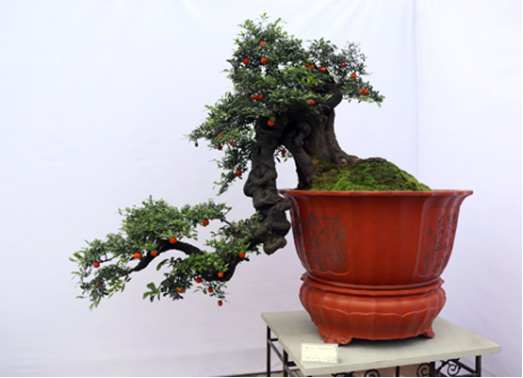
The Golden Bullet Tree, scientific name Diospyros armata, also known as Pinglan, thorn persimmon, and pinglan flower, is a semi-evergreen or evergreen shrub of the genus Diospyros in the family Ebenaceae. The stem of the Golden Bullet Tree is firm and upright, naturally gnarled and twisted, and iron in color, making it suitable for making tree-stump bonsai. The Golden Bullet Tree blooms with pale yellow flowers in April, the flower shape resembles a bottle, and the fragrance is like an orchid, hence it is also called "pinglan flower"; after flowering, it sets fruit in May, and after October the green fruit turns orange-red or orange-yellow, shaped like a pellet, hence it is called "Golden Bullet Tree"; the fruit remains on the tree until the following spring without falling; the leaf surface is dark green, leathery, and glossy: it is an ornamental flower beautiful in fruit, flower, and leaf. The tree-stump bonsai of the Golden Bullet Tree has very high economic value.
Cultivation Techniques for the Golden Bullet Tree
Propagation by Sowing
After the fifteenth day of the first lunar month, pick the ripe fruit, take out the seeds, wash them clean, and dry them. In early April, soak them in hot water at about 30°C for 48 hours, then take them out and place them in a container that can drain water, cover with two layers of gauze, and just like growing bean sprouts, pour clean water over the seeds once a day until the seeds open and sprout, then sow them on a prepared seedbed. After routine management, in three years the seedlings can be used to make small bonsai.
Cuttings from Female Plant Branches
Whether it is a new branch of the current year or an old branch, both can be rooted from cuttings. The key to successful rooting is paying attention to the season, namely mid-April each year. Second, the cutting bed environment must be kept humid and the cuttings fresh. If conditions permit, the cutting bed can be placed in a spot with full sun, misting the cutting bed during the day and stopping at night. If conditions do not permit, the cutting bed can be placed in a bright, ventilated, half-shade and half-sun location, and misting four times a day with a sprayer can ensure the survival of Golden Bullet Tree cuttings. Small bonsai made from cuttings can bear fruit after three years.
Digging Old Stumps from the Wild
From November of the current year to April of the following year is the time. Under the premise of protecting the natural ecological environment, professionals may dig in the mountains in a planned way. After bringing the old stump down the mountain, first soak it in clean water for two hours, then bury about 1/2 of the stump deeply in sandy soil, water thoroughly to settle the roots, and afterward as long as the environment is kept humid, the branches can grow to one meter in the same year. In March of the following year it can be dug up, potted, pruned, and shaped, and in three to four years it can become a basically formed tree-stump bonsai.
Routine Care and Management
For shaping the Golden Bullet Tree, metal wire can be used to set the form of the trunk and main branches. Afterwards, management should focus mainly on pruning, with wiring as a supplement. For potting, a mix of river sand, leaf mold, and loess in a 4:4:2 ratio can be used. After planting, water thoroughly once, place in a cool spot for half a month, and then normal management can begin. After new buds emerge, apply a decomposed liquid fertilizer once a month, with a fertilizer-to-water ratio of 1:10. Fertilize more in spring and autumn, less in summer, and not at all in winter. Watering should keep the potting soil on the moist side; in summer, water thoroughly every evening. In spring, autumn, and winter, water only when the potting soil is dry, and water thoroughly when you do.
Fruit-Bearing Cultivation
Because the Golden Bullet Tree is dioecious, during its flowering period you should try to have a male plant flowering near the female plant so as to allow natural pollination and increase the fruit set rate. If there is no male plant flowering near the female plant, hand pollination can be carried out. When the female flowers fall, the fruit is already attached to the flower base; at this time, spray 1:800 monopotassium phosphate twice at half-month intervals to increase the fruit set rate. In the ninth lunar month, similarly spray 1:600 urea water twice, which can make the fruit large and glossy. With cultivation and management by this method, from October of the current year to February of the following year, the Golden Bullet Tree has luxuriant branches and leaves and red fruit covering the branches, giving people a feeling of harvest, joy, and peace and beauty.
Precautions
Before spring budding, control water and keep the plant on the dry side, so as to prevent the leaves from growing too large and the branches and buds from elongating. During the water-control process, the Golden Bullet Tree, as a bonsai tree species, is cherished by bonsai enthusiasts everywhere, not just by local people. The Golden Bullet Tree is widely admired not only because of its small, oily-green, glossy leaves, fragrant flowers, good fruit, black bark, and trunk, but even more because it is easy to grow and highly tolerant, and especially because of its long lifespan, which allows it to be passed down through generations; it is also suitable for being brought indoors and taken outside, and for going north and south. Its strong tolerance and long lifespan are rare among other bonsai tree species. The roots, stems, and trunk of a raw stump can develop roots when they touch soil, and a small amount of fibrous roots can gradually support a huge stem. It is strongly shade-tolerant. It grows well on a balcony, and can be kept indoors for 1-2 [periods]; long-term moisture and flooding do not endanger its life.
There are several key times for pruning. First, before spring budding, before March; pruning at this time makes it easy for new buds to sprout on the branches. Second, in summer, cut off the branches that grew too long in spring to maintain a better proportion; after pruning, the ornamental period is long, and it can also make the autumn buds draw back and the branch form compact. Third, in early autumn, wait for the branches to thicken and then prune to foster spring buds; when pruning in autumn, be careful to retain the small fruit-bearing branches so as to favor fruiting in female plants. Grasping these three key times for pruning can make the tree form and branch pattern compact and perfect. For cold-region types of Golden Bullet Tree, which mainly produce spring buds each year, they must be cut back before mid-autumn so that new buds are more easily fostered to overwinter and spring buds grow vigorously.
The Golden Bullet Tree is dioecious, with diverse varieties and about half male and half female. Male plants do not bear fruit, but well-developed individuals can produce a few compound inflorescences, in which 1 female flower blooms among the male flowers, bears fruit, and can also produce autumn flowers and autumn fruit.
The Golden Bullet Tree has hard wood. After the bark of a vigorously growing trunk is damaged and the wood is exposed to sunlight and air, the surface layer can turn black, harden, carbonize, and not rot. This phenomenon is rarely seen in other tree species, and this property of the Golden Bullet Tree can be used in carving and shaping the trunk.
The Golden Bullet Tree tolerates poor soil. With sufficient fertilizer, the leaves are thick, dark green, and glossy; with too much fertilizer, the leaves curl and wrinkle, and the degree of wrinkling can indicate the fertilizer situation. The Golden Bullet Tree has strong drought tolerance and absorbs and transpires a lot of water. After losing water, the leaves become limp, and the leaf color darkens and loses luster. When severely short of water, the leaves droop downward. If this is observed and water is given promptly, the plant can recover its vitality. In severe cases the leaves fall off but new buds can still sprout; if the leaves do not fall off, that is a symptom of dehydration death.
Management Techniques for Golden Bullet Tree Bonsai
The Golden Bullet Tree likes a warm, humid environment with plenty of sunlight. It is somewhat tolerant of partial shade, not tolerant of drought, and has a certain degree of cold tolerance. Because the Golden Bullet Tree is dioecious, when planting, attention should be paid to matching female and male plants so that they can pollinate and set fruit. Although male plants cannot bear fruit, their roots are gnarled and varied in form, their leaves are dark green and glossy, and their flowers are elegantly colored and richly fragrant, so they are also often used to make bonsai.
During the growing season, place it outdoors in a sunny, well-ventilated spot for care. If light is insufficient, fruit set will be affected. Water frequently to keep the potting soil moist, but the potting soil should not be waterlogged for a long time. When temperatures are high or the air is dry, water should also be sprayed on the leaves to increase air humidity and favor plant growth. Apply a diluted decomposed liquid fertilizer once a month, and pay attention to a reasonable balance of nitrogen, phosphorus, and potassium in the fertilizer. From July to August each year, apply two additional organic liquid fertilizers mainly based on phosphorus and potassium fertilizer to promote fruit enlargement and vivid color.
The Golden Bullet Tree has strong sprouting ability. During the growing season, newly sprouted branches and buds on the roots and trunk can be removed at any time so as to avoid affecting the tree shape and consuming too many nutrients. In southern regions, overwinter outdoors in a wind-sheltered, sunny spot; in the north, overwinter in a cold room above 0°C, with watering appropriately controlled. In early March each year, remove all the fruit and prune and shape the plant, cutting off dead branches, diseased and pest-infested branches, thin and weak branches, overly dense branches, crossed and overlapping branches, and messy branches that affect the tree shape. Cut overly long branches short to maintain the beauty of the bonsai and favor the sprouting and growth of new buds. Repot once every 2 to 3 years, mostly in spring. When repotting, remove 1/2 of the old soil and cut off rotten roots and overly long old roots to promote the growth of new roots, then replant with new potting soil. The potting soil should be neutral or slightly acidic soil rich in humus, loose and fertile, with good drainage and air permeability, and some decomposed cake fertilizer, livestock and poultry manure, or crushed bones should be placed at the bottom of the pot.
[All content comes from the internet, edited and published by Bonsai Micro World]
▋Sharing is a virtue, and even more a joy ▋
Click below, the wonderful content continues
↓↓↓↓↓