How to Grow and Care for Jerusalem Cherry (Winter Cherry)
1. Pot and soil.
To grow Jerusalem cherry, choose a pot of appropriate size, and use loose, fertile, well-draining soil; in addition, you can add some humus fertilizer as a base fertilizer.
2. Light and temperature.
Jerusalem cherry likes a warm, sunny growing environment, and it grows best at temperatures between 18-25 degrees. When temperatures drop in winter, make sure the indoor environment does not fall below 5 degrees, so it can overwinter safely. Jerusalem cherry likes sunlight, so in winter place it where it can receive sunlight, and in summer when the light is intense, you can place it somewhere that avoids direct sun.
3. Watering and fertilizer.
Jerusalem cherry is not drought-tolerant, but it also fears waterlogging, so during cultivation pay attention to watering in moderation and keep the potting soil moist. Fertilize every half month, applying a thin liquid fertilizer once every half month. Before the flowering period, you can apply some phosphorus fertilizer to help produce abundant flowers and fruit. After flowering, control the amount of fertilizer to avoid burning the plant from too much and causing flowers and fruit to drop. When the fruit grows to the size of a mung bean, you can apply water-soluble fertilizer and some phosphorus and potassium fertilizer again, which can make the fruit bright and vivid.
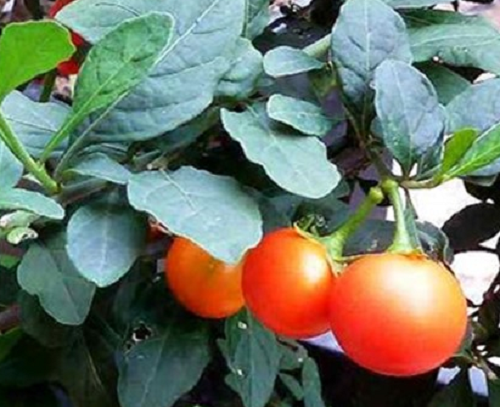
How to Grow and Care for Jerusalem Cherry
Chinese scientific name: Jerusalem cherryLatin scientific name: Solanum pseudocapsicum L. var. diflorum (Vell.) BitterOther names: Coral Cherry, Lucky FruitKingdom: PlantaePhylum: AngiospermsClass: DicotyledoneaeSubclass: SympetalaeOrder: TubifloraeFamily: SolanaceaeTribe: SolaneaeGenus: SolanumDistribution: Native to Europe and the subtropics; wild plants occur in Yunnan, ChinaJerusalem cherry, now named Coral Bean (Solanum pseudocapsicum L. var. diflorum (Vell.) Bitter). An erect small shrub, much branched and clump-forming, grown as a 1-2 year plant. Plant height 30-60 cm. Leaves alternate, narrowly oblong to oblanceolate. Flowers in summer and autumn, small, white, axillary. Berry deep orange-red, spherical, diameter 1-1.5 cm. It sets fruit after flowering, and the fruit does not fall for a long time, remaining on the branches until after the Spring Festival. Today there are also dwarf cultivars with a short, much-branched form. Berry with small seeds, fruit shape broadly elliptical, pointed at the tip. Other names include: Coral Cherry, Lucky Fruit, Coral Berry, Coral Bean, Jade Coral, Red Coral, Wild Chili, Wild Sea Pepper, False Cherry, Four-Season Fruit.1. Morphological characteristics
Coral Bean (Beijing); Jade Coral (Japan); Thorn Pomegranate (Mianxian, Shaanxi); Foreign Sea Pepper (Leibo, Sichuan); Jerusalem Cherry (Anjiang, Hunan). (Variety)An erect, branched small shrub, 0.3-1.5 m tall; young branchlets covered with dendritically branched stellate hairs, later gradually falling off. Leaves paired, unequal in size, elliptic-lanceolate, 2-5 cm long or slightly longer, 1-1.5 cm wide or slightly wider, apex obtuse or short-pointed, base cuneate and decurrent into a short petiole, leaf surface hairless, lower leaf surface along the veins often with dendritically branched stellate hairs, margin entire or slightly wavy, midvein prominent below, lateral veins 4-7 per side, conspicuous below; petiole about 2-5 mm long, covered with dendritically branched stellate hairs when young, later gradually falling off. Inflorescence short, axillary, usually 1-3-flowered, solitary or in a scorpioid cyme, peduncle short and almost absent, pedicel about 5 mm long, flowers small, about 8-10 mm in diameter; calyx green, deeply 5-parted, lobes ovate-lanceolate, apex obtuse, about 5 mm long; corolla white, tube hidden within the calyx, about 1.5 mm long, limb about 6.5-8.5 mm long, deeply 5-parted, lobes ovate, about 4-6 mm long, about 4 mm wide, apex pointed or obtuse; filaments about 1 mm long, anthers oblong, about twice the length of the filaments, apical pores slightly inward; ovary nearly round, about 1.5 mm in diameter, style about 4-6 mm long, stigma truncate. Berry solitary, spherical, coral red or orange-yellow, 1-2 cm in diameter; seeds flat, about 3 mm in diameter. Flowering April-July, fruit ripening August-December.
2. Related species
Coral Cherry (original variety)var. pseudo-capsicum
An erect, branched small shrub, up to 2 m tall, the whole plant smooth and hairless. Leaves alternate, narrowly oblong to lanceolate, 1-6 cm long, 0.5-1.5 cm wide, apex pointed or obtuse, base narrowly cuneate and decurrent into the petiole, margin entire or wavy, both surfaces smooth and hairless, midvein prominent below, lateral veins 6-7 pairs, more conspicuous below; petiole about 2-5 mm long, not clearly distinct from the leaf blade. Flowers mostly solitary, rarely in a scorpioid cyme, without a peduncle or nearly so, arising outside the axils or nearly opposite the leaves, pedicel about 3-4 mm long; flowers small, white, about 0.8-1 cm in diameter; calyx green, about 4 mm in diameter, 5-parted, lobes about 1.5 mm long; corolla tube hidden within the calyx, less than 1 mm long, limb about 5 mm long, lobes 5, ovate, about 3.5 mm long, about 2 mm wide; filaments less than 1 mm long, anthers yellow, oblong, about 2 mm long; ovary nearly round, about 1 mm in diameter, style short, about 2 mm long, stigma truncate. Berry orange-red, 1-1.5 cm in diameter, calyx persistent, fruit stalk about 1 cm long, enlarged at the tip. Seeds disk-shaped, flat, about 2-3 mm in diameter. Flowering in early summer, fruiting in late autumn.
3. Growth habits
Especially common at field edges, roadsides, in thickets or by ditches, commonly seen in areas at 1350-2800 m elevation, and also distributed in areas at 600 m.Jerusalem cherry likes sunlight, warmth and tolerates high temperatures, with no sunscald above 35°C. It is not shade-tolerant, nor cold-tolerant, nor drought-tolerant, and in the hot summer it fears rain and waterlogging. It is not demanding about soil, but grows vigorously in fertile, loose, well-draining slightly acidic or neutral soil. It has strong sprouting ability. It is not cold-tolerant; in the north, potted ornamental plants need to be moved into a greenhouse to overwinter.
Growing Jerusalem Cherry
Jerusalem cherry, now named Coral Bean (Solanum pseudocapsicum L. var. diflorum (Vell.) Bitter). An erect small shrub, much branched and clump-forming, grown as a 1-2 year plant. Plant height 30-60 cm. Leaves alternate, narrowly oblong to oblanceolate. Flowers in summer and autumn, small, white, axillary. Berry deep orange-red, spherical, diameter 1-1.5 cm. It sets fruit after flowering, and the fruit does not fall for a long time, remaining on the branches until after the Spring Festival. Today there are also dwarf cultivars with a short, much-branched form. Berry with small seeds, fruit shape broadly elliptical, pointed at the tip. Jerusalem cherry is generally grown from seed. In winter and spring, collect ripe red berries, wash them clean in water, remove the seeds and dry them in the sun for sowing. From March to April, sowing in pots can be done; seedlings emerge one week to 10 days after sowing, with a germination rate above 95%, and they emerge quickly and evenly. Jerusalem cherry is easy to grow; when seedlings are 6 cm tall they can be transplanted into pots, choosing loose, fertile and well-draining soil; both acidic and alkaline soils are suitable, the survival rate is extremely high, and with frequent fertilizer and water the branches and leaves become lush. During the growing period there are few pests and diseases. In summer, place it in a spot with ample sunlight for cultivation; no shading is needed.When the autumn flowers bloom in September, pause topdressing, control watering, and spray once or twice with 0.2% potassium dihydrogen phosphate, which can reduce flower drop, increase the fruit-setting rate and promote fruit enlargement. With proper management, usually the old fruit has not yet fallen while new fruit is already forming, so it can be enjoyed for the whole year and over the long term. Because Jerusalem cherry is an evergreen small shrub that grows erect and has an independent trunk, with strong branching ability, spreading lateral branches and emerald-green leaves, repeated pinching and pruning during the growing period, along with simple wiring techniques, or adjusting the planting direction, can easily produce an ideal plant shape.