A Complete Guide to Making Winter Jasmine Bonsai
Choosing the Pot
Material and color:
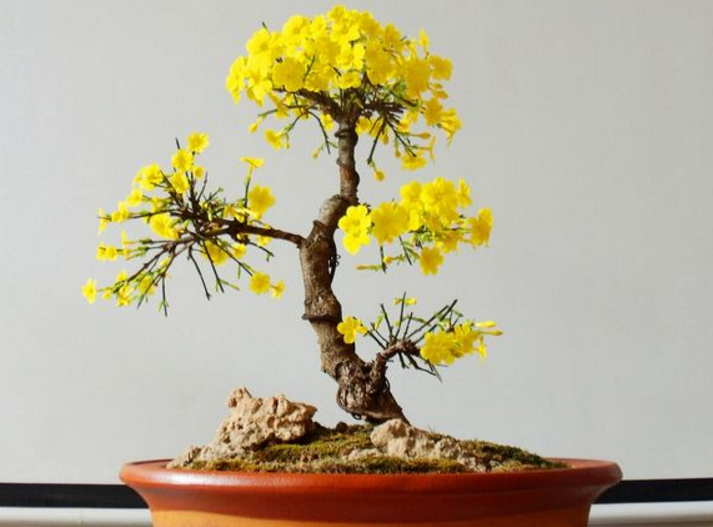
For winter jasmine bonsai, a purple clay ceramic pot or glazed ceramic pot in a medium-to-deep color is usually chosen. To set off the flower color of winter jasmine, a darker-colored pot is usually selected, such as dark blue, brown, or purplish red.
Shape:
The shape of the pot is determined by the styling of the winter jasmine; generally a round or square pot is chosen. If it is a cascade style, a deep cylindrical pot can be used to highlight the beauty of the roots.
Bonsai Styling
Winter jasmine has slender branches that arch and droop, making them easy to wire and bend, and it produces many root suckers and has a well-developed root system. It can be made into exposed-root style, weeping-branch style, curved-trunk style, fan style, or forest style bonsai. Because winter jasmine has strong sprouting ability, sends out new shoots several times a year, and has soft branches, the styling is carried out by combining wiring and pruning. The trunk and thick branches are wired and bent with metal wire or palm rope and similar materials, while the side branches and thin branches are controlled by pruning. Pruning is mainly done after flowering: cut away useless and weak twigs, and cut back the retained branches to either longer or shorter lengths, achieving the effect of "one branch shows twists and turns, two branches differ in length, three branches gather and scatter." During the growing season, pay attention to pinching and cutting back to control growth and promote branching, with focus on cultivating autumn shoots for flower display.
Repotting Tips
Winter jasmine is repotted once every 2 years, in spring or autumn. When repotting, combine it with root pruning: trim away dead roots or overly long roots to promote the development of fibrous roots. When repotting, you can also place cake fertilizer at the bottom of the pot as a base fertilizer.
Some winter jasmine plants need their roots raised. When planting, lift the plant appropriately, mound soil around the roots, and water gradually; the roots will become exposed.
The above is an introduction to how to make winter jasmine bonsai. If you like it, flower lovers can try it at home yourselves! For more wonderful content, please follow the Four Seasons Plants website!
What color is winter jasmine, and what are the methods for making winter jasmine bonsai?
Winter jasmine has small, slender branches, with trifoliate compound leaves arranged oppositely. Its flowers are solitary on the previous year's branches. The leaves open first, and the flowers have a delicate fragrance and a golden-yellow color with a red tinge on the outside. Its flowering period is from February to April. It is named because it is the earliest among the hundred flowers to bloom, and only after it blooms does the spring arrive when all flowers bloom together.
[Growth Habits]
Winter jasmine likes sunlight and can also tolerate slight shade. It fears waterlogging, and in North China it can overwinter outdoors, but it requires a warm and humid climate, and loose, fertile, well-drained sandy soil is the best choice. In acidic soil it grows more vigorously, while in alkaline soil it grows poorly. Its roots have strong sprouting ability, and the parts of the branches that touch the ground easily take root.
[Color]
There are many plants in the same genus as winter jasmine.
Red jasmine: Also called red-flowered jasmine, it is a climbing shrub. Its corolla is red or rose-red and fragrant.
Jasminum officinale: It is a white-flowered plant.
Jasminum nudiflorum: Its flowers are yellow, forming terminal many-flowered cymes.
Yunnan yellow jasmine: Its flowers are solitary and pale yellow, with dark spots.
Jasminum officinale var. grandiflorum: The cyme is terminal, with several flowers, all white and fragrant.
[Potted Plant Making]
1. Winter jasmine is generally best grown in a medium-to-deep purple clay ceramic pot or similar, with no strict requirement for shape. For cascade style, a deep cylindrical pot can be used, and sometimes, to highlight the beauty of its roots, a shallow pot can also be used.
2. Winter jasmine likes sunlight, is also drought-tolerant and cold-tolerant, and is not strict about soil requirements. Generally, well-drained neutral sandy loam is best. It can also adapt well to slightly acidic soil or lightly saline-alkaline soil. It is not tolerant of waterlogging. For potted winter jasmine, leaf mold mixed with loam can also be used. Of course, we can also use fully weathered vegetable garden soil; soil rich in nutrients and loose and soft in texture is very suitable for the growth and development of winter jasmine.
3. Because the roots of winter jasmine are very distinctive, when pruning and shaping it we should first consider how to highlight the posture of its roots. Of course, during its dormant period we can also remove the soil around its roots, tidy them and wire them appropriately to make them form coiled shapes, just like the old gnarled roots of ancient trees, and then pot and plant it. Its main branches and trunk are suitable for bending, not for being straight; generally it is enough to rough-bind them with palm fiber.
4. Because winter jasmine's branches naturally droop and its roots are distinctive, it is very suitable for processing into weeping-branch style and exposed-root style, and the two are often combined, with coiled roots exposed and the trunk made into a lying-trunk style or curved-trunk style, while the small branches droop and sweep, giving it a unique charm. Winter jasmine is generally repotted once every two years, preferably in spring or after leaf drop in autumn. When repotting, you can combine it with root pruning, cutting away dead roots and overly long roots to facilitate the development of fibrous roots. You can also place soybean cake crumbs at the bottom of the pot as a base fertilizer. For winter jasmine that needs exposed roots, when planting you can lift the roots appropriately and mound soil around them; later, as watering leaches the soil away, the roots will naturally become exposed.
Winter Jasmine Bonsai Making and Prices, and How to Grow Winter Jasmine Bonsai
Winter jasmine is one of the "Four Friends in the Snow," ranking alongside plum blossom, narcissus, and camellia. As living environments change, more and more people like to grow flowers, and bonsai and potted plants have become the first choice. Next, enjoy some winter jasmine bonsai pictures and learn about winter jasmine bonsai making and growing methods.
I. How to Make Winter Jasmine Bonsai
1. Pot Selection
For winter jasmine bonsai, it is generally appropriate to use a purple clay ceramic pot or glazed ceramic pot in a medium-to-deep color. The pot shape is determined according to the styling of the winter jasmine bonsai. For cascade-style winter jasmine bonsai, a deep cylindrical pot can be used; sometimes, to highlight the beauty of the roots, a shallow pot is also used. The pot color is best chosen to set off the beauty of the winter jasmine's small yellow flowers, such as dark blue, light blue, black, or purplish red.
2. Bonsai Styling
Because winter jasmine's branches naturally droop and its roots are distinctive, it is very suitable for processing into weeping-branch style and exposed-root style, and the two are often combined, with coiled roots exposed and the trunk made into a lying-trunk style or curved-trunk style, while the small branches droop and sweep, giving it a unique charm.
3. Pruning Methods
After digging up winter jasmine, cut off the branches, because if there are too many branches and the roots are damaged, it will die; if the branches are too short, the buds are not easy to send out. Plant it with one third of the roots exposed. After planting, place it in a shady place and do not expose it to strong sun. Be careful not to water too much. Wait until it survives, then look at the shape of the winter jasmine and prune it appropriately. It is necessary to control the growth of winter jasmine branches; if they are too long, they will affect the handling of the overall shape.
4. Repotting Tips
Winter jasmine is generally repotted once every two years, preferably in spring or after leaf drop in autumn. When repotting, you can combine it with root pruning, cutting away dead roots and overly long roots to facilitate the development of fibrous roots. You can also place soybean cake crumbs at the bottom of the pot as a base fertilizer. For winter jasmine that needs exposed roots, when planting you can lift the roots appropriately and mound soil around them; later, as watering leaches the soil away, the roots will naturally become exposed.
II. Winter Jasmine Bonsai Prices
The price of winter jasmine is made up of many factors: first, the styling; second, the age of the pot; and importantly, the size! Nowadays, growers of winter jasmine all like single-trunk winter jasmine; those with thick lower parts, thin upper parts, and no legginess will certainly be priced very high. The degree of curvature is also very important! As the saying goes: flowers have no fixed price! Everyone has their own eye! Nowadays the price of winter jasmine has risen very sharply; one thousand yuan or several thousand yuan can no longer buy good winter jasmine! Good winter jasmine has all been collected by individuals, and wild ones have been dug up so much that few remain. Furthermore, winter jasmine has irreplaceable room and potential for appreciation in value!
III. How to Grow Winter Jasmine Bonsai
1. Temperature: For newly planted or newly repotted winter jasmine bonsai, first water thoroughly, place in a shaded place for about 10 days, then move to a half-shade, half-sun place; after caring for it for one week, place it in a sunny, well-ventilated, relatively humid place for care. In winter, in the south it is enough to bury the pot containing the winter jasmine in soil in a wind-sheltered, sunny place for safe overwintering; in the north, it should be moved into a low-temperature (around 5°C) indoor place in early winter to overwinter. If you want winter jasmine to bloom early, you can move it in due course into a medium-temperature or high-temperature sunny indoor place. For example, if placed indoors in a sunny spot at around 13°C, spraying clear water on the branches, trunk, and leaves 1-2 times daily, it can bloom in about 20 days; if placed indoors in a sunny spot at around 20°C, it can bloom in about 10 days. After flowering, keep the room temperature at around 8°C, and be careful not to let wind blow directly on it, which can prolong the flowering period. After the flowers open, the higher the room temperature, the faster the flowers fade.
2. Watering: Winter jasmine likes humidity, especially in the hot summer. In addition to watering once every morning, it should also be watered appropriately in the afternoon. To maintain the humidity of the microclimate, water should often be sprayed on the ground. Winter jasmine fears water accumulating in the pot; during the plum rain season, when rain continues for days, the pot should be laid on its side or moved to a place where it will not be rained on. In winter, when temperatures are low and water evaporation is little, it should be watered less.
3. Fertilizing: When planting winter jasmine, place a few pieces of animal hoof at the bottom of the pot as a base fertilizer. During the growing period of winter jasmine, apply decomposed dilute liquid fertilizer 1-2 times a month. July-August is the flower bud differentiation period of winter jasmine, so liquid fertilizer containing more phosphorus should be applied to facilitate flower bud formation. If, before the flowering period, one application of decomposed dilute organic liquid fertilizer is given, it can make the flower color more brilliant and prolong the flowering period.
4. Pruning: Winter jasmine has strong sprouting ability. During the growing period, it is necessary to pinch frequently, and cut away or shorten certain branches, in order to maintain the tree shape. After the flowers fade, the branches should be cut short, generally leaving only 2-3 buds; the main branches can appropriately retain a few more buds. After new branches emerge, if cared for properly, flower buds will cluster.
5. Pest and Disease Prevention: Winter jasmine has very few pests and diseases. Occasionally red spider mites occur, and they should be removed in time.
The above iswinter jasmine bonsairelated knowledge. Winter jasmine is an excellent ornamental flower for cold winter and early spring, and winter jasmine bonsai can be pruned and shaped at will.