What are the precautions for growing Calliandra haematocephala (powder puff tree)?
Pruning
The calliandra plant grows very tall and large, so pruning should begin when the young tree reaches 2 m in height. The main branches of the calliandra can be cut back to encourage new shoots and make the crown fuller. Normally, pay attention to pruning the plant shape, removing surplus side branches and unnecessary new buds, and also cut off dead and diseased branches that affect the healthy growth of the calliandra.
Pests and diseases
The main disease calliandra encounters during its growth period is canker. When calliandra develops canker, it can be treated with a 50% Tuzet 800-fold solution. Longhorn beetles and psyllids prefer to parasitize calliandra trees; specialized insecticides can be used to kill the pests, and gardeners who prefer eco-friendly methods can also remove the pests by hand.
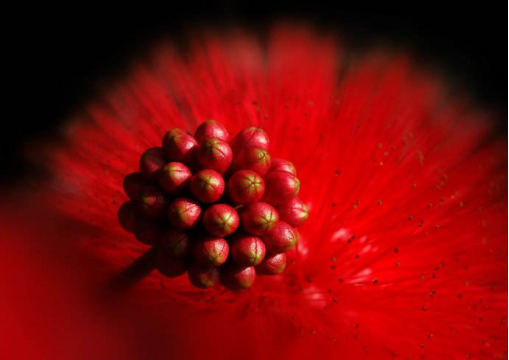
Overall, caring for calliandra is not complicated. Gardeners whose growing conditions are suitable should hurry and add a calliandra to their yard!
Calliandra growing methods and precautions
Deciduous shrub or small tree, 1-3 m tall; branches spreading, branchlets cylindrical, brown, rough. Stipules ovate-lanceolate, persistent. Bipinnate compound leaves, total petiole 1-2.5 cm long; pinnae 1 pair, 8-13 cm long; leaflets 7-9 pairs, oblique-lanceolate, 2-4 cm long, 7-15 mm wide, the middle and upper leaflets larger, the lower ones smaller, apex obtuse with a small mucro, base oblique, margins sparsely pubescent; midvein slightly toward the upper margin; petiolules only 1 mm long.Capitulum axillary, about 3 cm in diameter (including filaments), with about 25-40 flowers, peduncle 1-3.5 cm long; calyx campanulate, about 2 mm long, green; corolla tube 3.5-5 mm long, pale purplish red, apex with 5 lobes, lobes reflexed, about 3 mm long, glabrous; stamens exserted beyond the corolla, very conspicuous, staminal tube about 6 mm long, white, with a subulate appendage inside the tube mouth, the free filaments in the upper part about 2 cm long, deep red. Legume linear-oblanceolate, 6-11 cm long, 5-13 mm wide, dark brown, dehiscing from apex to base along the suture at maturity, valves reflexed; seeds 5-6, oblong, 7-10 mm long, about 4 mm wide, brown. Flowering period August-September; fruiting period October-November.
Calliandra haematocephala calliandra profile: how to grow calliandra / how to propagate calliandra
Calliandra profileCalliandra haematocephala
Also known as: red acacia, American acacia, red powder puff
Category: herbaceous flowering plant
Family and genus: Plantae, Angiosperms, Dicotyledoneae, Rosales, Fabaceae, Calliandra
Full bloom period: autumn
Calliandra (scientific name: Calliandra haematocephala), a deciduous shrub or small tree of the Fabaceae family, genus Calliandra; branches spreading, branchlets brown, rough. Stipules ovate-lanceolate, persistent. Capitulum axillary, with about 25-40 flowers, peduncle 1-3.5 cm long; calyx green; corolla pale purplish red, apex lobes glabrous; stamens exserted beyond the corolla, stamens white, with a subulate appendage inside the tube mouth, the free filaments in the upper part deep red. Legume linear-oblanceolate, dark brown, dehiscing from apex to base along the suture at maturity, valves reflexed; seeds oblong, brown. Flower...
Calliandra growing methods and precautions: an introduction to calliandra
Calliandra (scientific name: Calliandra haematocephala), a deciduous shrub or small tree of the Fabaceae family, genus Calliandra; branches spreading, branchlets brown, rough. Stipules ovate-lanceolate, persistent. Capitulum axillary, with about 25-40 flowers, peduncle 1-3.5 cm long; calyx green; corolla pale purplish red, apex lobes glabrous; stamens exserted beyond the corolla, stamens white, with a subulate appendage inside the tube mouth, the free filaments in the upper part deep red. Legume linear-oblanceolate, dark brown, dehiscing from apex to base along the suture at maturity, valves reflexed; seeds oblong, brown. Flowering period August-September; fruiting period October-November.
It has been introduced in Taiwan, China, Fujian and Guangdong, and is cultivated for ornament. Native to South America, it is now often cultivated in tropical and subtropical regions. The flowers are extremely beautiful.
Morphological characteristics and appearance of calliandra
Calliandra is a deciduous shrub or small tree, 1-3 m tall; branches spreading, branchlets cylindrical, brown, rough.
Leaves
Calliandra stipules ovate-lanceolate, persistent. Bipinnate compound leaves, total petiole 1-2.5 cm long; pinnae 1 pair, 8-13 cm long; leaflets 7-9 pairs, oblique-lanceolate, 2-4 cm long, 7-15 mm wide, the middle and upper leaflets larger, the lower ones smaller, apex obtuse with a small mucro, base oblique, margins sparsely pubescent; midvein slightly toward the upper margin; petiolules only 1 mm long.
Flowers
Calliandra capitulum axillary, about 3 cm in diameter (including filaments), with about 25-40 flowers, peduncle 1-3.5 cm long; calyx campanulate, about 2 mm long, green; corolla tube 3.5-5 mm long, pale purplish red, apex with 5 lobes, lobes reflexed, about 3 mm long, glabrous; stamens exserted beyond the corolla, very conspicuous, staminal tube about 6 mm long, white, with a subulate appendage inside the tube mouth, the free filaments in the upper part about 2 cm long, deep red.
Calliandra flowering period is August-September.
Fruit
Calliandra legume linear-oblanceolate, 6-11 cm long, 5-13 mm wide, dark brown, dehiscing from apex to base along the suture at maturity, valves reflexed; seeds 5-6, oblong, 7-10 mm long, about 4 mm wide, brown.
Calliandra fruiting period is October-November.
Ecological habits of calliandra
Calliandra is a tropical flowering plant; it prefers warm, humid and sunny environments, is not cold-tolerant, and requires deep soil with good drainage.
Calliandra likes light and a warm, humid climate, and is suited to deep, fertile, well-drained acidic soil.
Cultivation techniques for calliandra
Young plants need more water, so watering should be attended to during the growing period. Potted plants are more prone to drought and water shortage, with leaves appearing wilted, so attention should be paid to replenishing water. For fertilizing, natural organic fertilizer or compound fertilizer can be used, applied once a month, with more phosphorus and potassium fertilizer during the flowering period. The cultivation site needs sufficient sunlight; flowering is poor in shaded places.
When the trunk of a young tree reaches more than 2 m in height, trunk-establishing pruning can be carried out. Select 3 side branches staggered up and down as the main branches, and use them to expand the crown. In winter, cut back the 3 main branches, and cultivate several side branches on each main branch, distributed in a mutually staggered way, each occupying a certain space. When the crown extends too far and the lower part becomes bare, promptly cut back and renew the head, and remove dead branches.
Cuttage propagation
Calliandra is generally propagated by cuttage. In spring, healthy branches 20 cm long can be cut for cuttings, and the cutting bed temperature must be kept at 15-28°C. For cuttings, it is best to cut non-lignified, well-developed 1-2 year old branches, each segment about 15-500px, inserted into a moist sand bed; either shading or full-light misting is suitable.
Seed propagation
Collect seeds in October, store the seeds dry until sowing the following spring. Before sowing, soak the seeds in 60°C hot water, changing the water once a day; on the third day, take them out and keep them moist to promote germination for 1 week. They sprout 5-7 days after sowing. During the seedling period, prune side branches in time to ensure the trunk grows straight. Transplanting is best done before the buds swell, but when transplanting large trees, supports should be set up to prevent them from being blown over by wind. In winter, open a ditch around the trunk and fertilize once.
Disease control of calliandra: disease control
The main disease is canker.
Control method
It can be sprayed with a 50% Tuzet 800-fold solution.
Pest control
The pests include longhorn beetles and psyllids.
Control method
Use 1 kg of kerosene plus 50 g of 80% dichlorvos EC to kill longhorn beetles; for psyllids, spray with a 1500-fold solution of 40% dimethoate EC.
Distribution area of calliandra
Calliandra has been introduced in Taiwan, China, Fujian and Guangdong, and is cultivated for ornament.
Calliandra is native to South America and is now often cultivated in tropical and subtropical regions.
Landscape uses of calliandra
The flowers are beautiful and slightly fragrant, with a long flowering period and fast growth; it is a good ornamental and nectar-source plant, widely cultivated in tropical and subtropical regions. The wood is hard and can be used for farm tools; the bark contains tannin; the root bark decocted in water can be taken to treat indigestion; the flower buds, young leaves and young fruits are edible.
Uses: The flowers are beautiful, shaped like powder puffs, with a delicate fragrance that assails the senses; the leaves are unusual, closing at sunset and opening at sunrise, giving people a symbol of friendliness. The flowers and leaves are elegant and unusual, and the green shade is like an umbrella; planting it in front of a hall for ornament. As a shade tree, street tree, or planted beside garden ponds, etc., it is excellent.
Calliandra has brilliant flower colors and is an excellent flowering tree species, suitable for planting in garden green spaces. Calliandra has bright green leaves and bright red flowers shaped like powder puffs, very lovely; it is a flowering shrub with relatively high ornamental value, and there are many horticultural flowering varieties. It can be used for potted cultivation and park greening arrangements, and grows well in greenhouses in the Shanghai area. The tree form is graceful, the leaf shape elegant; in midsummer the tree is full of powder-puff flowers, with color and fragrance, able to create a soft and relaxed atmosphere; it is suitable as a courtyard shade tree, street tree, and for planting at forest edges, in front of houses, on lawns, on slopes, etc. It is an excellent ornamental tree for street trees, courtyard shade trees, greening around the four sides, and garden embellishment. The silk tree has an open crown, and in summer the green shade is serene; the bipinnate compound leaves open by day and close at night, very unusual; in summer the pink powder-puff flowers display their beauty, very lovely, suitable for scattered planting beside ponds, watersides, riverbanks and streams.
Flower language of calliandra
The flower language and symbolic meaning of calliandra: unrestrained, bold, festive.
Calliandra pictures