How to grow jacaranda? Detailed guide to cultivation methods and precautions
1. Temperature and light
The jacaranda is native to tropical America and prefers a warm, humid environment with plenty of light; it is not tolerant of cold, frost or snow. It grows best at temperatures between 22 and 30 degrees Celsius. If the temperature drops below 15 degrees, the jacaranda will stop growing or may even be damaged by the cold. If summer temperatures exceed 30 degrees, this will also affect the growth of the jacaranda, and at the same time, appropriate shading is needed during high summer temperatures.
2. Soil and fertilizer
The jacaranda prefers fertile, moist sandy soil. When planting, apply plenty of base fertilizer in the planting hole. After the tree is established, it only needs one application of fertilizer each in spring and autumn. Then in early spring, one pruning is needed, and aged branches can be pruned away. During the growth process, pay attention to moderate watering and the application of nitrogen fertilizer.
3. Pest and disease control
The jacaranda does not suffer from many pests and diseases; the main pest is the longhorn beetle. If you find traces of longhorn beetles on the trunk of the jacaranda, you can use a small knife to pry open the bark and remove the longhorn beetle larvae. You can also, before longhorn beetle infestation occurs, apply a liquid made by mixing quicklime, one part sulfur iodine and salt onto the trunk below 80 cm from the ground, which can prevent longhorn beetles from laying eggs and prevent pest damage in advance.
Introduction to morning glory / Care knowledge for morning glory
Introduction to morning glory / Care knowledge for morning glory Morning glory pictures
Introduction to morning glory
Morning glory (scientific name: Ipomoea nil) belongs to the Convolvulaceae family. In some regions it is called trumpet flower, while Japanese people call it asagao. It is native to tropical America.
Morning glory has been part of the ranks of traditional famous flowers for more than a thousand years. It is not only recorded in flower manuals, flower records and famous works, but has also been praised in many poems and writings throughout the dynasties. Morning glory is also known as morning glory, qianniu, and asagao flower. It is an annual twining herbaceous flowering plant of the genus Ipomoea in the Convolvulaceae family. The trailing stem is slender, about 3-4 m long, and the whole plant is densely covered with short bristles. The leaves are alternate, entire or lobed. The cyme is axillary, with 1 to several flowers. The corolla is trumpet-shaped. The flower colors are bright and beautiful. The capsule is spherical, and after maturity it splits open at the back of the locule; the seeds are large, black or yellowish-white, and have a very long lifespan. The flowering period is from June to October, and most flowers open in the morning and fade by noon.
There are two explanations for the origin of the name morning glory: one is based on the record in Tang Shenwei's "Classified Materia Medica", that a farmer was cured of a chronic illness by taking morning glory seeds, and out of gratitude he led his own water buffalo to the place in the field where the morning glory vines grew to give thanks; the other explanation is that the flowers of morning glory have a star-shaped pattern inside, and its flowering period coincides with the date when the stars Altair and Vega meet, hence the name.
Morphological characteristics of morning glory
Stem
Morning glory is an annual twining herb, and the stem is covered with reversed short soft hairs and mixed with reversed or spreading long stiff hairs.
Leaves
The leaves of morning glory are broadly ovate or nearly circular, deeply or shallowly 3-lobed, occasionally 5-lobed, 4-15 cm long and 4.5-14 cm wide, with a rounded, heart-shaped base; the middle lobe is oblong or ovate, acuminate or abruptly acuminate; the lateral lobes are shorter, triangular, with sharp or rounded sinuses; the leaf surface is sparsely or densely covered with slightly stiff soft hairs; the petiole is 2-15 cm long, with the same indumentum as the stem.
Flowers
The flowers of morning glory are axillary, solitary or usually 2 borne at the tip of the peduncle; the peduncle varies in length, 1.5-18.5 cm long, usually shorter than the petiole, sometimes longer, with the same indumentum as the stem; the bracts are linear or leaf-like, covered with spreading slightly stiff hairs; the pedicel is 2-7 mm long; the bracteoles are linear; the sepals are nearly equal in length, 2-2.5 cm long, lanceolate-linear, the inner 2 slightly narrower, the outer surface covered with spreading bristles, denser at the base, sometimes also mixed with short soft hairs; the corolla is funnel-shaped, 5-8 (-10) cm long, blue-purple or purple-red, with the corolla tube lighter in color; the stamens and style are included; the stamens are unequal in length; the filaments are covered with soft hairs at the base; the ovary is hairless, and the stigma is capitate.
The flowering period of morning glory is June to October.
Fruit
The capsule of morning glory is nearly spherical, 0.8-1.3 cm in diameter, and splits into 3 valves. The seeds are ovate-trigonous, about 6 mm long, black-brown or cream-yellow, covered with brown short downy hairs.
Morning glory is robust by nature, likes a mild climate, sufficient light, and moderate ventilation. It has strong adaptability to soil, is relatively tolerant of drought and saline-alkaline conditions, and is not afraid of high temperatures and intense summer heat. It is a deep-rooted plant, and when planted in the ground the soil should be deep.
It is an annual or perennial twining herbaceous plant, also called a vine plant, and the whole plant has short hairs. Therefore, planting morning glory is generally done by sowing in spring, and it blooms in summer and autumn. There are many varieties, and the flower colors include blue, crimson, peach red, purple, etc., as well as bicolor varieties. The petal edges vary greatly, and it is a common ornamental plant. The fruit is ovate-spherical and can be used as medicine.
Morning glory leaves are usually three-lobed with a heart-shaped base. The flowers are white, purple-red or purple-blue, funnel-shaped, with 5 stamens of unequal length, the filaments covered with soft hairs at the base, 5 sepals, 1 pistil, a 3-locular ovary, and a capitate stigma. The flowering period is most abundant in summer. The seeds have medicinal value.
Close relatives of morning glory include Ipomoea tricolor, Ipomoea purpurea and Ipomoea indica.
Ecological habits of morning glory
Morning glory grows on mountain slopes in shrubland, along dry river valley roadsides, beside gardens and homes, and along mountain roads at altitudes of 100-200 (-1600) m, or is cultivated.
Cultivation techniques for morning glory
Optimum germination temperature
20~25℃
Sowing period
Spring, summer;
Optimum growth temperature
22~34℃
Flowering period
Summer, autumn
For seedling raising, first soak the seeds in warm water for 4-6 hours or treat them with sulfuric acid. After sowing, cover with about 1 cm of soil, keep the soil warm and moist, and they will germinate after 5-6 days. When two true leaves appear, they can be transplanted, with a plant spacing of 30 cm.
Choose a well-drained potting soil and provide sufficient sunlight and a well-ventilated environment. During the growing period, water when the surface of the potting soil is slightly dry, and apply diluted liquid fertilizer once every half month. Nitrogen fertilizer should not be too much, so as to avoid overly luxuriant stems and leaves. Potted plants need supports to hold them up.
Morning glory is not only a good material for vertical greening of fences and trellises, but is also suitable for potted ornamental display on courtyards and balconies. For potting, early April is suitable. Use half ordinary potting soil and half plain sandy soil, and put it into a No. 2 tube pot (inner diameter 13 cm), sowing 4-5 seeds per pot. Because the seed coat is relatively thick and germination is slow, you can make a small cut in the seed coat above the hilum with a small knife. After sowing, keep at 25 degrees Celsius, and germination will occur in about 7 days. When the two cotyledons are observed to be flat and extended, divide and transplant the seedlings; you can remove the whole clump from the pot and separate the seedlings with soil. When growing as a potted plant, remove 1 cm from the lower end of the main root, and plant it in a No. 2 tube pot with ordinary potting soil, one plant per pot. Note that when transplanting morning glory in the open ground, the main root must never be injured; transplant seedlings when small and early, and the larger the soil ball the better.
When the seedlings grow 6-7 leaves and are about to send out vines, take out the whole clump and repot it into a blank pot (inner diameter 24 cm) for final planting. The potting soil should be fertilized potting soil, and 50 g of hoof pieces should be applied as base fertilizer. After planting, water thoroughly. Wait until the potting soil settles, then insert a thin bamboo pole 1 m long straight into the center of the pot. Then use about 3 m of galvanized wire, tie one end around the bamboo pole level with the soil surface, and then coil it upward from the pot mouth to form an evenly shaped tower-like spiral frame that is wide at the bottom and narrow at the top. Fix the upper end of the wire to the top of the bamboo pole. Morning glory is a left-twining plant, so the coiling direction of the galvanized wire must match the habit of morning glory twining to the left. When the main vine climbs along the wire to the top of the pole, pinch off the growing tip. When each lateral vine grows to 6-7 leaves, pinch off the tip. In this way the flowers can be large and the vines will keep producing and flowering.
Planting methods
To scientifically grow morning glory, it must be potted. This makes scientific management convenient, facilitates exhibition and evaluation, and also helps ensure seed collection of superior varieties.
Potted large-flowered morning glory can also be made not to climb, and can be grown into a dwarfed, bushy, lush plant shape. When the seedlings grow 5 to 6 leaves, plant them in a No. 2 tube pot (inner diameter 23 cm). Then pinch off the growing tip to encourage 2-3 lateral buds, and remove the rest. When the lateral buds unfold leaves and extend vines, keep 2-3 leaves and remove the tips again. In this way, about 10 flowers can bloom at one time. After the flowers fade, remove them immediately to encourage the lateral branches to sprout new buds again. Keep a few as appropriate and remove the excess, still pinching the tips as before. In this way the plant clump can remain full and the flowers can continue without interruption.
Seedling raising
The germination temperature of morning glory seeds is 20-30 degrees Celsius. Generally, sowing is done in late April and early May (in the south it can be earlier). Sow in rows by variety in a fine sandy soil seedbed. With moderate humidity, germination occurs in about 10 days. After about another 10 days, the cotyledons fully open. When the true leaves have just begun to appear, they should be transplanted into small pots. If too early, the seedlings are weak; if too late, the roots are damaged; neither is good for later development. Small pots should be marked to indicate the variety.
Final planting
After the seedlings in the small pots grow two or three true leaves, the root system has developed well and they can be finally planted in medium pots, with base fertilizer added in advance. As Mr. Mei said, morning glory is not afraid of heavy fertilizer, and horse hoof pieces, cooked hemp residue, etc. can be used as base fertilizer. The development of the morning glory root system requires temperature. According to Japanese researchers, black pots absorb heat better than red pots. The pots should be turned frequently so that sunlight is even and the root system develops fully.
Pinching
After the true leaves of morning glory grow to three or four, the center begins to produce vines, and at this time they should be pinched off. After the first pinching, vines will grow again from the leaf axils. After the vines produce three or four leaves, pinch again, and at the same time combine this with shaping. After each pinching, topdressing should be applied, and the fertilizer used is similar to that used for chrysanthemums. Be careful not to let fertilizer water and mud stain the leaves (including the cotyledons), so as to prevent the leaves from falling off. After the vines grow, they enter the flowering period (generally one month after final planting). Ideally, the first leaf of the vine produces axillary buds again, and flower buds emerge from the leaf axils of the second and third leaves. After the flower buds take shape, the stipules of the buds can be removed to facilitate bud development. To ensure that nutrients are fully supplied to the flower buds so that large and brilliant flowers bloom, some flower buds can also be removed to cultivate single flowers, just like cultivating variety chrysanthemums. After flowering, remove the spent flowers so they do not set seed, so as to avoid affecting the nutrition of the next batch of flowers. Of course, after three or four batches of flowers have bloomed, axillary buds proliferate and become difficult to control. Ordinary varieties can be changed to ground planting, while superior varieties are prepared for seed collection.
Shaping and pruning
Mainly for ground planting, used as a hedge decoration: when the main vine produces 7-8 leaves, pinch it, keeping 4 leaves; after 3 branch vines grow, keep 4 leaves and pinch again. After 9 branch vines have grown, distribute them evenly on the fence or wall and tie them, letting them grow, and a green hedge and flower wall can soon be formed.
For indoor ornamental salt cultivation, when the seedlings are about 6 cm tall, a flower support can be set up in the pot to let them twine upward. Alternatively, when there are 7-8 leaves, keep 4 leaves and pinch, and after 3 branch vines grow, keep 1 leaf and pinch again. Keep each pot to no more than 9 flower buds. In this way the plant shape can be full and the flowers large. A basket-style cultivation method can also be used.
Seed collection
Good varieties must be kept for seed. After they mature in autumn, collect the seeds, classify and label them, and store them. If variations appear, they should be kept with even greater care. For hybridization of morning glory, after selecting the female parent and male parent, cut off the upper end of the flower bud at dusk the day before flowering, then remove the stamens and wrap it in a wax paper bag. The next morning, remove the wax paper bag, use the stamens of the male parent for artificial pollination, then wrap it again in a wax paper bag. After one or two weeks, the wax paper bag can be removed, but the pollinated seed pod must be clearly marked and recorded. The following year, all the hybrid seeds should be planted well, and after flowering the results can be observed, from which the role of various genetic factors can be studied.
Experienced morning glory enthusiasts can distinguish good from poor seedlings by the shape of the cotyledons, so as to remove inferior ones early. They can also estimate the flower color from the color of the young stem, for example, white-green means white flowers, deep purple means purple flowers, and so on. If the cotyledon shape is unusual, the true leaf shape is unusual, and the flower shape is also unusual.
Variety classification of morning glory
There are about 60 or more species of morning glory. The following three types are commonly cultivated:
Lobed-leaf morning glory
Lobed-leaf morning glory has deeply three-lobed leaves, and medium-sized flowers borne 1 to 3 per axil, in clear blue, rose red or white.
Round-leaf morning glory
Round-leaf morning glory has broad heart-shaped leaves, entire margins, and small flowers in white, rose red, clear blue and other colors.
Large-flowered morning glory
The currently popular large-flowered morning glory has large leaves and long petioles, with three lobes, the central lobe being larger, and the leaves readily developing irregular yellow-white patches. The flowers are borne 1 to 3 per axil, the common peduncle is shorter than the petiole, and the flowers are large, with a flower diameter reaching 10 cm or more. It is native to tropical Asia and Africa. This species is most extensively cultivated in Japan, where it is called asagao flower, and many horticultural varieties have been bred, with diverse flower forms and rich, colorful flower colors, widely popular in many places.
Distribution range of morning glory
Morning glory is native to the Americas; it is commonly cultivated in various places and often escapes into the wild.
Disease control of morning glory
Symptoms
The main affected parts are leaves, petioles and tender stems. On affected leaves, small light green spots first appear on the leaf. Later they gradually turn pale yellow, with indistinct edges. In severe cases they expand into large disease spots. In the later stage, white blister-like protrusions are produced on the back of the diseased area. When they rupture, white powdery material is released, which is the sporangia of the pathogen. When tender stems are affected, flowers and stems become distorted. When the disease spots surround the petiole or tender shoot, the host parts above the girdle grow poorly, shrink and die.
Pathogen and occurrence pattern
The pathogen is Albugo ipomoeae-panduranae, a fungus of the genus Albugo. The pathogen overwinters in diseased tissues as oospores. The following spring, the oospores germinate and produce sporangia, infecting morning glory and other Convolvulaceae plants. Generally, August to September is the peak period of disease occurrence. Morning glory seeds can carry the pathogen and become the source of infection the following year.
Control methods
① Pull out and destroy diseased plants promptly, to reduce infection of seeds.
② Select and keep disease-free seeds as propagation seeds, and disinfect the seeds before sowing. Avoid crop rotation with Convolvulaceae plants.
③ In the early stage of disease, spray 1% Bordeaux mixture or 50% dimethomorph 500x solution; spraying once every 10-15 days gives a better control effect.
Medicinal or dietary value of morning glory
The medical information and health dietary information on Huhua.com is for reference only and cannot be used as a basis for diagnosis or medical treatment. Any health problem should be consulted with professional medical staff, and the treatment of any disease should follow medical advice.
Ultimate flower-protecting task: love yourself, start from reality, and strictly follow medical advice. For illness, do not be careless, do not delay, do not give up hope, face it bravely, warm the silent world with love, and care for the flower field in your heart with your heart.
Medicinal value
Morning glory has relatively high medicinal value. Wu Kuan of the Ming Dynasty wrote a poem praising it: "The materia medica records medicines, and in the herbal section one sees morning glory. In the breeze among the fences, its vines emerge in tangled abundance."
Modern pharmacological research and analysis show that morning glory seed contains components such as pharbitin, pharbitic acid A, gallic acid, lysergic acid amide, and ergine, which can stimulate the intestines and enhance peristalsis, and have a strong purgative effect. When taking it, the dosage must be strictly followed and it must not be taken in excess. The medicinal names of morning glory seed are erchou, heichou, and baichou. Heichou is black morning glory seed, baichou is white morning glory seed, and erchou is a mixture of black and white morning glory seeds.
Edible efficacy
It has the effects of purging, promoting urination, reducing swelling, and expelling parasites, and mainly treats limb edema, nephritic edema, cirrhotic ascites, constipation, abdominal pain due to parasitic accumulation, and other conditions. Preparation of morning glory seed: take the original medicinal material, remove impurities, wash off the soil with clean water, and dry in the sun. For fried morning glory seed, take morning glory seed, place it in a frying pan, heat and stir-fry over a low fire until it slightly puffs up, gives off a fragrant aroma, and shows a fire color, then take it out and spread it to cool. The finished product occasionally shows scorched yellow. After frying, its water-disinhibiting and bowel-relaxing effects can be moderated.
Nature and flavor: cold in nature, bitter in taste
Functions: enters the lung, kidney, and large intestine meridians; slightly toxic; drains water and expels parasites.
Main indications: suitable for ascites, abdominal distension and constipation, ascariasis, and other conditions.
Morning glory seed contains palmitic acid, gibberellin A3, gibberellin A20, gibberellin A26, A27, pharbitic acid C, D, etc. Although slightly toxic, it can treat edema, phlegm fullness with panting and coughing, constipation, ascariasis, pinworm, beriberi, and other conditions. It is contraindicated for pregnant women and those with qi deficiency and spleen deficiency.
As the saying goes: "In autumn enjoy chrysanthemums, in winter support plums, in spring plant crabapple, in summer grow morning glory." It can be seen that among the many flowers and plants of summer, morning glory can be regarded as a favorite.
Landscape uses of morning glory
Morning glory is a common trailing herbaceous flower of summer and autumn. It can be used for shade in small courtyards and in front of residential windows, for beautifying small trellises and fences, and can also be planted as ground cover.
Cultural background of morning glory
Legendary stories
Legend one
As the saying goes: "In autumn enjoy chrysanthemums, in winter support plums, in spring plant crabapple, in summer grow morning glory." It can be seen that among the many flowers and plants of summer, morning glory can be regarded as a favorite.
Then surely someone will ask: "Where did morning glory come from?" There is a touching legend about this!
Long ago, no one knows where or when, a mountain suddenly appeared shaped like a crouching ox, so everyone named it "Funiushan" (Crouching Ox Mountain). At the foot of Funiushan there was a small village with few people, and one family in the village had a pair of twin sisters. The villagers were all very poor and had no money to buy oxen for plowing, so they could only use some homemade earthen tools to dig and plow the soil. The twin sisters lived at the foot of the mountain. They reclaimed some wasteland in front of and behind the mountain, and with their own hands sowed in spring, weeded in summer, and harvested in autumn, managing to get by. The two sisters were kind-hearted and often helped people even poorer than themselves.
One day, the two sisters were digging the ground when they suddenly hit a particularly hard spot. The elder and younger sisters brought all their tools, but no matter what, they could not dig up even a bit of soil. After growing tired from working for a long time, the two sisters sat by the hard soil to rest a while. Suddenly, that hard soil cracked open by itself. The elder sister quickly opened her eyes wide and looked; a silvery light shone from inside. The younger sister ran over and took out an object; it turned out to be a silver trumpet. While the two sisters were wondering, an old man with white beard and white hair suddenly came over. The old man smiled and said to them: "This mountain was sent down from heaven by the Jade Emperor. Under it are pressed one hundred green ox spirits. These green ox spirits had cultivated very well and transformed into human form, doing evil in the human world. The Jade Emperor subdued them and pressed them under Funiushan. To this day, they have been pressed there for exactly nine hundred years. By tomorrow they will all turn into golden oxen and will no longer harm the human world. This silver trumpet is the key to Funiushan. Tonight, when you hear a 'hua la la' sound from the mountain, soon afterward a golden light will shine from one place; that is the mountain's eye. You only need to insert the silver trumpet into it. But you must also remember the verse, 'Funiushan, hua la la, to open the mountain you need my silver trumpet,' and recite it three times. Then the mountain eye will grow larger, and you can go in and carry out a golden ox, and you will have no worries about food and drink for a lifetime. This key appears only once every nine hundred years, and it is only effective for a short while. Once dawn comes, it will no longer work. Absolutely do not be trapped inside the mountain by it, otherwise you will certainly die. Also, this silver trumpet must absolutely not be blown, otherwise all one hundred oxen will come to life and rush out of the mountain opening." Before the two sisters could recover their senses, the old man had disappeared.
The two sisters knew they had met an immortal and were very happy. They hurried home and discussed how to open the mountain and carry out the golden oxen. The elder sister said: "We must be quick on our feet and try to carry out all one hundred golden oxen and distribute them to the poor villagers, so that everyone no longer has to suffer the landlord's anger and can live a good life." The younger sister said: "Golden oxen are good, but they cannot be eaten as food. Bright yellow gold and shining white silver are valuable goods in the eyes of the rich, but in the eyes of the poor they are not even as good as a spoonful of flour. If we blow the silver trumpet and turn all those golden oxen into live oxen to distribute to the villagers, so they have oxen to plow the fields, would that not be better?" The elder sister happily agreed with the younger sister's opinion.
So the two sisters split up to notify the villagers and tell them to go to the foot of Funiushan at night to lead the oxen away. At night, there was no moon and no stars in the sky, and it was pitch dark in front of and behind the mountain, with not a bit of light visible. The elder sister pulled the younger sister from the front of the mountain around to the back and listened, but there was not the slightest movement. The elder sister said to the younger sister: "Do not give up, let us wait a little longer." Thus they waited until the fifth watch, when suddenly they heard a "hua la la" sound from inside the mountain, and a dazzling golden light shone from the northern slope. The two sisters hurriedly ran toward the place giving off light. They saw that the hole was only as thick as a finger. Looking in along the hole, they saw a golden square table inside, and on the square table were neatly arranged rows of golden oxen the size of steamed buns. The younger sister quickly took out the silver trumpet and inserted it into the mountain eye, and the elder sister quickly recited: "Funiushan, hua la la, to open the mountain you need my silver trumpet." After reciting it three times, the mountain eye slowly grew larger, but only enough for one person to squeeze in. The elder sister slipped in, and the younger sister followed in after her. As soon as the elder sister got in, she blew the silver trumpet. Immediately the golden oxen on the table all came to life. They stretched their legs, shook their hair, jumped down from the table, and all became big oxen. They rushed out along the mountain eye. When the last ox had just stuck its head out, the east had already turned slightly red, and the mountain eye slowly grew smaller. This nearly drove the two sisters frantic. The two sisters together pushed the ox's rear, but it would not budge.
As for the villagers, when they heard the trumpet, they rushed one after another to Funiushan. They saw oxen running all over the mountain slope. They ran up, and each person led one ox away, feeling deeply grateful to the two sisters. They all wanted to thank them, but could not find any trace of them. At this time someone discovered the ox that was stuck. Everyone pulled at the ox's head, some pulled at its feet, and they tried desperately to drag it out, but it would not come out. Later someone put a nose ring on the ox's nose, then tied a long rope to the nose ring, and everyone pulled together with one heart. The ox, hurt by the pulling, became anxious, kicked with all four hooves, and came out. The mountain eye immediately closed, and the two sisters were shut inside the mountain.
At this time the sun came out, and the silver trumpet in the mountain eye changed and became a morning glory flower. Some people also say that in memory of those two sisters, morning glory is also called qianniuhua. Others say that the famous Nanyang large yellow ox of today are the descendants of those golden oxen!
Of course, the above is only a legend, expressing a good wish of the ancient laboring people. However, morning glory really is beneficial to people. It is not only ornamental but can also be used as medicine. It is cold in nature and bitter in taste, and has the function of expelling water and reducing accumulation, with special efficacy for conditions such as edema and abdominal distension, beriberi, and difficulty in urination and defecation. Even today, some farmers still use it to treat illnesses.
Legend two
Long ago, in Lizhuang, Jinzhou, Hebei, there was a young man named Li Hu. He was very sturdy and strong, but for some unknown reason he contracted tympanites. Although he repeatedly asked doctors for diagnosis and treatment, he never improved. His wife was very anxious, and finally invited an old physician from Luzhou Prefecture, Shanxi, to examine Li Hu. After examining him, the old physician wrote a prescription: "Decoct wild morning glory flower seeds in water and take the decoction."
Li Hu's wife had never heard of this medicine, so she had to go to his door again and tell the old physician the situation.
After hearing this, the old physician said: "At the gate of my old home in Luzhou Prefecture, Shanxi, there is this kind of wild flower, and its flower seeds are this medicine. You can send someone to my home to fetch it." Li Hu's wife hurried to Shanxi and brought back wild morning glory flower seeds. She decocted them in water and gave them to Li Hu for several doses, and indeed they were effective. In less than a month Li Hu recovered. To thank the old physician for saving his life, Li Hu led an ox to the old physician's home, thanked him profusely, and wanted to give the ox to the old physician, and asked: "Sir, what kind of medicine was it that you gave me to cure my illness?" For a moment the old physician found it hard to answer. It turned out that this wild morning glory flower had no name yet. Now that Li Hu asked, the old physician thought: this flower seed can cure an incurable disease, its power can lead an ox, and today the patient has also led an ox to the door, so it would be better to call it "qianniuhua" (lead-ox flower)! Then he pointed to the wild morning glory at the door and said: "It is called morning glory; what you took was morning glory seeds, and it happens that you also led an ox." From then on, the wild morning glory had the name "morning glory."
Celebrities and flowers
Peking opera master Mei Lanfang
The famous Peking opera performing art master Mei Lanfang was very fond of flowers. He not only cultivated traditional famous flowers such as red plum in snow, frost-defying autumn chrysanthemum, the king of flowers peony, and the minister of flowers Chinese peony, but also especially liked morning glory. Morning glory has graceful tendrils and elegant charm. Although it opens many flowers, the flowers are thin and small, and the colors are relatively monotonous. In order to make morning glory bloom with brilliant flowers, Mr. Mei Lanfang bought many reference books and practiced according to them, gradually mastering the skills of sowing, fertilizing, transplanting, pruning, and crossbreeding.
Mr. Mei Lanfang also formed a small group with friends who grew flowers, and when they met, they could not talk for three sentences without mentioning morning glory. They gave each other good seeds, observed and studied together, and often organized small flower shows, agreeing on a date and taking turns holding them at the homes of flower-growing friends. There were certain reasons why Mr. Mei Lanfang was so addicted to flowers; one very important one was that he regarded cultivating and observing flowers and plants as one of the sources and means for truly shaping characters and enriching and improving his performing art. He grew morning glory because morning glory blooms early in the morning, and he often competed with morning glory to see who was earliest. Mr. Mei Lanfang always took the lead, so he could exercise his body movements in laughter. Once, he was bending over to smell a flower when a friend saw him and said it looked like he was doing the "lying fish" pose. He was inspired by this, carefully pondered it, studied and practiced it repeatedly, and finally in<<贵妃醉酒>> made the "lying fish" pose of the imperial concubine enjoying flowers even more perfect, vivid, and expressive.
Flower-and-bird painting master Wang Tianyi
Mr. Wang Tianyi began specializing in flower-and-bird painting with morning glory. After determining his direction, he widely consulted accomplished old painters about the artistic conception and techniques for various flowers and birds. He realized that a good flower-and-bird painting is not only highly skilled technically, but is also beautiful as a re-creation of images. To paint a good flower-and-bird painting, one needs not only to be familiar with the appearance and structure of the flowers and birds, but also to have observations and feelings, to lodge the painter's emotions in it, and to express ideals and wishes.
In order to paint morning glory well, when he went out to gather inspiration, he always carefully observed morning glory in various places. For example, in some places morning glory is called "qinniangzi," meaning that it rises as soon as the rooster crows, urging everyone to start the day's work early. In some places it is also called "qianniuhua," which also carries the meaning of urging people to work diligently. Although morning glory is not as rich and magnificent as peony, nor as elegant as chrysanthemum, nor as fragrant as orchid, its spirit of striving to climb, growing regardless of environment, fearing no thorns, and still blooming at the top even when the leaves and vines have withered in late autumn, not being blown down by the west wind, precisely confirms the noble qualities of the artist.
"Stepping through thorns to drive the ox, welcoming the rising sun shining over Shenzhou; in life I do not dream of the moon palace, but wish to blow the military horn until golden autumn." This is one of the inscribed painting poems that old Mr. Wang liked very much, and it is also the best expression of the spiritual emotion and ideals he endowed to morning glory.
Birthday flower
Every year on August 6
Morning glory
Flower language: fame
Flower divination: You are temperamental, yet like to imitate adults' shrewdness and capability, which makes you seem very interesting. You have great romantic appeal to the opposite sex and like to pursue adults' mature love, but how can you, still inexperienced in the world, understand the world of adults? Better to be a little more natural; your heart will feel more at ease.
Flower motto: A little devil playing grown-up, putting on airs.
Flower meaning: An older woman seducing a younger man. In the old saying, an old cow eats tender grass; today, an old grass leads a young ox, so to speak. When you meet such a woman, you can say: "Oh my, you must be a morning glory."
How to paint the morning glory
① First paint the vines: use a long-tipped small weasel-hair brush with light ink. Hold the brush with a suspended wrist and use the center tip, showing strength within light, brisk and gentle strokes. The ink tone should vary slightly, and the brush tip should hold a little less water, to express the tough yet supple nature of the vines. The vines are the framework of the whole painting, so pay attention to the overall composition.
② Next paint the leaves: use a short-tipped large goat-hair brush with medium-dark ink. Note that when loading ink, the different parts of the brush head should hold different amounts of ink and water, so that a single stroke produces leaves with varying tones. Paint the leaves according to the characteristics of morning glory leaves, each leaf completed in three strokes. When dotting the leaves, pay attention to differences in density, size and direction.
③ Use a long-tipped small weasel-hair brush dipped in dark ink to outline the leaf veins.
Switch to a clean short-tipped medium goat-hair brush, and use rouge mixed with indigo to make a purplish-red color to paint the flower corolla. The upper part of the morning glory corolla is darker in color, while the base is white, so when painting, leave a blank at the flower center according to this characteristic. The flower shape should be round and full, and the color rich and saturated. The two flowers should differ in tone.
Then dip into a deeper flower color to dot out the unopened buds, paying attention to the echo between the buds and the main flowers.
④ Use three-green mixed with a little gamboge to make a light green color to tint the base of the flower center. While still wet, use a short-tipped goat-hair brush with gamboge mixed with white, and paint the stamens in one stroke. Then use a long-tipped small weasel-hair brush dipped in dark ink to paint the calyx, and add vines in varying shades of dark and light, making the whole painting complete.
Finally add a few moss dots to give the picture more variation.
Poems in praise of the morning glory
"Morning Glory"
Song Dynasty, Qin Guan
The Silver River has just shifted, the water clock is about to run out; the one treading the void leans on the jade railing.
Her immortal robe is dyed the blue of the horizon; she begs to give it to the mortal world to gaze upon at dawn.
"Morning Glory, Part One"
Song Dynasty, Yang Wanli
A plain silk hat top with a green silk brim; slipping off the blue robe to put on a madder shirt.
Seeing the bamboo fence, the heart rejoices alone; lightly it flies up onto the emerald jade hairpin.
"Morning Glory, Part Two"
Song Dynasty, Yang Wanli
At dawn it thinks of joy, at dusk it thinks of sorrow; twining around the fence and coiling on the trellis, so delicate and soft.
The osmanthus has not yet bloomed and the hibiscus has fallen; it buys up the autumn wind and revels in autumn as it pleases.
"Morning Glory"
Song Dynasty, Wei Zhen
Green, green the soft vines wrap around the tall bamboo; brushed emerald into flowers, fragrant wherever they settle.
It must have been plucked from the hand of the River Drum; the Weaving Girl slantwise tucks it into her hair, fragrant as cloud.
"Morning Glory"
Song Dynasty, Lin Pushan
Round like flowing spring water, blue as cut gauze; on the wall top the vines cross and interlace on their own.
The Weaving Girl picked it as a tear of longing; ever toward deep autumn it bears this flower.
"Morning Glory"
Song Dynasty, Wang Yingchen
With slender leaves and soft branches, it is hard to stand alone; who will lift it up to lean on the railing.
Once it is led up onto the eaves and pillars, it will not let people of the day look down on it.
"Morning Glory"
Song Dynasty, Wei Zhen
Green, green the soft vines wrap around the tall bamboo; brushed emerald into flowers, fragrant wherever they settle.
It must have been plucked from the hand of the River Drum; the Weaving Girl slantwise tucks it into her hair, fragrant as cloud.
"Morning Glory"
Song Dynasty, Xu Juyin
Red smartweed and yellow flowers come in turn with autumn; everywhere along the fence is the green morning glory.
Wind and mist entering the eye all become delight; only I regret the farming family's poor harvest.
"Morning Glory on the Fence"
Song Dynasty, Mei Yaochen
Amid the mist and dew, a Chu maiden picks morning glories on the fence.
Flowers and vines join and stretch on; the stars' light has not yet faded.
How early she picks them; by sunrise their color is gone.
Held and placed among plum brine, dyeing ginger to serve on the plate.
Brilliant as coral branches, it vexes the old man's tender teeth.
With tender teeth he cannot eat; fine grain and meat become his enemy.
"Morning Glory"
Song Dynasty, Chen Zongyuan
Green vines like rattan need no planting; pale blue flowers bloom around the bamboo fence.
Throwing on clothes toward dawn, it is still lovable; suddenly I see a dragonfly bringing dew.
The flower language of the morning glory
Flower language
Honor
Flower divination
In temperament, yet fond of imitating adults' shrewdness and capability, making you seem very amusing. You have great luck with the opposite sex and like to pursue the mature love of adults, but how can you, inexperienced in the world, understand the world of adults? Better to be more natural; your heart will feel more at ease.
Flower motto
A little devil playing grown-up, putting on airs.
Flower meaning
An older woman seducing a younger man. In the old saying, an old cow eats tender grass; today, an old grass leads a young ox, so to speak. When you meet such a woman, you can say: "Oh my, you must be a morning glory."
How to grow jacaranda, and what are the effects and functions of jacaranda?
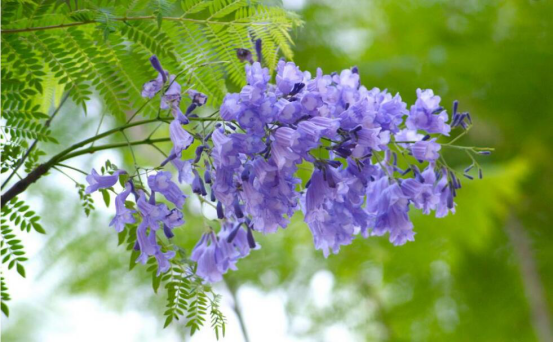
Jacaranda is a plant of the genus Jacaranda in the family Bignoniaceae. It is distributed in Argentina, Bolivia, Brazil, as well as Guangxi, Hainan, Guangdong, Yunnan, Fujian and other places in China. The tree crown is tall and large, 13-14 m high, and can reach up to 20 m at most. The leaves are bipinnately compound, large, with more than 16 pairs of pinnae, and each pinna has 10-24 pairs of leaflets, pinnate, closely set; quite elegant, the leaflets about 6 mm long. Panicles are borne at the branch tips or in the leaf axils; the flowers are bell-shaped, 25-35 cm long; pale purple, blooming in late spring and early summer. The fruit is a capsule, round and slightly flat, light brown, about 5 cm in diameter. When it blooms, the leaves fall completely. Other names for this tree include, because its leaves resemble fern; it is also called blue mist tree, and the wood is dark brown.
How to grow jacaranda
1. Temperature and light
Jacaranda is native to tropical America and likes a warm, humid, sunny environment, and is not tolerant of frost or snow. The suitable growth temperature is 22 to 30°C. If the winter temperature is below 15°C, growth stalls; if below 3 to 5°C, there is cold damage; if the summer temperature is above 32°C, growth is also inhibited. It likes light and can tolerate semi-shade.
2. Soil and fertilizing
It likes fertile, moist sandy loam or loam. When planting, apply enough base fertilizer. After it survives, topdress once each in spring and autumn. Carry out pruning and shaping once every early spring. Old plants need heavy pruning. When potted, the trunk can be cut back or grafted for dwarfing, and watering and nitrogen fertilizer application should be controlled.
3. Pest and disease control
Jacaranda has few diseases. The main pest is the longhorn beetle. If reddish-brown frass is found at the base of the trunk, use a small knife to pry open the bark and capture the larvae; alternatively, before the adults appear, apply a mixture of 10 parts quicklime, 1 part sulfur and salt below 80 cm on the trunk base to prevent the adults from laying eggs.
Propagation methods of jacaranda
Seed propagation
The capsule ripening period of jacaranda is November. After collection, place them in a windless place to sun-dry or pile them up, and after drying store them until March of the following year. Sow when the temperature is around 20°C, but the seed germination rate is only about 5%.
Cutting propagation
It can be done in both spring and autumn. Choose medium-maturity branches as cuttings, and the rooting rate is high.
Tissue culture
Some scientific research institutions in China have already used the stem tips and stem segments of seedlings as explants and propagated a large number of test-tube plantlets.
The effects and functions of jacaranda
1. The ornamental value of jacaranda
Jacaranda is a tall deciduous tree, reaching up to fifteen meters at most. Its leaves are opposite and oval in shape. The calyx of jacaranda is slender, mostly blue, and the filaments grow on the middle part of the calyx. Jacaranda bears woody capsules, and the flowering period is usually between May and June. Both the leaves and flower shape of jacaranda are very beautiful, which is the main reason it is an ornamental plant.
2. Jacaranda can be used in landscape construction
Jacaranda is a distinctive tree species that is both foliage- and flower-worthy. It mostly grows in tropical and subtropical regions and can be used as a street tree and landscape tree. It is the most common ornamental tree species in gardens and scenic areas in the south. It blooms once each in summer and autumn, and when the flowers are in full bloom, the purple-blue blossoms are especially attractive, and the floral fragrance can drift far.
3. The economic role of jacaranda
Jacaranda is an economic tree species with high economic value. Its wood can be used for papermaking and can create high economic value. In addition, jacaranda wood is yellow-white, relatively light, and straight-grained, making it an ideal material for making furniture. Moreover, after being made into furniture, jacaranda is not easy to deform and can be stored for a long time, and it sells very well in the furniture market.
What is the flower language of jacaranda?
The flower language of jacaranda: representing tranquility, profundity and hesitation, waiting for love in despair. Together with the flame tree, which is covered in red flowers, they are called the "twin shadows" (the red shadow tree refers to the flame tree, and the blue shadow tree is the jacaranda).