Cultivation Methods and Daily Care Tips for Hypericum patulum
1. Temperature
Hypericum patulum prefers to grow in sunny spots, but it can also tolerate shade, which is quite unusual. Moreover, Hypericum patulum is a temperate and subtropical tree species and is cold-hardy. So Hypericum patulum is a tough plant.
2. Soil
Hypericum patulum does not have high soil requirements; it can grow in fertile soil and also in poor soil, so it is very easy to grow.
3. Watering
Hypericum patulum has a well-developed root system and strong sprouting ability, but water must not accumulate during watering, or the roots will rot. It is suitable for growing in well-drained, moist, light loam.
4. Pruning
Hypericum patulum can be pruned multiple times; it has vigorous vitality and its branches grow quickly.
5. Cultivation
In the fruit ripening period each autumn, select superior Hypericum patulum plants, wait for the fruit to dry, then rub out the seeds, air-dry them, store them in bags at low temperature, and set them aside for later use. Before sowing, soak the seeds in warm water for 1-2 days to increase the germination rate of Hypericum patulum seeds. Prune the roots; a level cut surface will heal more easily. For sowing, plow the soil deeply and harrow it finely. After broadcasting, cover the surface with about 1 cm of soil, cover the bed with grass and sprinkle water to moisten it, then wait for seedlings to emerge.
6. Weeding and loosening the soil
To improve the survival rate, Hypericum patulum needs weeding and soil loosening, done once every 3-4 days.
7. Pest and disease control
Pest and disease control is also needed during cultivation. Hypericum patulum has relatively few pests and diseases, mainly aphids. The control methods are: during winter pruning and summer pruning, cut off branches and leaves that have been bitten by insects to remove overwintering eggs and pest sources; in winter or before sprouting in early spring, spray machine oil emulsion or diesel emulsion to kill overwintering eggs; in the early occurrence period from April to May, spray 40% omethoate emulsifiable concentrate at 1000-1500 times dilution 2-3 times to bring it under control; from May to June, during the peak damage period, apply systemic insecticides such as omethoate and monocrotophos mixed with oil to the trunk.
Cultivation Methods for Hypericum patulum
Through breeding trials, Hypericum patulum can be propagated by division, cutting, and seeding. When large quantities of seedlings are needed, tissue culture propagation can be used.
This is done each year during the fruit ripening period from August to September. Select well-grown Hypericum patulum plants for picking, wait for the capsules to dry, then rub out the seeds, and air-dry them to obtain pure seeds for later use. They are generally stored in bags at low temperature. Soaking the seeds in warm water for 1-2 days before sowing can significantly increase the germination rate of Hypericum patulum seeds. Deep plowing and fine harrowing are required, with sufficient base fertilizer, and flat beds 1.0-1.5 m wide should be made, ready for sowing.
Sowing can be done in spring or autumn. Generally, sowing is carried out in late March or early April in spring, choosing a windless day; preferably there should be no heavy rain or torrential rain for 2-3 days after sowing. Either drilling or broadcasting can be used. Cover with about 1 cm of topsoil, cover the bed with grass and sprinkle water to moisten it. Seedlings emerge 10 days after sowing, and by about 20 days they have emerged completely.
This is generally done in spring or autumn. Select vigorous 1-2 year old branches and cut them into 10-15 cm long cuttings, with the cut surface flat at the top and slanted at the bottom, and soak them in auxin or rooting powder. The Hypericum patulum seedbed should be watered thoroughly, and cuttings can be inserted after the water drains away. The plant and row spacing is 10 cm × 10 cm, and the insertion depth is 2/3 of the cutting length. Management mainly consists of irrigation, soil loosening, and weeding.
Using river sand or perlite as the cutting medium gives a relatively high cutting survival rate; using the middle and upper parts of branches as cuttings gives better root growth and development in the cutting seedlings; treatment with indolebutyric acid has a certain promoting effect on cutting survival and the growth and development of cutting seedlings. When carrying out cutting propagation of Hypericum patulum, using river sand or perlite as the cutting medium and the middle and upper parts of new shoots as cuttings, and treating with indolebutyric acid can achieve a relatively high survival rate and higher quality cutting seedlings.
Differences between Hypericum patulum and Hypericum monogynum, Hypericum patulum price, Hypericum patulum efficacy, cultivation methods for Hypericum patulum
Hypericum patulum
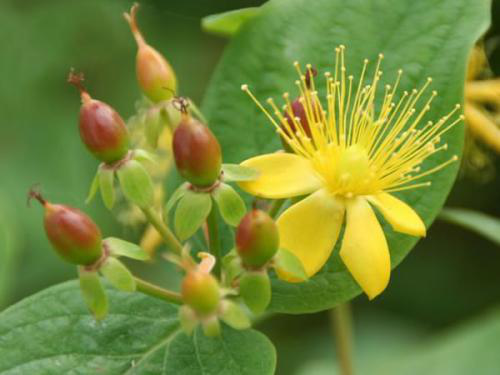
Hypericum patulum (scientific name: Hypericum patulum Thunb. ex Murray) is a semi-evergreen or evergreen small shrub in the Clusiaceae family (Guttiferae), with red or dark brown branchlets. Leaves are opposite, ovate, long ovate, or ovate-lanceolate.Differences between Hypericum patulum and Hypericum monogynum
Hypericum monogynum and Hypericum patulum are plants of the same family and genus. The most obvious difference is that Hypericum monogynum has long filaments, while Hypericum patulum has short filaments. Hypericum patulum has a long flowering period, beautiful flowers, and branches and leaves with a fresh fragrance, and it has relatively few pests and diseases. Hypericum patulum is cold-hardy and light-loving, and has the effect of clearing heat and detoxifying.
Hypericum patulum price
Hypericum patulum seedlings Yunnan forsythia , green leaves and yellow flowers all sizes available 0.45
Supply of landscaping seedlings shrubs [Hypericum monogynum] Hypericum patulum. Hypericum butterfly complete specifications 1.80
Nursery wholesale supply of various seedlings 3.00
Brightly colored blooms [Hypericum patulum] full branches and leaves, gorgeous and lovely 10.00
[Mingjie Landscape] Supply of seedlings factory year-round supply shrub Hypericum patulum 8.00
Wholesale Hypericum patulum Shuyang County Linshan Seedlings 4.00
Hypericum patulum efficacy
Ornamental value:
Flowers are for ornamental use. Hypericum patulum has large flowers, a beautiful flower shape, and striking golden-yellow flowers, with an ornamental period of up to 10 months. It is a very precious wild ornamental shrub.
It is suitable for planting in courtyards, beside rockeries, and along roadsides, lawns, and other places. It can also be arranged in specialized gardens and flower borders, can be grown in pots for ornamental use, and can also be used as cut flowers. It is a good material for urban greening in the western region. It is suitable for group planting and can be planted in courtyards, roadsides, flowerbed edges, and beside the roots of large trees. It is a relatively ideal ornamental plant and can also be used as a cut flower. It is a good material for urban greening in the western region.
Medicinal value:
The whole plant is used medicinally. Its traditional Chinese medicine names are Mangzhonghua, Xilianqiao, and Tulianqiao. It is bitter in nature and cold, and has effects such as clearing heat and detoxifying, relaxing muscles and promoting blood circulation, promoting diuresis and treating strangury, and promoting lactation. The root is used medicinally and can relax muscles and promote blood circulation, promote lactation, and promote diuresis.
Main functions: clear heat, drain dampness, and detoxify; soothe the liver and unblock the collaterals; remove blood stasis and relieve pain. Indications include damp-heat strangury; hepatitis; colds; tonsillitis; hernia with unilateral swelling; muscle and bone pain; and traumatic injuries.
Cultivation Methods for Hypericum patulum
Through breeding trials, Hypericum patulum can be propagated by division, cutting, and seeding. When large quantities of seedlings are needed, tissue culture propagation can be used.
Sowing method
This is done each year during the fruit ripening period from August to September. Select well-grown Hypericum patulum plants for picking, wait for the capsules to dry, then rub out the seeds, and air-dry them to obtain pure seeds for later use. They are generally stored in bags at low temperature. Soaking the seeds in warm water for 1-2 days before sowing can significantly increase the germination rate of Hypericum patulum seeds. Deep plowing and fine harrowing are required, with sufficient base fertilizer, and flat beds 1.0-1.5 m wide should be made, ready for sowing. Sowing can be done in spring or autumn. Generally, sowing is carried out in late March or early April in spring, choosing a windless day; preferably there should be no heavy rain or torrential rain for 2-3 days after sowing. Either drilling or broadcasting can be used. Cover with about 1 cm of topsoil, cover the bed with grass and sprinkle water to moisten it. Seedlings emerge 10 days after sowing, and by about 20 days they have emerged completely.
Cutting propagation
This is generally done in spring or autumn. Select vigorous 1-2 year old branches and cut them into 10-15 cm long cuttings, with the cut surface flat at the top and slanted at the bottom, and soak them in auxin or rooting powder. The Hypericum patulum seedbed should be watered thoroughly, and cuttings can be inserted after the water drains away. The plant and row spacing is 10 cm x 10 cm, and the insertion depth is 2/3 of the cutting length. Management mainly consists of irrigation, soil loosening, and weeding.
Using river sand or perlite as the cutting medium gives a relatively high cutting survival rate; using the middle and upper parts of branches as cuttings gives better root growth and development in the cutting seedlings; treatment with indolebutyric acid has a certain promoting effect on cutting survival and the growth and development of cutting seedlings. When carrying out cutting propagation of Hypericum patulum, using river sand or perlite as the cutting medium and the middle and upper parts of new shoots as cuttings, and treating with indolebutyric acid can achieve a relatively high survival rate and higher quality cutting seedlings.
Related encyclopedia
Pocket scale non-woven bag lamp wick bamboo shoot crab claw red rice note3 ykk zipper ybs zipper large mountain cherry climbing wall plum wild senna winter plum green pine watch Omega Longines famous watch children's building blocks flint clematis orchis curling iron sugar apple