How to propagate Hypericum patulum? These methods are simple and easy to learn
1. Cuttage propagation
In spring or autumn, select several robust current-growth branches and cut them into 10-15 cm long cuttings, then soak them in auxin or rooting powder. The Hypericum patulum seedbed should be watered thoroughly, and once the water has drained, the cuttings can be inserted. Water and loosen the soil frequently.
2. Division propagation
Division propagation is generally carried out in spring or autumn. When dividing, a soil ball must be kept to improve the survival rate. When digging up division seedlings, the root system of Hypericum patulum can be wrapped in a nylon bag or planted directly into a flower pot. Try as much as possible not to damage the root system of Hypericum patulum. After digging and packaging, transport promptly and water frequently.
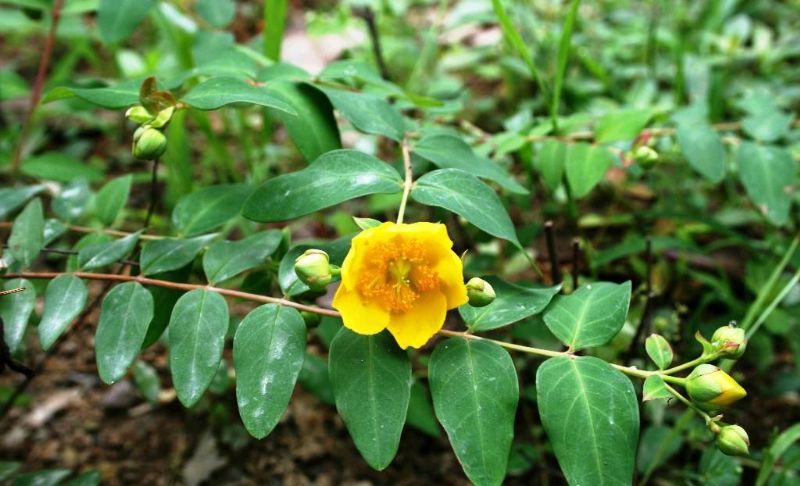
Now I believe you have gained some understanding of how to grow Hypericum patulum. If you also like Hypericum patulum, then take action and plant one of your own in this beautiful season.
What is the flower language of Hypericum patulum? What propagation methods does Hypericum patulum have?
Hypericum patulum has large flowers, bright colors, and a flowering period as long as 10 months, making it the best choice for home potted plants. So what is the flower language of Hypericum patulum? How should it be propagated? Let's find out next.
I. What is the flower language of Hypericum patulum?
The flower language of Hypericum patulum: hating sorrow
Hypericum patulum is a semi-evergreen or evergreen small shrub of the Clusiaceae family, with red or dark brown branchlets. Leaves are opposite, ovate, long-ovate, or ovate-lanceolate. The flowering period is April-July, and the fruiting period is July-October. Flowers are solitary at the branch tips or in cymes, 4 cm-5 cm in diameter, golden yellow, with numerous stamens united into 5 bundles, golden yellow.
Hypericum patulum grows on hillsides or in sparse forests in valleys, roadsides, or thickets, at an altitude of 450-2400 m. It is a temperate and subtropical tree species, slightly cold-tolerant. It likes light and is slightly shade-tolerant. The root system is well developed, with strong sprouting ability and tolerance to pruning. It is vigorous, but dislikes waterlogging. It grows in well-drained, moist, and fertile sandy loam.
II. Propagation methods of Hypericum patulum
Hypericum patulum can be propagated by division, cuttage, and seeding. When a large number of seedlings are needed, tissue culture propagation can be used.
1. Division propagation: Division propagation is generally carried out during cultivation in spring or autumn. When dividing, a soil ball must be kept, which helps survival. When digging up division seedlings, the root system of Hypericum patulum can be wrapped in a nylon bag or planted directly into a flower pot. Try as much as possible not to damage the root system of Hypericum patulum. Dig and package at the same time, transport promptly after digging and packaging, and water frequently, which helps survival.
2. Cuttage propagation: Cuttage is generally carried out in spring or autumn. Select robust 1-2 year old branches and cut them into 10-15 cm long cuttings, with the upper cut flat and the lower cut slanted, and soak them in auxin or rooting powder. The Hypericum patulum seedbed should be watered thoroughly, and once the water has drained, the cuttings can be inserted, with a plant-row spacing of 10 cm x 10 cm and a insertion depth of 2/3 of the cutting length. Management is mainly watering, loosening the soil, and weeding.
3. Seeding propagation: Before sowing Hypericum patulum, soaking the seeds in warm water for 1-2 days can significantly increase the germination rate of Hypericum patulum seeds. Deep plowing and fine harrowing are required, sufficient base fertilizer should be applied, and flat beds 1.0-1.5 m wide should be made, ready for sowing. Sowing can be done in spring or autumn, generally in late March or early April in spring. Choose windless weather, and preferably no heavy rain or rainstorm within 2-3 days after sowing. Either drilling or broadcasting can be used, covering with about 1 cm of surface soil. Cover the bed surface with grass and sprinkle water to moisten it. Seedlings emerge 10 days after sowing and are fully emerged in about 20 days.
The above isthe flower language of Hypericum patulumandthe propagation methods of Hypericum patulumintroduced. We hope it is helpful to everyone. If you want to learn more about Hypericum patulum, continue to follow us.
How to propagate Hypericum patulum: propagation and cultivation methods of Hypericum patulum
Hypericum patulum is a semi-evergreen or evergreen small shrub of the Clusiaceae family. The whole plant is used medicinally and has the effects of clearing heat, promoting diuresis, and detoxifying; soothing the liver and dredging collaterals; and removing blood stasis and relieving pain. Hypericum patulum grows in many places in China. Below let us take a look at how to propagate Hypericum patulum and the propagation and cultivation methods of Hypericum patulum.
Introduction to Hypericum patulum
Hypericum patulum (scientific name: Hypericum patulum Thunb. ex Murray) is a semi-evergreen or evergreen small shrub of the Clusiaceae family, with red or dark brown branchlets. Leaves are opposite, ovate, long-ovate, or ovate-lanceolate. The flowering period is April-July, and the fruiting period is July-October. Flowers are solitary at the branch tips or in cymes, 4 cm-5 cm in diameter, golden yellow, with numerous stamens united into 5 bundles, golden yellow.
In China, Hypericum patulum is distributed in southern Gansu, Shaanxi, Hubei, Hunan, Sichuan, Anhui, Jiangsu, Zhejiang, Fujian, Guizhou, Yunnan, Taiwan, China, and other provinces and regions. Gansu is the northern boundary of the natural distribution of this species, and in Gansu it is produced in Wudu, Kangxian, and Wenxian.
How to propagate Hypericum patulum
Through breeding trials, Hypericum patulum can be propagated by division, cuttage, and seeding. When a large number of seedlings are needed, tissue culture propagation can be used.
I. Sowing method
This is carried out each year in August-September when the fruit matures. Select well-grown Hypericum patulum for picking. After the capsules dry, rub out the seeds, and after air-drying, the pure seeds obtained are set aside for use. Generally, they are stored in bags at low temperature. Before sowing, soaking the seeds in warm water for 1-2 days can significantly increase the germination rate of Hypericum patulum seeds. Deep plowing and fine harrowing are required, sufficient base fertilizer should be applied, and flat beds 1.0-1.5 m wide should be made, ready for sowing. Sowing can be done in spring or autumn, generally in late March or early April in spring. Choose windless weather, and preferably no heavy rain or rainstorm within 2-3 days after sowing. Either drilling or broadcasting can be used, covering with about 1 cm of surface soil. Cover the bed surface with grass and sprinkle water to moisten it. Seedlings emerge 10 days after sowing and are fully emerged in about 20 days.
II. Cuttage propagation
Generally carried out in spring or autumn. Select robust 1-2 year old branches and cut them into 10-15 cm long cuttings, with the upper cut flat and the lower cut slanted, and soak them in auxin or rooting powder. The Hypericum patulum seedbed should be watered thoroughly, and once the water has drained, the cuttings can be inserted, with a plant-row spacing of 10 cm × 10 cm and a insertion depth of 2/3 of the cutting length. Management is mainly watering, loosening the soil, and weeding.
Using river sand or perlite as the cuttage substrate gives a relatively high cuttage survival rate; using the middle and upper parts of branches as cuttings gives better root growth and development of the cuttage seedlings; treatment with indolebutyric acid has a certain promoting effect on cuttage survival and the growth and development of cuttage seedlings. When carrying out cuttage propagation of Hypericum patulum, using river sand or perlite as the cuttage substrate and using the middle and upper parts of new shoots as cuttings, after treatment with indolebutyric acid, a relatively high survival rate and relatively high-quality cuttage seedlings can be obtained.
III. Division propagation
Division propagation is generally carried out during cultivation in spring or autumn. When dividing, a soil ball must be kept, which helps survival. When digging up division seedlings, the root system of Hypericum patulum can be wrapped in a nylon bag or planted directly into a flower pot. Try as much as possible not to damage the root system of Hypericum patulum. Dig and package at the same time, transport promptly after digging and packaging, and water frequently, which helps survival.
IV. Tissue culture
1. Obtaining material
Select young tender branches of Hypericum patulum from the current year, rinse them clean under running water, cut them into 3 cm lengths, absorb excess water with filter paper, soak them on an ultra-clean workbench in 70% alcohol for 20 seconds, rinse 3 times with sterile water, then transfer them into 0.1% mercuric chloride solution and shake for 5 minutes, rinse 5 times with sterile water, then place them in a small autoclaved magnetic dish lined with filter paper, cut them into 0.5-1.0 cm small stem segments each containing one bud, and inoculate them in differentiation medium for culture.
2. Cluster bud induction
After 20 days on differentiation medium, sterile small stem segments gradually differentiate cluster buds at the stem nodes, and after 30 days the buds are 1-2.5 cm long. At this time, cut off the obtained clustered tender bud stems, cut them into small segments of about 1 cm, and transfer them to proliferation medium for culture. At 40 days, the average seedling height is 3-4 cm, and the proliferation coefficient is 6-8 times.
3. Rooting and transplanting
When the Hypericum patulum bud seedlings grow to 2-3 cm high, cut off the tender stems and transfer them into rooting medium. After 2 weeks, each plant has 3-5 roots, and the rooting rate reaches 99%. After rooting, place the test-tube plantlets in a greenhouse without opening the cover for 5 days, then open the cover and place them for 2 days. Take them out, wash them clean, soak them in clean water for 2-3 hours, and transplant them into a substrate of vermiculite, river sand, and forest soil (5:1:3). Cover with plastic film, set up a shade net to prevent direct sunlight, and maintain humidity at about 90%. After 10 days, remove the plastic film, and new roots and new leaves begin to develop, with a survival rate of 93.6%. After 20 days, move the surviving seedlings into a substrate of forest soil and garden soil (1:1), with a plant-row spacing of 10 cm x 15 cm. Pay attention to moisture and light. After 15 days, the survival rate is 98%. When the transplanted seedlings grow to 15-20 cm, transplant them with soil into the field, water thoroughly, and after 1 week of recovering from transplanting, they begin vigorous growth.
Cultivation techniques of Hypericum patulum
1. Field digging
From early February to mid-March each year, after the soil thaws and before budding, or from late October to mid-November after most leaves fall and before the soil freezes.
2. Digging and transport
Use bare-root digging, trying as much as possible not to damage the root system. When roots are broken, the cuts are required to be smooth and not split. After digging out, it is best to put plastic bags over the root system, or use methods such as soaking the roots in moisturizing agents or coating the roots with mud slurry, which helps improve the survival rate. For long-distance transport, it is best to keep a soil ball. The soil ball should be complete, the packaging should be tight, and water should be watered sufficiently; the crown should be wrapped and tied up with straw rope to reduce friction damage and improve the survival rate.
3. Digging holes
The cultivation holes must be dug in advance. If the seedlings arrive, they should be planted immediately. The hole diameter is required to be 20-30 cm larger than the diameter of the root system or soil ball, to facilitate the extension of old roots and the development of new roots. The surface soil and subsoil in the hole should be placed separately. The bottom of the hole should be large and flat. If conditions permit, some organic fertilizer can be applied and covered with surface soil.
4. Cultivation
Before cultivation, prune the roots, and the cuts should be flat to facilitate healing. During cultivation, the root system must be spread out. First put in surface soil and firm it layer by layer, so that the root system and soil are closely combined. Form a soil berm around it. Water thoroughly immediately after planting, water thoroughly a second time after 3 days, and water thoroughly again after 1 week to ensure survival.
5. Watering and fertilizing
Watering: From bud break to the flowering period, water 2-3 times as appropriate. In summer drought, water another 2-3 times. In the rainy season, pay attention to drainage and waterlogging prevention, and avoid waterlogging. Water once before winter to prevent freezing.
Fertilizing: Apply sufficient decomposed organic fertilizer before cultivation. After that, each year after leaf fall in autumn, open a ditch around the root zone and apply decomposed compost. Generally, no additional fertilizing is needed during the growing season, so as to avoid excessive growth and drooping of branches, which affects the ornamental effect.
6. Weeding
In order to make flowers abundant and leaves lush, intertillage and weeding need to be strengthened. In dry seasons and midsummer, loosen the soil and weed once every 2-3 weeks. After each watering, loosen the soil promptly to prevent soil compaction, improve soil aeration, and facilitate root growth and development. In the rainy season, weed once every 2 weeks.
7. Shaping and pruning
Carry out shaping and pruning each year in summer or winter, cutting off excessive growth branches, weak branches, and diseased and pest-infested branches, and shortening long branches as needed for the shape. Through pruning, keep the plant in a good tree shape and vigorous tree vigor, make the plant grow robustly with abundant flowers and lush leaves, thereby improving the ornamental value.
8. Disease and pest control
Hypericum patulum has few diseases and pests, mainly aphids. Control methods include: during winter pruning and summer pruning, cut off damaged branch tips or dried curled leaves to eliminate some overwintering eggs and insect sources; in winter or before budding in early spring, spray 5% machine oil emulsion or 5% diesel emulsion to kill overwintering eggs; in April-May at the early stage of occurrence, spray 40% omethoate emulsifiable concentrate 1000-1500 times dilution, 20% fenvalerate emulsifiable concentrate 2000 times dilution, 50% methamidophos emulsifiable concentrate 1500 times dilution, or 2.5% deltamethrin emulsifiable concentrate 3000 times dilution; 2-3 times can control it; in May-June, the peak damage period, use moisture-absorbing insecticides such as 40% omethoate and monocrotophos at 10-20 times dilution to apply rings on the trunk or soak the roots for control, with good results.