What causes the leaves of Sageretia thea (Chinese sweet plum) to turn yellow
First, if it is placed outdoors, it may be caused by the potting soil being too dry or too wet, especially water accumulating after rain and poor drainage.
Second, it may be caused by being kept for a long time indoors in a stuffy, unventilated, shaded spot, or by suddenly being moved outdoors and exposed to the blazing sun. After the Sageretia thea drops its leaves, as long as the branches and trunk do not wither and some remaining leaves are still attached, after gradually moving it outdoors to a semi-shaded, ventilated spot and adding fertilizer and water management, it will still grow leaves again after autumn.
Of course, there are also some other minor reasons, such as too much fertilizer burning the leaves yellow, lack of fertilizer making the leaves thin and yellow, too much alkalinity soaking the leaves yellow, lack of acid making the leaves yellow, too much acid making the leaves yellow, large flowers in a small pot making the leaves yellow, pests and diseases causing yellow leaves, and so on...
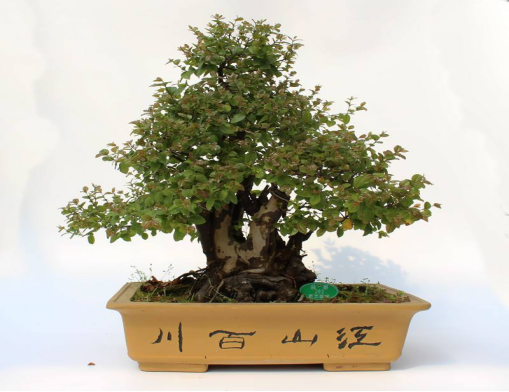
But gardening friends, do not worry when you run into this situation, we have plenty of ways to deal with it.
Common pests and diseases of Sageretia thea
Common pests and diseases of Sageretia thea
The common pests and diseases of Sageretia thea include rust disease, longhorn beetle damage, red spider mites, and so on.
Rust disease of Sageretia thea
The pathogen of rust disease is a fungus caused by Pucciniastrum, which produces rust spores and makes the leaves turn yellow, or the spots on the upper surface of the leaf start out orange-yellow, and the spot tissue gradually becomes swollen and thicker while the underside of the leaf bulges, affecting its appearance.
As time goes on, the spots will expand, and can expand into a circular shape and turn black, finally causing the leaves to wither and drop off.
Longhorn beetle damage of Sageretia thea
When Sageretia thea is affected by longhorn beetle damage, the female longhorn beetle will bite through the bark and then lay eggs on the branches and trunk. The newly hatched larvae will bore and feed under the bark, and as they grow they gradually bore into the trunk and roots, then gradually hollow out the branches and trunk of the Sageretia thea, causing it to die.
Red spider mite damage of Sageretia thea
Red spider mites are reddish-brown and oval in shape. Red spider mites will spin webs on the plant's leaves and lay eggs there, using their mouthparts to pierce the branches and leaves and suck out the sap, causing the chlorophyll in the leaves to be destroyed, making the leaf color gradually turn yellow, and grayish-yellow spots also appear on the leaf surface, until the leaves dry up and drop off.
Prevention and control of the common pests and diseases of Sageretia thea
Prevention and control of rust disease of Sageretia thea
Rust spot disease of Sageretia thea can be treated by pruning: before the spring rains, completely cut off the branches and buds on the Sageretia thea tree that carry the fungus.
In addition, before the spring rains you can spray lime sulfur mixture or sodium pentachlorophenate 350 times solution plus 1.01 kg to reduce the disease.
Prevention and control of longhorn beetle damage of Sageretia thea
You can directly insert a suitable piece of wire into the insect hole to stab the larvae to death.
Prevention and control of red spider mite damage of Sageretia thea
You can directly spray dichlorvos or dimethoate 1000 times solution to 1500 times solution.
Points to note for household flowers and plants over the winter
Points to note for household flowers and plants over the winter -- winter has arrived, people need to add clothes, and the plants at home also need to be prepared for winter. Regarding nourishing plants in winter, the landscaping department and relevant horticultural experts have put forward the following views
Fertilizing flowers and plants depends on the variety
People need nourishment in winter, but for winter flowers and plants, “nourishment” is not necessarily a good approach. It is said that balcony potted plants in a dormant or semi-dormant state should stop being fertilized in winter. For vigorously growing foliage plants, you can spray or water on a 0.3% urea solution, and you can also scatter multi-element compound fertilizer granules on the pot surface. For flowering and fruiting ornamental trees and shrubs, such as white orchid, Aglaia odorata, pomegranate, crape myrtle, jasmine, and so on, you should continue to apply quick-acting phosphorus and potassium fertilizer. For Chinese elm, Sageretia thea, holly, Buddhist pine, trident maple, water willow, boxwood, and so on, after each pruning you can apply a light fertilizer.
Watering temperature matters
In winter, plants evaporate much less than in summer. Therefore, experts suggest that after the weather turns cold, the frequency of watering the plants at home can be appropriately reduced. As for water temperature, avoid too great a difference between the water temperature and the soil temperature and air temperature. As for watering time, it can be done before 10 o'clock and after 16 o'clock. While watering, you must not neglect loosening the soil of potted plants, and for some ornamental plants it is best to add a small amount of ferrous sulfate. But it should also be targeted, for example, spider plant is best kept indoors over the winter, and watered promptly when dry, but not watered too much, otherwise the roots will rot. Although pothos is relatively easy to grow, note that it must be kept moist all the time, and the temperature must not be too low. Aloe likes moisture, but it is better to wait until the soil is very dry before watering.
Plants also need to get some air
After the weather turns cold, some residents move the plants that were originally on the open balcony into their homes for the winter. Experts suggest that residents should promptly prune away dead branches and pest- and disease-infested branches. In the first week after moving them indoors, it is best to open the windows and doors so the plants can get some air too and gradually adapt to the temperature changes, otherwise the potted flowers are prone to yellowing and dropping leaves.