How to grow olive flowers? These methods you need to master
Soil
Olive flowers are suited to growing in fertile, well-drained sandy soil. They are drought-tolerant and highly adaptable to soil. They can grow in slightly alkaline sandy loam and lime-rich clay.
Temperature
Olive flowers are relatively cold-hardy and can tolerate low temperatures of -12°C. In winter they can overwinter outdoors. They are long-lived tree species with very strong growth ability.
Watering
Olive flowers are relatively drought-tolerant, but the soil should still be kept moist. In summer, prolonged sunlight can lead to water shortage, so a sufficient water supply must be ensured.
Fertilizing
For young olive trees, fertilizing is mainly based on nitrogen fertilizer, applied frequently and lightly, once every two months, or once before and once after each new shoot flush. For fruiting trees, fertilizing is mainly based on nitrogen, phosphorus and potassium fertilizers. Under the drip line at the outer edge of the canopy, dig a 20 cm deep ring trench, or two crescent-shaped trenches, and apply the fertilizer into the trenches. If it is liquid fertilizer, cover with soil after it dries; if it is dry fertilizer, cover with soil immediately after application.
Weeding
During the growth of olive flowers, regular weeding is needed to prevent weeds from growing densely and consuming nutrients that belong to the olive tree. Glyphosate or paraquat can be chosen; both are very good herbicides. Herbicides cause obvious phytotoxicity to olive branches and leaves, so the leaves and branches must not be touched when spraying. Spraying time is generally before spring weeds bloom and set seed, and during the vigorous growth period of summer weeds in late June.
When growing olive flowers, what other precautions should be noted?
How to grow olive flowers? Precautions for growing olive flowers
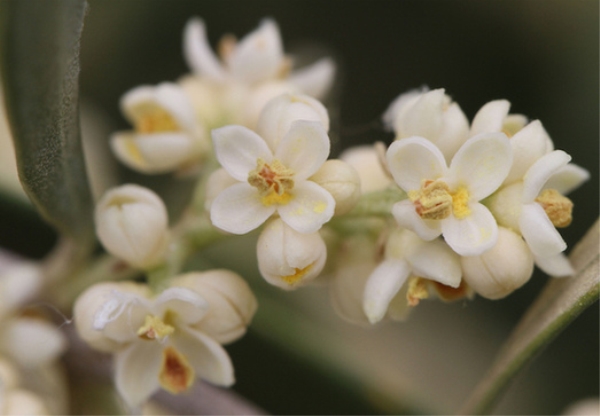
The olive flower tree has a tall, upright and verdant canopy, with delicate white flowers. Under sunlight, the silvery white and emerald green set each other off beautifully. It is a symbol of wisdom, courage and victory. So, how to grow olive flowers? Precautions for growing olive flowers.
1. Planting methods for olive flowers
A. Planting large seedlings:
When planting, the roots should be in close contact with the soil. The main trunk only needs to be buried 6 cm deep. Seal the top with yellow mud, and wrap the main trunk with rice straw to prevent wind and sun exposure from causing water loss. The rice straw must be 10 cm above the ground and must not touch the soil, to avoid attracting termites. Water after planting. Note: (1) Great care must be taken when lifting seedlings and planting, do not break the root bark or damage the root tips; (2) Do not put base fertilizer in the hole, use only easily rooting red-yellow soil topsoil; (3) The soil must be pressed firmly and compacted, which is the key to survival; (4) After planting, set up protective frames.
B. Planting small seedlings:
Planting time: from Grain Rain to Start of Summer is more suitable.
Olive tree planting method: In the hole, use burnt soil and legume green manure as base fertilizer, and scatter 1 jin of lime per hole to prevent termite damage. When planting, use surface fine soil, add water in the hole and mix into mud slurry, place the seedling into the slurry so the lateral roots spread naturally, then cover with fine soil and press firmly so the roots and soil are fully in contact.
2. Fertilizer and water management for olive flowers
(1) Fertilizer: major elements, nitrogen, phosphorus, potassium, calcium, sulfur.
A. Fertilizing young trees:
Mainly nitrogen fertilizer, appropriately combined with other fertilizers, following the principle of frequent and light application, generally once every two months, or once before and once after each new shoot flush.
(2) Fertilizing fruiting trees:
Three times a year: namely pre-flowering fertilizer: around March, nitrogen. Or: pre-flowering fertilizer
Post-fruiting fertilizer: around October, nitrogen, potassium. Flower-strengthening and fruit-strengthening fertilizer
Flower bud differentiation fertilizer: November-December, nitrogen, phosphorus, potassium. Post-fruiting fertilizer
Fertilizing method: Under the drip line at the outer edge of the canopy, dig a 20 cm deep ring trench, or two crescent-shaped trenches, and apply the fertilizer into the trenches. If it is liquid fertilizer, cover with soil after it dries; if it is dry fertilizer, cover with soil immediately after application.
3. Shaping and pruning olive flowers
(1) Shaping young trees:
After the seedlings survive planting, cut the trunk when the seedling height reaches 1-1.5 m. Generally cut at about 0.8 m. Select and retain 3-5 shoots as main branches in different directions. When the main branches are too long, cut them back at 60 cm. Each main branch keeps 3 lateral branches, and thereafter handle them level by level, so they form an early-fruiting, high-yielding canopy as soon as possible.
(2) Pruning fruiting olive flower trees:
For trees just entering production, in principle light pruning is mainly used, mainly removing overly long branches to promote lateral branches; for pruning during full production, the main aim is to regulate the ratio of vegetative growth to reproductive growth; for later pruning, the main aim is to remove dead branches, shaded branches, and diseased and pest-damaged branches inside the canopy.
The growing methods for olive flowers are actually relatively simple. For gardening enthusiasts growing them in pots, it is essential to know how to care for them. The above are the growing methods for olive flowers.
Growing methods for olive flowers
Pruning
Olive trees should be pruned in early summer. Pruning allows the flowering branches of olive flowers to sprout flower buds again.
Pests and diseases
The common disease of olive flowers is anthracnose, which can be treated by spraying 600 times diluted copper oxychloride solution.
Soil
The olive tree is a world-renowned precious and high-quality woody oil tree species characterized by "high yield, high quality and high efficiency". It is a strongly shade-tolerant tree, likes to grow in well-drained plots, is drought-tolerant, and is highly adaptable to soil. It can grow in slightly alkaline sandy loam and lime-rich clay.
Do you all understand the effects of olive flowers? In traditional Chinese medicine, olives have long been called the "fruit of the lung and stomach" and have very good effects, but they must not be eaten in excess. Be sure to follow a doctor's advice before eating them in appropriate amounts!!