What are the cultivation methods and precautions for coral ardisia (Ardisia crenata)?
1. Pay attention to humidity
Coral ardisia can only grow in a wet or semi-dry, semi-humid climate, and the air humidity must be kept at 60%-80%, otherwise the lower leaves will turn yellow and drop off, and the upper leaves will become dull.
2. Pay attention to temperature
Coral ardisia's homeland is in tropical regions, so everyone must be especially careful when growing coral ardisia in winter, and the temperature must be kept above 9°.
3. Light must be sufficient
Coral ardisia especially loves light, so if you want to grow it indoors, please place it in a spot where it can get sunlight as much as possible, such as a dining room with large floor-to-ceiling windows, a balcony, and so on. Grow it indoors for one month and then move it outdoors for one month, following this indoor-outdoor pattern.
4. Pay attention to fertilizing
Organic fertilizer should be added when sowing for the first time. In addition, in spring, summer and autumn, follow the order of one application of Huabao then one of clean water every 2-3 days; in winter, follow the order of one application of Huabao then two of clean water every 4-6 days.
5. Pruning must be timely
If coral ardisia becomes thin, gets pests, dries up, grows too vigorously, and so on, be bold about cutting off those branches and leaves, and you can also choose methods such as grafting to save it.
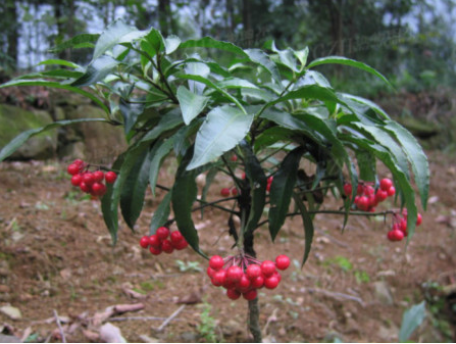
Cultivation methods for coral ardisia
Humidity management
It likes a humid or semi-dry climate environment, and requires the relative air temperature of the growing environment to be 50-70%. When the relative air humidity is too low, the lower leaves turn yellow and fall off, and the upper leaves lose their luster.
Temperature management:
Because it is native to subtropical regions, it has very strict requirements for winter temperature, and stops growing when the ambient temperature is below 8°C.
Light management
It has a strong ability to adapt to light. When keeping it indoors, place it in a spot with bright light as much as possible, such as a well-lit living room, bedroom, study, and similar places. After keeping it indoors for a period of time (about one month), move it to an outdoor spot with shade (with insulation conditions in winter) for a period of time (about one month), and alternate back and forth like this.
Fertilizer and water management
For potted plants, in addition to adding organic fertilizer when potting, proper fertilizer and water management should also be carried out during regular care. Spring, summer and autumn: these three seasons are its peak growing seasons, and fertilizer and water management follows the cycle of “Huabao”——clean water——“Huabao”——clean water, with an interval of about 1-4 days; the interval is shorter on sunny days or during high temperatures, and longer on rainy days or during low temperatures, or do not water at all. Winter: during the winter dormant period, the main task is to control fertilizer and water well, and fertilizer and water management follows the cycle of “Huabao”——clean water——clean water——“Huabao”——clean water——clean water, with an interval of about 3-7 days; the interval is shorter on sunny days or during high temperatures, and longer on rainy days or during low temperatures, or do not water at all. For plants grown in the ground, in spring and summer, apply fertilizer and water 2-4 times according to drought conditions: first dig a small ditch in a ring 30-100 cm outside the root crown (the larger the plant, the farther from the root crown), with the ditch width and depth both 20 cm. Sprinkle 25-50 jin of organic fertilizer into the ditch, or 1-5 liang of granular compound fertilizer (chemical fertilizer), then water thoroughly. After winter begins and before spring begins, apply fertilizer once more in the above manner, but there is no need to water.
Pruning
In winter, when the plant enters dormancy or semi-dormancy, cut off weak, pest- and disease-affected, dead, and overly dense branches. You can also organize the branches in combination with cuttings. Repotting: as long as it is cared for properly, it will grow very quickly. When it grows to a certain size, consider giving it a larger pot so it can continue to grow vigorously. For the potting soil and component ratio used for repotting, you can choose one of the following: vegetable garden soil: cinder = 3:1; or garden soil: medium-coarse river sand: sawdust (mushroom residue) = 4:1:2; or one of paddy soil, pond mud, or leaf mold.
Cultivation methods for coral ardisia
Coral ardisia is also called Dalosan and Fuguizi, and many people also call it Jinyumantang. It is in the Myrsinaceae family and the Ardisia genus among angiosperms. Coral ardisia likes a humid or semi-dry climate environment, and requires the relative air temperature of the growing environment to be 50-70%. When the relative air humidity is too low, the lower leaves turn yellow and fall off, and the upper leaves lose their luster. Because coral ardisia is native to subtropical regions, it has very strict requirements for winter temperature, and stops growing when the ambient temperature is below 8°C.Coral ardisia has a strong ability to adapt to light. When keeping it indoors, place it in a spot with bright light as much as possible, such as a well-lit living room, bedroom, study, and similar places. After keeping it indoors for a period of time (about one month), move it to an outdoor spot with shade (with insulation conditions in winter) for a period of time (about one month), and alternate back and forth like this.
For potted plants, in addition to adding organic fertilizer when potting, proper fertilizer and water management should also be carried out during regular care.
Spring, summer and autumn: these three seasons are its peak growing seasons, and fertilizer and water management follows the cycle of "Huabao" - clean water - "Huabao" - clean water, with an interval of about 1-4 days; the interval is shorter on sunny days or during high temperatures, and longer on rainy days or during low temperatures, or do not water at all.
Winter: during the winter dormant period, the main task is to control fertilizer and water well, and fertilizer and water management follows the cycle of "Huabao" - clean water - clean water - "Huabao" - clean water - clean water, with an interval of about 3-7 days; the interval is shorter on sunny days or during high temperatures, and longer on rainy days or during low temperatures, or do not water at all.
For plants grown in the ground, in spring and summer, apply fertilizer and water 2-4 times according to drought conditions: first dig a small ditch in a ring 30-100 cm outside the root crown (the larger the plant, the farther from the root crown), with the ditch width and depth both 20 cm. Sprinkle 25-50 jin of organic fertilizer into the ditch, or 1-5 liang of granular compound fertilizer (chemical fertilizer), then water thoroughly. After winter begins and before spring begins, apply fertilizer once more in the above manner, but there is no need to water.
In winter, when the plant enters dormancy or semi-dormancy, cut off weak, pest- and disease-affected, dead, and overly dense branches. You can also organize the branches in combination with cuttings.
Repotting: as long as it is cared for properly, it will grow very quickly. When it grows to a certain size, consider giving it a larger pot so it can continue to grow vigorously. For the potting soil and component ratio used for repotting, you can choose one of the following: vegetable garden soil: cinder = 3:1; or garden soil: medium-coarse river sand: sawdust (mushroom residue) = 4:1:2; or one of paddy soil, pond mud, or leaf mold.