Pachystachys lutea Growing Methods and Precautions Explained
1. Temperature
The suitable temperature for the growth of Pachystachys lutea is about 15°C-25°C. Too high or too low a temperature is bad for its growth. Too low a temperature will cause leaves to fall off, and in severe cases the plant may even wither and die. In winter, it should be placed indoors in a spot with ample sunlight, watering should be slightly controlled, and the temperature should be at least above 10°C.
2. Light
During the growth period, apart from the hot summer when slight shading is acceptable, it should be given ample light at all other times. In a half-sunny, half-shady environment, Pachystachys lutea can still grow fairly well, but it must never be too shaded, otherwise it will become leggy, and it will bloom very late and produce very few flowers, failing to achieve the desired ornamental effect.
3. Soil
The soil should be loose, fertile, and contain a large amount of humus. Usually peat soil and leaf mold are used, mixed with a small amount of decomposed cow dung as a base fertilizer. This can ensure that Pachystachys lutea has a good growing environment and thus grows healthily.
4. Fertilizer and Water
During the growth period of Pachystachys lutea, it is necessary not only to keep the potting soil moist, but also to meet its relatively high requirements for relative air humidity. In spring and autumn, watering should be guaranteed once a day; in summer, watering should be done 2 to 3 times a day; in winter, it is only necessary to keep the potting soil moist. During the growing season, an organic fertilizer is generally applied once every 15 days. Note that when the temperature is higher than 35°C or lower than 15°C, fertilization should be stopped.
5. Pruning
For newly rooted cuttings, attention should be paid to pinching. Pinching should be carried out when the seedlings are about 6 cm tall and when the branches grow to about 4 cm, after which buds will form and flowers will bloom on the new branches within a month. Pruning is carried out every spring.
Now that you know the growing methods for Pachystachys lutea, you must also want to know about its propagation methods.
How to Cultivate Pachystachys lutea: Growing Methods for Pachystachys lutea
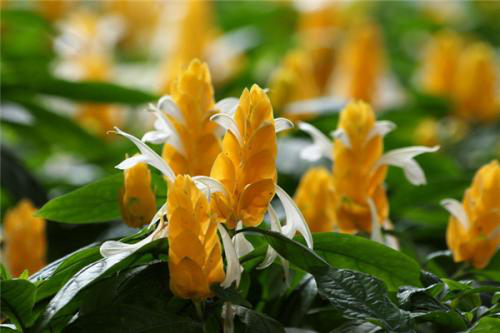
Pachystachys lutea, also called the yellow shrimp plant, has a peculiar flower shape, bright yellow flowers, and a long flowering period. Pachystachys lutea is also a very good indoor potted plant. So how do you cultivate Pachystachys lutea? Let's take a look at the growing methods for Pachystachys lutea below.
I. How to Cultivate Pachystachys lutea
Each node of the stems and branches of Pachystachys lutea has about a pair of latent axillary buds, and the axillary buds in the middle of the branches mature and have strong sprouting ability. Cut cuttings 3-4 cm long, insert them into a seedbed or cutting pot, cover with plastic film or glass, and be careful to water to keep the substrate moist. They will take root after a week, the axillary buds will sprout and grow after 20 days, and they can be potted after a month. When potting, choose robust opposite double-forked seedlings.
Under greenhouse conditions, Pachystachys lutea can be propagated by cuttings throughout the year, but for home cultivation, cuttings should be taken from April to May in spring. This is because at this time cuttings root quickly and are easy to keep alive, and they can bloom by autumn. Before taking cuttings of Pachystachys lutea, the growing soil must first be prepared. For pot cultivation, you can mix leaf mold and peat soil with 1/2 vermiculite or 1/3 river sand, then add a small amount of base fertilizer. It should be loose and well aerated, and heavy clay soil should be avoided. For the cuttings of Pachystachys lutea, choose robust, plump branches with short internodes from the plant, cut them into sections 9 cm to 12 cm long, with the cut made 0.5 cm below the node. It is best to use a sharp knife to make a smooth cut, and it is even better if the cutting has a heel. Remove the lower leaves and keep the top leaves.
II. Growing Methods for Pachystachys lutea
1. Soil: The potting soil for growing Pachystachys lutea should be fertile, loose, and well aerated, and heavy clay soil should be avoided. You can use 5 parts leaf mold, 3 parts garden soil, 1 part river sand, and 1 part decomposed organic fertilizer mixed evenly as the growing soil.
2. Temperature: The suitable growing temperature for Pachystachys lutea is 15-25°C, and the overwintering temperature should not be lower than 10°C, otherwise Pachystachys lutea will stop growing and the leaves will easily fall off. If the low temperature lasts too long, it will also cause root rot and even plant death in Pachystachys lutea. If you want Pachystachys lutea to bloom in winter, the daytime temperature should be kept at around 25°C and the nighttime temperature should be kept above 15°C.
3. Light: Pachystachys lutea is relatively sun-loving. In greenhouse cultivation, there is no need for shading. Letting the plant receive ample light in spring, autumn, and winter can make the plant grow more robust and reduce diseases. In an excessively shaded environment, Pachystachys lutea will become leggy, and flowering will be delayed and sparse. Seedlings should avoid direct strong light, and attention should be paid to ventilation.
4. Watering: During the growth period, Pachystachys lutea should be watered thoroughly to keep the potting soil moist, with a soil humidity of about 80% being suitable. But water accumulation in the pot must also be prevented. In summer, water before the potting soil dries out completely, and frequently spray water on the Pachystachys lutea plant and its surroundings to maintain relatively high environmental humidity.
5. Fertilization: Pachystachys lutea likes fertilizer. During the growth period, apply a liquid cake fertilizer water once every 10 days, but do not apply too much nitrogen fertilizer alone, otherwise the stem nodes will become slender and the number of flowers will decrease. During the flowering period, apply phosphorus and potassium fertilizer twice more to meet the fertilizer needs of Pachystachys lutea as it continuously forms buds and blooms. Insufficient fertilizer is often the main reason why Pachystachys lutea grows poorly and produces few and small flowers.
The above isPachystachys lutea growing methodsintroduced. Pachystachys lutea is an excellent potted flower variety, so you might as well grow some to decorate your home.
Propagation Methods for Pachystachys lutea
Cuttings
The best time for cuttings is April, when they are most likely to survive. Take tender shoots about 8-10 cm long from old branches and insert them into sand. Special attention must be paid to maintaining temperature and humidity, with the temperature above 21°C and humidity at about 80%. They will take root in about half a month.
Alright, the above are the growing methods for Pachystachys lutea. After reading this, do you friends feel confident about growing master-level Pachystachys lutea? Hurry up and put it into practice!