How to grow potted holly? Care methods and points to note
Soil
Holly prefers a warm climate, has some cold tolerance, and likes moist, semi-shaded and fertile soil, but it can also grow well in ordinary soil, as it is not strict about environmental conditions. After planting holly seedlings, water once and then let them grow naturally; depending on the situation, water once every half a month. In colder places in winter, measures such as mounding soil around the plants for cold protection can be taken.
Pruning
Holly sprouts and grows branches many times each year and is very tolerant of pruning. In summer, carry out shaping and pruning once or twice; in autumn, according to needs, trim it flat or prune it into different shapes, properly thin out branches, and maintain a certain crown shape.
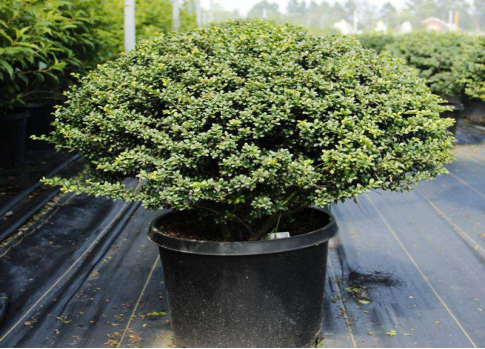
Light
When the light is especially strong, be sure to put up a shade net to prevent strong light and high temperatures from affecting the growth of the seedlings. When the light is weaker, gather up the shade net. However, note that the shade net should provide the plant with a comfortable environment.
Weeding
Weeding at the seedling stage has two parts: one is manual weeding, but extra care is needed to avoid damaging the holly's roots; the other is chemical weeding. Mix the herbicide into a 500-fold diluted solution and spray it directly on the ground fabric.
Fertilizer
Holly trees do not need much fertilizer added during the seedling stage of growth. It is enough to apply an appropriate amount of foliar fertilizer; water-soluble flower fertilizer can also be used, mixed with water at a ratio of 5:2000, and after mixing, spray it. The best time is from 4 p.m. to 6 p.m. The amount of water should be moderate, just enough to spray the leaf surfaces, once every half a month.
Pests
The main pest of holly is aphids. For aphids, prevention should be the priority. An 800-fold diluted solution can be used for pest control. The best time is from 8 a.m. to 10 a.m. or after 4 p.m. The dosage should also be moderate. In other situations, spraying once every 5 days is enough.
Cutting propagation of potted holly
Holly is mainly propagated by cuttings. Cutting propagation is simple and easy to do, roots quickly, and has a high survival rate, so it is widely used in production.
Seedbed selection
For the cutting seedbed, choose a place with high terrain, deep soil, loose soil, and good drainage and irrigation.
Cutting selection
Holly cuttings can be taken all year round; the best times are late spring and early summer and late summer and early autumn. Choosing the best-quality branches makes rooting easiest!
Cuttings
It is better to insert shallowly than deeply; the mother plant is best inserted 1 cm into the soil. The cuttings should not have too many leaves, to avoid nutrient loss, but they should not all be cut off either.
Transplanting
Two to three months after cutting, when new roots have grown to 1 to 2 cm, they can be transplanted into nutrient bags. When the seedlings grow to 26 to 30 cm, they can be planted in the ground.
The above is an introduction to the care methods for potted holly. I hope it can help you. Thank you for reading.
Summer care and management methods for potted Japanese holly
Japanese holly has dense branches and leaves, is emerald green in all four seasons, and bears fruit all over its branches in autumn, making it an excellent ornamental tree species. Its leaf colors are mottled and its leaf shapes are unusual, making it even more beautiful. Old stumps made into root-exposed, claw-revealing stump bonsai, with curved and elegantly ancient branches, are especially pleasing to the eye and are truly ornamental treasures. Japanese holly is relatively shade-tolerant, and its branches and leaves are dense, so it should be placed in a shaded spot to grow well.I. Morphological characteristics:
Japanese holly belongs to the Aquifoliaceae family, genus Ilex. It is an evergreen shrub with many branches; leaves are simple and alternate, small and densely growing, leathery, elliptical or obovate, or long elliptic-lanceolate, with wavy shallow blunt teeth along the edges, dark green and glossy on the surface, and light green with glandular dots on the underside; the leaves are often clustered at the branch tips, and the crown is spherical or ovate, quite similar to boxwood. In May it produces small white flowers, with male and female flowers on separate plants; female flowers are solitary in the leaf axils, while male flowers are in cymes of 3 to 7 flowers. The fruit is spherical and shiny black when ripe.
II. Growth habits:
It prefers semi-shaded places, likes a warm and humid climate, and requires fertile, loose, well-drained acidic sandy loam; it has poor cold tolerance and grows slowly.
III. Summer care:
1. Light: Japanese holly is relatively shade-tolerant. In summer, it should be placed in a shaded spot. Pay attention to shading and avoiding heat, and do not expose it to strong sunlight.
2. Watering: Japanese holly prefers moisture. In summer, frequently spray water on the leaf surfaces, or place it on wet sand to maintain a humid environment.
3. Fertilizing: During summer growth, apply decomposed cake fertilizer water once every two weeks.
4. Pest and disease control: Japanese holly is prone to sooty mold in summer, which can be controlled by spraying Bordeaux mixture or applying lime sulfur mixture. The main pest is scale insects, which can be killed by spraying 50% dimethoate emulsifiable concentrate at 2000-fold dilution, or removed manually. If allowed to spread, they will affect normal growth and fruiting.