How to grow Sageretia thea (Chinese sweet plum)? Master these five key care tips
Water
There is a bit of finesse to the water used for Sageretia thea care. Natural water such as river water, pond water and rainwater is best. If using tap water, it should be stored for one or two days so the chlorine can evaporate. Water left over from washing clothes, and water containing grease or salt, must never be used.
Fertilizing
Sageretia thea should be fertilized in moderation. Too much fertilizer makes the branches and leaves grow excessively and spoils the overall shape. Too little fertilizer leaves the branches thin and weak, looking sickly and ugly. So fertilizing must be kept in balance: spring is the growth and development period, so apply more fertilizer. Autumn is the opposite. In winter, remember never to fertilize. Fellow gardeners surely also know that flowers should not be fertilized when the midday sun is direct or when it is raining. It is best to apply liquid fertilizer on a cloudy day or in the evening; when the potting soil is somewhat dry, loosen the soil so the fertilizer can better penetrate into the soil.
Soil
Sageretia thea stumps have naturally well-developed root systems and tolerate both drought and waterlogging. Once dug up by people and planted in a shallow pot only inches across, their growing environment shrinks, and the slightest mistake can kill them, so they must be cared for down to the smallest detail. Choose breathable, loose potting soil, and during the care period it is best to put in more soil in the pot. The potting soil should be replaced once every two years, adding some base fertilizer to keep the soil fertile so the Sageretia thea can grow well.
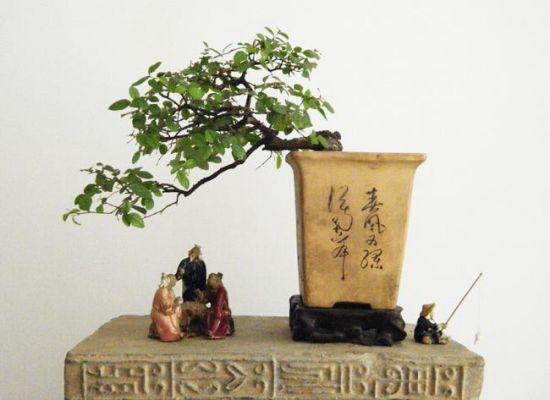
Prune at the right time
The usual pruning time is late spring and early autumn, the two seasons when Sageretia thea stumps have the strongest sprouting ability and the most vigorous growth. Water shoots, overlapping branches, crossing branches, radiating branches, dead branches and pest- or disease-damaged branches should be cut away at any time. But note that in the high heat of summer, new leaves sunburn easily and may curl, so after pruning it is best to place the plant in a shaded spot and only expose it to strong light once it has sprouted normally.
Pest and disease control
The pests of Sageretia thea are not exactly trouble-free. The main pest is the longhorn beetle, also called the heart-boring worm. After the female longhorn beetle bites through the bark of the Sageretia thea, she lays her eggs on the branches and trunk; once the eggs hatch, the larvae gnaw continuously, and after growing into adults they bore into the trunk and the heartwood. Slowly the Sageretia thea is hollowed out by the insects and dies. So when controlling the pest, locate its position by its excrement, then insert a thin wire into the bore hole to stab it dead, or soak a cotton ball with a 200-times dilution and plug the bore hole so the insect is poisoned by the pesticide, and finally seal the insect hole shut with wet mud.
How to make a Sageretia thea bonsai: Sageretia thea bonsai care methods
Because Sageretia thea has naturally peculiar roots and trunks, a rugged and elegantly ancient tree posture, extremely strong adaptability and no strict demands on soil, many people love to make Sageretia thea into bonsai and place them at home for viewing. So how is a Sageretia thea bonsai made, and how is it cared for in daily life? Below we introduce the making method and the care methods for Sageretia thea bonsai.
How to make a Sageretia thea bonsai
1. Obtaining material:
To make a Sageretia thea bonsai, you can use one-year-old branches for cutting propagation in March or the plum rain season; you can also do layering propagation from April to June; you can also sow seeds as they are collected when the fruit ripens, or dry them in the shade and sow them in a seedbed to raise saplings; in the provinces south of the Yangtze River you can also dig up wild old root stumps or young trees in mountain areas and, after they survive being planted in the ground to "nurture the stock", process them and pot them up.
2. Shaping:
Sageretia thea has extremely strong growth, a long lifespan, is easy to shape, sprouts very vigorously, tolerates pruning, and has soft twigs that are easy to wire. It is mostly processed by the method of coarse wiring and fine pruning; it can also be shaped by the complete pruning method (that is, the "cut-and-grow branch method"), or processed and shaped mainly by wiring with pruning as a supplement. The tree forms are often made into the slanting-trunk style, lying-trunk style, curved-trunk style, dead-wood style, double-trunk style, cascade style, exposed-root style and so on. The foliage is mostly pruned into a natural form, and can also be processed into cloud-pad or steamed-bun shapes.
3. Potting:
Transplanting and potting are best done in spring, in February to March before budding. Choose a lighter-colored zisha (purple clay) pot or glazed ceramic pot, with a relatively shallow or medium-deep rectangular or oval shape. The potting soil should be made by mixing loose, fertile, slightly acidic leaf mold, river mud and pond mud with sand. When planting in the pot, the root system should be properly trimmed; the lateral roots and fibrous roots should be mounded with loose, fertile soil; and the bottom of the pot should be lined with tile shards to aid drainage and aeration.
Sageretia thea bonsai care methods
1. Water must be sufficient
Natural water such as river water, pond water and rainwater is best. If using tap water, it should be stored for one or two days so the chlorine escapes before use, which is safer. Soapy laundry water, as well as water with grease or salt, must never be used.
2. Fertilizing needs care
If Sageretia thea is given too much fertilizer, the branches and leaves grow excessively; with too little fertilizer the branches are thin and weak, the leaves turn yellow, and it is prone to pests and diseases. So fertilizing must follow principles: newly planted, freshly potted or just repotted plants, and those whose roots have been damaged, must not be fertilized for one month. In spring and summer, the peak growth season for potted trees, more fertilizer must be applied. After autumn arrives, when potted trees grow slowly, apply less. In winter, when potted trees enter dormancy, fertilizing can be stopped. Do not fertilize on rainy days or around midday in midsummer. It is best to apply liquid fertilizer on a cloudy day or in the evening; when the potting soil is slightly dry, loosen the soil so the fertilizer water can seep into the soil. To speed up the decomposition of the fertilizer, be sure to water the next morning.
3. The potting soil must be good
Sageretia thea stumps originally grew in the wild, with well-developed root systems and tolerance of drought and waterlogging. Once dug up by people and planted in a shallow pot only inches across, their growing conditions are restricted, and with improper care they easily die, so they must be tended with special care. Choose well-draining potting soil, and during the care period it is best to put the potting soil in thicker. Replace the soil with new soil once every two years and apply some base fertilizer to keep the soil fertile, so the stump bonsai can grow normally.
4. Prune at the right time
The usual pruning time is late spring and early autumn, the two seasons when Sageretia thea stumps have the strongest sprouting ability and the most vigorous growth. Water shoots, overlapping branches, crossing branches, radiating branches, dead branches and pest- or disease-damaged branches should be cut away at any time. But note that in hot weather, new buds burn easily and the leaves may curl, so after pruning it is best to place the plant in a shaded spot and only expose it to strong light once it has sprouted normally.
5. Points to note when growing a new stump
Growing a new stump on a balcony is different from growing it in the ground. Planting too early or too late both bring a lot of trouble for care and management, and the survival rate is relatively low, so the time for digging up or buying and potting must be timely. The best time is fifteen to twenty days before the local Sageretia thea buds, around March 10. At this time the weather is gradually warming, rainfall is slowly increasing, air humidity is high, and there is no risk of severe frost damage; the newly dug stump has already revived and is stirring, has accumulated nutrients, and after potting the wound heals quickly, the regenerative power is strong and the survival rate is high. After half a month it will sprout and grow leaves.
Because a balcony has unfavorable factors such as strong wind, dryness and limited space, it is not suitable to plant new stumps in autumn. The most important thing when choosing a stump is to check whether the stump stock is fresh, and to choose small and medium-sized stump stock that grows robustly and has many fibrous roots. Large stump stock is not suitable for growing on a balcony.
The above is our introduction to the making methods and care methods for Sageretia thea bonsai. We hope it can help you. For more home knowledge, please stay tuned.
Making and caring for Sageretia thea bonsai
Known as one of the "seven sages of bonsai", Sageretia thea holds an important place in Chinese gardens. Sageretia thea belongs to the Rhamnaceae family; its form is rugged and elegantly ancient, it is one of the five famous trees of Lingnan bonsai, and it is also one of the tree species first spread from our country to the world. The fruit of Sageretia thea is edible, with a taste that is sweet with a touch of sour, and it is also called sour plum fruit.
Making a Sageretia thea bonsai
If you want to cultivate Sageretia thea, you can refer to the following steps:
1. In the rainy season each year, propagate the branches by cuttings; after the rainy season, propagate by layering; or cultivate the original old tree roots and new seedlings separately.
2. Sageretia thea has very strong growth, tolerates pruning, is easy to shape, and has soft branches. Prune its branches appropriately to ensure nutrients are not lost.
3. The best season for potting is spring. For the pot, it is best to choose a light-colored zisha (purple clay) pot or glazed ceramic pot, preferably oval. For the soil, river mud, pond mud and slightly acidic leaf mold can be mixed with sand in proportion. Before potting, trim the roots appropriately, and place tile shards at the bottom of the pot for drainage and aeration.
Caring for Sageretia thea bonsai
To cultivate Sageretia thea well, besides the basics, we must also care for it properly. As for care, we can start with humidity and temperature.
Sageretia thea likes a hot and humid climate. The humidity of the growing environment is best kept at 70%-80%; if the humidity is too low, the lower leaves will turn yellow and drop. Because Sageretia thea is a subtropical tree species, it likes high temperatures, and the lowest temperature of the growing environment should preferably not fall below 10°C. Around frost, do a good job of keeping Sageretia thea warm. Spring, summer and autumn are the peak growth seasons for Sageretia thea. In summer, place Sageretia thea in a place with air circulation, which helps it dissipate heat better. Also mist it appropriately, twice a day. In winter, place Sageretia thea in a spot with ample light; if the temperature is too low, you can wrap it in plastic wrap, but at midday, when the temperature rises, remove the plastic wrap.
Besides the seasons, we should also grasp the following care points well:
1. Watering: rainwater and river water are best. If you water with tap water, first prepare the water and let it sit for a day; this is done so the chlorine in the water disperses. Water from washing vegetables, water from rinsing rice and water used for washing clothes must never be used.
2. Fertilizing: fertilizing must be kept to the right amount. Too much and the branches and leaves grow wildly; too little and the branches and leaves turn yellow and decline. So when fertilizing, please remember: for Sageretia thea that has just been repotted, because its roots are damaged, it must not be fertilized for one month. Spring and summer are the early growth period of Sageretia thea, so apply more fertilizer. Apply less fertilizer in autumn, because by then the growth rate of Sageretia thea has already slowed. In winter, do not fertilize. Do not fertilize on rainy days, and do not fertilize at midday in summer; a cloudy day or the evening is the best time to fertilize, and loosen the soil before fertilizing.
3. Soil: We have already introduced the soil requirements above, but we should add that the soil must be replaced with new soil once every two years!
We hope you can cultivate a Sageretia thea bonsai you love.