How to care for Chinese sweet plum (Sageretia thea) in winter? Master the care essentials for a safe winter
Watering
Pay special attention to how you water a Sageretia bonsai in winter. The Sageretia bonsai enters dormancy in winter and basically needs no water, so watering lightly or not at all is best.
Temperature control
The Sageretia bonsai is naturally not cold-hardy, so keeping it warm is essential. In winter it should be moved indoors for care, especially in the northern regions of our country, where it should be placed in a spot indoors that gets sunlight. If kept outdoors, wrap it in clear plastic film, and every two days, when the temperature is higher around noon, uncover the film to let the Sageretia breathe.
Humidity
The Sageretia bonsai likes a humid environment, and it is best to keep it where the relative air humidity is high, reaching about 70 to 80 percent. If the relative air humidity is too low, the lower leaves of the Sageretia will turn yellow and drop, and the upper leaves will lose their luster. In the northern regions of our country, indoor heating is used in winter, but it is fairly dry, so spray water on the leaves to maintain the humidity of the environment.
Light
In winter, keep the light as abundant as possible, and try to place the Sageretia bonsai in a spot with good light, such as the living room, bedroom, study, or balcony.
Fertilizing the Sageretia bonsai in winter
During its winter dormancy, the Sageretia bonsai basically stops growing and has a low demand for fertilizer, so no fertilizing is needed.
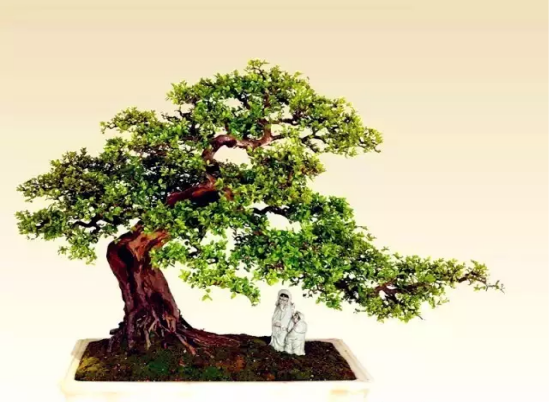
Sageretia bonsai care essentials, Sageretia bonsai picture appreciation
Image: Sageretia bonsai
[Common questions] Sageretia bonsai care essentials, Sageretia bonsai picture appreciation
[Expert answer]
1. Pruning: A Sageretia stump bonsai can be pruned and shaped year-round. At any time, cut off leggy shoots and overly dense branches that spoil the shape, so the stump keeps a graceful form, with branches and leaves properly spaced, good ventilation and light penetration, and fewer pests and diseases.
2. Fertilizing: For a Sageretia bonsai, you can seal cake fertilizer and kitchen waste in a jar to ferment, then take the upper layer of fertilizer liquid, dilute it with 4 to 5 times its volume of water, and apply it. Sageretia is an acid-loving plant, so add 1% ferrous sulfate to the fermented fertilizer liquid before applying; when Sageretia sprouts, spray 1 to 2 times with 0.1% urea; before and after flowering, spray once with 0.1% to 0.2% monopotassium phosphate, etc.
3. Watering: Be careful not to let the potting soil become too wet or too dry. In the dog days of summer, water once in the morning and once in the evening. To shorten the branches and leaves and make the form more attractive, you can control water appropriately during the spring and summer growing seasons.
4. Repotting: Repot a Sageretia bonsai once every 3 to 4 years, preferably before bud break in spring. When repotting, appropriately prune away some old roots, dead roots, and overly long or dense roots, replace 1/2 of the old soil, and fill in with fertile, loose potting soil to promote the growth and development of new roots.
5. Shading: A Sageretia bonsai has little soil and shallow roots, so harsh sun can easily scorch or kill young buds, young shoots, and young leaves. Therefore, shade is necessary in summer; set up a shade frame or move it indoors, under the eaves, or into tree shade, or other places without direct sunlight.
6. Temperature: A Sageretia bonsai has poor cold hardiness and is prone to freezing, drying up, and even dying. So in winter it should be placed indoors, with attention to ventilation, and the room temperature kept above 5°C; when the room temperature exceeds 25°C, you can open the windows to avoid leggy growth caused by high temperatures; when the room temperature is below 5°C, you can wrap it in plastic for warmth (remove the plastic bag once the temperature is above 5°C); when the room temperature is below 0°C, use methods such as heating with hot water to raise the temperature, ensuring the Sageretia bonsai safely overwinters.
7. Pests and diseases: A Sageretia bonsai is easily harmed by pests and diseases. The main pests include: tea tortrix, which can be killed by spraying with 2000 times dilution of 35% phosalone emulsion; longhorn beetles, which can be killed by applying lime sulfur mixture; and scale insects, which can be removed by brushing them off by hand.
[Editor's comments] Sageretia is divided into large-leaf Sageretia and small-leaf Sageretia. For making bonsai, it is best to choose small-leaf Sageretia, because small-leaf Sageretia is more conducive to bonsai shaping. The editor of First Agricultural Economics above shared with you the care essentials for Sageretia bonsai and provided some pictures for everyone to enjoy. We hope you like them.
Sageretia management essentials
Sageretia, also known as duijieci, Sageretia thea, sour fruit, and sour-seed tree, is a deciduous climbing shrub of the genus Sageretia in the buckthorn family. The bark is grayish brown, and the small branches are slender with prickles. The simple leaves are opposite, ovate or elliptical, with fine serrated edges, thinly leathery and bright green. In autumn and winter it blooms small pale yellow flowers; the drupe is nearly spherical, purplish black when ripe, edible, and tastes sour with a hint of sweetness. Its roots and trunk are naturally peculiar, and its tree form is vigorous and antique and elegant. It is one of the main tree species for Chinese stump bonsai, one of the five famous trees in Lingnan bonsai, and also one of the bonsai plants exported from China to the United States after China's entry into the WTO.
Humidity management:It likes a humid climate environment and requires the relative air humidity of the growing environment to be 70 to 80%. If the relative air humidity is too low, the lower leaves turn yellow and drop, and the upper leaves lose their luster.
Temperature management:Because it originates from tropical regions, it likes high-temperature and high-humidity environments, so it has very strict requirements for winter temperatures. When the ambient temperature is below 10°C, it stops growing, and when frost appears, it cannot safely overwinter. Sageretia
In summer:Strengthen air convection so that the heat inside the plant can be released; place it in semi-shade, or give it 50% shade; spray it appropriately, 2 to 3 times a day.
In winter:Move it indoors to a bright spot for care; outdoors, you can wrap it in film to overwinter, but every two days, when the temperature is higher around noon, uncover the film to let it breathe.
Light management:It likes a semi-shady environment. In autumn, winter, and spring, you can give it plenty of sunlight, but in summer, shade it by more than 50%. When caring for it indoors, place it in as bright a spot as possible, such as a well-lit living room, bedroom, study, or similar place. After caring for it indoors for a period (about one month), move it outdoors to a shaded spot (with warmth-keeping conditions in winter) for care for a period (about one month), and alternate back and forth like this.
Fertilizer and water management:For potted plants, in addition to adding organic fertilizer when potting, you should also carry out appropriate fertilizer and water management during regular care.
Spring, summer, and autumn:These three seasons are its peak growing seasons. Fertilizer and water management follows the cycle of "Huabao" - clear water - "Huabao" - clear water, with an interval of about 1 to 4 days. On sunny days or during high temperatures, the interval is shorter; on rainy days or during low temperatures, the interval is longer, or do not water.
In winter, during the winter dormancy period, the main task is to control fertilizer and water well. Fertilizer and water management follows the cycle of "Huabao" - clear water - clear water - "Huabao" - clear water - clear water, with an interval of about 3 to 7 days. On sunny days or during high temperatures, the interval is shorter; on rainy days or during low temperatures, the interval is longer, or do not water. For plants grown in the ground, in spring and summer, according to drought conditions, apply fertilizer and water 2 to 4 times: first dig a small ring-shaped trench 30 to 100 cm outside the root collar (the larger the plant, the farther from the root collar), with the trench 20 cm wide and 20 cm deep. Sprinkle 25 to 50 jin of organic fertilizer into the trench, or 1 to 5 liang of granular compound fertilizer (chemical fertilizer), then water thoroughly. After winter begins and before spring arrives, apply fertilizer once more in the same way as above, but do not water.