How to grow Spathodea campanulata (African tulip tree)? Detailed guide to care precautions
I. Common diseases
Damping-off is the most important disease of Spathodea campanulata (African tulip tree), occurring mainly during the rainy spring season and causing severe damage. Both mature Spathodea campanulata trees and seedlings are affected by this disease. The main symptom is the appearance of dark brown lesions on the affected parts, and in severe cases it can even cause large areas of plants to die off in patches. In response, we should take the following measures.
① Promptly remove and burn the affected plants to prevent the disease from spreading to other plants.
② Select plants that have not been affected by the disease for transplanting. In addition, the soil must be disinfected and free of pathogens. After planting, be sure to apply rotted compost!
③ Soil disinfection is the key point. It is recommended to use 50 ml of formaldehyde mixed with 6 kg of water per square meter of soil for disinfection, or alternatively, mix pentachloronitrobenzene (PCNB) with fine sandy soil in proportion and spread it on the seedbed for growing Spathodea campanulata seedlings. Both methods can prevent diseases at the source.
④ In spring, before any symptoms are found, spray once every 10 days with 70% thiophanate-methyl 1000x solution or 75% chlorothalonil 1000x solution. This is done to nip the disease in the bud.
II. Common pests
The main pests of Spathodea campanulata (African tulip tree) include aphids, geometer moths, cutworms, and scarab beetles. Aphids can induce sooty mold; the larvae of geometer moths and noctuid moths eat young leaves; the larvae of cutworms and scarab beetles bore into and feed on the root system.
To control aphids, spray 5% diesel emulsion or 3-5 degree Beaume lime sulfur mixture before bud break, in order to kill overwintering adults and eggs. Spray again after flowers fall, and spray a third time in October in autumn. Note that to control geometer moth and noctuid moth larvae, treat early and when they are small. For these, spray 50% methamidophos 1500x solution. Cutworm and scarab beetle larvae are underground pests. The control method is to strengthen nursery management and not apply unrotted organic fertilizer. Plow in winter to turn overwintering larvae up to the soil surface to freeze to death.
The above is the editor's compilation of the growing methods for Spathodea campanulata (African tulip tree) and the control methods for its main diseases and pests. We hope it will be helpful for your future cultivation of Spathodea campanulata. Thank you for reading.
Propagation methods of Spathodea campanulata (African tulip tree) Growing methods and precautions for Spathodea campanulata
Flower Bonsai Network introduction: Today, the editor of Flower Bonsai Network shares with you an article about the propagation methods of Spathodea campanulata (African tulip tree), and its growing methods and precautions. Let's take a look.
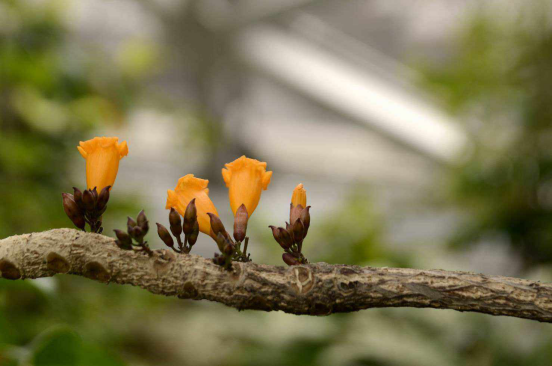
Spathodea campanulata (African tulip tree) is a small tree. Its flowers are orange and very vivid. When it blooms, it looks like a burning flame, which is very fitting. Today we will learn about the propagation methods of Spathodea campanulata.
Seed propagation of Spathodea campanulata (African tulip tree)
Seed propagation is the main propagation method of Spathodea campanulata (African tulip tree).
Spathodea campanulata can bloom in many seasons, so we can collect seeds in many seasons, and therefore we generally use seed propagation to propagate Spathodea campanulata. The method for collecting Spathodea campanulata seeds is to pick the mature fruits, place them in a windless environment to dry, and after cracks appear from drying, gently knock the seeds out. In this way, we have collected the seeds of Spathodea campanulata. We can store the seeds over winter and sow them when the suitable season arrives.
We generally sow the seeds in spring when it is warmer. Because the seeds of Spathodea campanulata are very small, we usually broadcast them directly on the soil, then cover them with a thin layer of soil, maintain a temperature of about 25°C, and at the same time keep the soil moist. It takes about one week to germinate, and it takes three to five years of growth to bloom.
Cutting propagation of Spathodea campanulata (African tulip tree)
Cutting propagation is generally not used for propagating Spathodea campanulata, because the survival rate of plants propagated this way is relatively low. To improve the survival rate of cutting propagation, we can use vegetative propagation methods. The air layering method can effectively improve the survival rate of Spathodea campanulata cutting propagation. Plants propagated by this method are generally used for potted cultivation.
Spathodea campanulata successfully propagated by this method generally blooms in one to two years.
Growing methods and precautions for Spathodea campanulata (African tulip tree)
Spathodea campanulata is a woody plant with a relatively robust nature and is relatively easy to grow. Using Spathodea campanulata as an ornamental tree species and admiring its brilliant flowers is also very poetic.
Growing methods for Spathodea campanulata (African tulip tree)
Soil
Spathodea campanulata likes deep soil with fertility. Neutral or slightly acidic soil with good drainage is best. It can tolerate poor soil. When planting, a certain amount of base fertilizer needs to be applied.
Light and temperature
Spathodea campanulata likes light and prefers a warm growing environment. It can tolerate heat but not cold. The suitable growing temperature is between 23°C-30°C. In winter, it can tolerate temperatures around 0°C, but it cannot remain in a low-temperature state for a long time, as this will cause frost damage to the plant. Generally, when growing Spathodea campanulata in China, open-field planting can be done in South China, while in other regions it needs to be potted in winter and moved indoors for care. Spathodea campanulata likes a growing environment with abundant sunlight. Only with sufficient light will it grow well, but it can also tolerate partial shade.
Watering and fertilizing
Spathodea campanulata has low water and fertilizer requirements. During the growing period, attention should be paid to timely water replenishment, especially during high temperature and drought. Fertilizing should be based on soil fertility. During the growing period, fertilizer should be appropriately supplemented, mainly by light and frequent applications, with 3-5 applications per year. More nitrogen fertilizer can be applied, and in autumn, additional phosphorus and potassium fertilizer should be applied.
Precautions for growing Spathodea campanulata (African tulip tree)
Propagation methods
The commonly used methods for propagating Spathodea campanulata are cutting, sowing, or layering, all of which can be done in spring.
Common diseases and pests
The common disease of Spathodea campanulata is damping-off, which mainly occurs during the rainy spring season and causes severe damage. The main pests are aphids, Daopan noctuid moths, yellow noctuid moths, geometer moths, large and small cutworms, and scarab beetles, etc. These pests all cause more or less harm to Spathodea campanulata and need to be controlled in a timely manner.
Pruning
Spathodea campanulata is a plant that tolerates pruning relatively well. It can be pruned regularly to maintain its plant shape.
Growing methods and precautions for Spathodea campanulata (African tulip tree)
Growing methods for Spathodea campanulata (African tulip tree)
Soil
Spathodea campanulata likes deep soil with fertility. Neutral or slightly acidic soil with good drainage is best. It can tolerate poor soil. When planting, a certain amount of base fertilizer needs to be applied.
Light and temperature
Spathodea campanulata likes light and prefers a warm growing environment. It can tolerate heat but not cold. The suitable growing temperature is between 23°C-30°C. In winter, it can tolerate temperatures around 0°C, but it cannot remain in a low-temperature state for a long time, as this will cause frost damage to the plant. Generally, when growing Spathodea campanulata in China, open-field planting can be done in South China, while in other regions it needs to be potted in winter and moved indoors for care. Spathodea campanulata likes a growing environment with abundant sunlight. Only with sufficient light will it grow well, but it can also tolerate partial shade.
Watering and fertilizing
Spathodea campanulata has low water and fertilizer requirements. During the growing period, attention should be paid to timely water replenishment, especially during high temperature and drought. Fertilizing should be based on soil fertility. During the growing period, fertilizer should be appropriately supplemented, mainly by light and frequent applications, with 3-5 applications per year. More nitrogen fertilizer can be applied, and in autumn, additional phosphorus and potassium fertilizer should be applied.
Precautions for growing Spathodea campanulata (African tulip tree)
Propagation methods
The commonly used methods for propagating Spathodea campanulata are cutting, sowing, or layering, all of which can be done in spring.
Common diseases and pests
The common disease of Spathodea campanulata is damping-off, which mainly occurs during the rainy spring season and causes severe damage. The main pests are aphids, Daopan noctuid moths, yellow noctuid moths, geometer moths, large and small cutworms, and scarab beetles, etc. These pests all cause more or less harm to Spathodea campanulata and need to be controlled in a timely manner.
Pruning
Spathodea campanulata is a plant that tolerates pruning relatively well. It can be pruned regularly to maintain its plant shape.