How to Grow and Care for Dwarf Flowering Cherry (Prunus japonica)
I. Temperature
The dwarf flowering cherry (Prunus japonica) is native to China. Unlike its delicate appearance, it can grow strongly even in the three northeastern provinces, so its vitality is extremely tenacious, and it is a very easy plant to keep alive! However, the dwarf flowering cherry prefers a warm and humid environment, so although you do not need to worry about the temperature conditions when growing it, you should still give it some attention. Do not be careless and set it aside just because it is easy to grow!
II. Watering
Humidity, as I just told everyone, the dwarf flowering cherry likes to grow in a warm and humid environment. So here comes the key point - when growing the dwarf flowering cherry, be sure not to let it dry out. It needs to be watered every day for it to produce beautiful flowers. But do not rush things; watering should be appropriate. If you water too much and cause waterlogging, the dwarf flowering cherry will get root rot!
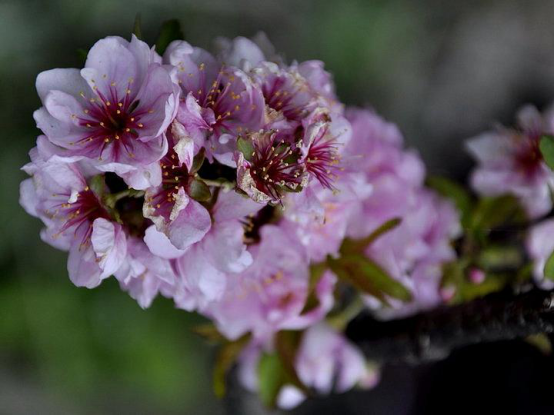
III. Soil
Soil: Although the dwarf flowering cherry looks like a delicate little girl, its requirements for soil are actually not strict. The dwarf flowering cherry is a plant that is very tolerant of poor soil; even if it is planted in slightly alkaline or even slightly acidic soil, it can still grow strongly. However, if conditions allow, it is of course best to plant the dwarf flowering cherry in fertile sandy loam with good drainage and rich nutrients!
IV. Light
The dwarf flowering cherry likes a semi-shaded environment. If it is planted in a sunny, well-lit, stuffy location, the dwarf flowering cherry will show poor growth. So the location for planting the dwarf flowering cherry must be chosen carefully!
The dwarf flowering cherry is so beautiful that many people may wonder whether it is toxic. So next, let us look at an introduction to whether the dwarf flowering cherry is toxic.How to Grow Dwarf Flowering Cherry and Its Benefits and Effects
The dwarf flowering cherry is a shrub in the genus Prunus. Its flowers grow in clusters, blooming together with the leaves or before the leaves, with white or pink petals, and it is very beautiful. So how do you grow the dwarf flowering cherry? What benefits and effects does it have? Let us learn about it together below.
I. How to Grow Dwarf Flowering Cherry
1. Temperature: The dwarf flowering cherry likes a slightly humid to dry climate environment. It is cold-hardy. During high summer temperatures, it cannot tolerate stuffiness, otherwise it will enter a semi-dormant state and its growth will be hindered. The most suitable growth temperature is 15-30°C. It likes a semi-shaded environment and grows poorly in strong sunlight and stuffy conditions.
2. Planting: The dwarf flowering cherry has strong adaptability, so cultivation and management are relatively simple and extensive. Transplanting needs to be done after leaf drop and before bud break. When planting in February-March in spring, apply decomposed compost as a base fertilizer in the hole, and water thoroughly after planting. After it survives, it can be watered only during drought. To make the plant bloom abundantly and grow lush foliage, in the first two or three autumns after it survives, apply 1-2 shovelfuls of decomposed compost beside the plant.
3. Watering: For newly planted dwarf flowering cherry, apply sufficient base fertilizer in the planting hole before planting. After planting, water thoroughly the first time to settle the roots, water a second time after 7 to 10 days, and water 3 times in succession, then seal the basin promptly after watering. Water appropriately during drought.
4. Fertilizing: Apply fertilizer once before leaf expansion in early spring and once before flowering in April, with 1 kg of organic fertilizer per plant. In autumn, apply 0.5 kg of diammonium phosphate per plant. For field-planted plants, according to drought conditions in spring and summer, apply fertilizer water 2-4 times. First dig a small ring-shaped trench 30-100 cm outside the root crown (the larger the plant, the farther from the root crown), with the trench 20 cm wide and 20 cm deep. Scatter 25-50 jin of organic fertilizer into the trench, or 1-5 liang of granular compound fertilizer (chemical fertilizer), then water thoroughly.
5. Pruning: During growth, its root suckering ability is very strong and needs to be controlled. Root suckers should be removed regularly to maintain a fine and upright plant shape. For young trees, the trunk can be headed at a seedling height of 30 cm. For mature trees, thinning branches should be the main approach. After flowering, promptly cut off remaining flower branches, and prune diseased and insect-damaged branches, overly dense branches, weak slender branches, and dead branches inside the clump.
II. Benefits and Effects of Dwarf Flowering Cherry
1. Medicinal effects: The seeds of the dwarf flowering cherry (Yuliren): pungent, bitter, sweet, neutral. They moisten dryness and lubricate the intestines, descend qi, and promote urination. They are used for dry intestines due to depleted fluids, food accumulation with qi stagnation, abdominal distension and constipation, edema, beriberi, and painful urinary dribbling. The seed kernel is used as medicine under the name Yuliren. Preparations of the dwarf flowering cherry and Yuliren have a significant blood pressure-lowering effect.
2. Ornamental value: The dwarf flowering cherry is an ornamental flowering tree beautiful in both flowers and fruit. It is suitable for mass planting and is well suited for planting in front of steps, beside houses, on mountain rock slopes, or as accents at forest edges and around lawns. It can also be cultivated for flower paths and flower hedges.
The above isHow to Grow Dwarf Flowering Cherryand an introduction to the benefits and effects of the dwarf flowering cherry. Its flowers can be enjoyed ornamentally, and its seeds can be used medicinally. Do you want to grow it?
How to Grow and Care for Dwarf Flowering Cherry (Prunus japonica)
Habits of the Dwarf Flowering Cherry
The dwarf flowering cherry likes a sunny, warm and humid environment. The tree is robust and highly adaptable, tolerant of cold, heat, drought, moisture, and smoke and dust. See, the dwarf flowering cherry is said to be this tough. Its root system is well developed.
How to Grow Dwarf Flowering Cherry
Temperature
The dwarf flowering cherry likes warm and humid places. It is originally from our country, and it can basically grow healthily in the provinces and cities of North China, South China, and Central China, and basically also in places such as Heilongjiang, Jilin, and Liaoning. So everyone does not need to worry about the temperature issue for the dwarf flowering cherry!
Humidity
As said earlier, the dwarf flowering cherry likes a warm and humid environment, so when growing the dwarf flowering cherry, be sure not to let it dry out. The dwarf flowering cherry can tolerate moisture, but please remember, moisture does not equal waterlogging. If waterlogged, the dwarf flowering cherry will also get root rot!
Soil
The dwarf flowering cherry is not strict about soil and is very tolerant of poor soil. It can grow in slightly alkaline soil and can also adapt to slightly acidic soil. However, the dwarf flowering cherry grows more vigorously in calcareous soil.
But the most suitable soil for the dwarf flowering cherry is still well-drained, neutral, fertile, loose sandy loam.
Notes on Growing Dwarf Flowering Cherry
1. When watering, note that you should not wait until it dries out before watering; it is best to keep the soil of the dwarf flowering cherry moist at all times.
2. During high temperatures, the dwarf flowering cherry cannot tolerate stuffiness, so it is best to place it in a cool, ventilated place.
3. During the drought-prone periods of spring and summer, observe the dwarf flowering cherry carefully and apply fertilizer water 2-4 times.