A detailed guide to fiddle-leaf fig propagation methods, teaching you how to easily propagate new plants
1. Cutting the cuttings.
When propagating fiddle-leaf fig by cuttings, it is best to choose one- to two-year-old branches, cut them off 20 to 30 cm above the soil surface in the pot, then cut the removed branches into sections of three or four nodes as cuttings. Each cutting should keep one leaf, and about two-thirds of the leaf should be cut off, which can reduce water evaporation.
2. Rooting the cuttings.
Soak the wounds of the cuttings with the leaves already prepared in water, or coat the wounds with some plant ash to stop the sap from flowing out. Then insert the cuttings into a cutting bed made of river sand or perlite, taking care to maintain the temperature and the air humidity in the environment. Generally, in an environment of 27 to 28 degrees, roots will grow in about one month. After the roots have grown, they can be transplanted into flower pots for care and growth.
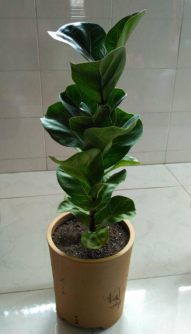
Fiddle-leaf fig Ficus lyrata fiddle-leaf fig illustrated guide: how to grow fiddle-leaf fig / how to propagate fiddle-leaf fig
Fiddle-leaf fig profileFiddle-leaf fig Ficus lyrata
Fiddle-leaf fig cultivation methods and precautions fiddle-leaf fig introduction
The fiddle-leaf fig, also known as the fiddle-leaf rubber tree, is named for its leaf tips that swell into the shape of a violin. It is an evergreen tree of the genus Ficus in the mulberry family. The fiddle-leaf fig can reach 12 m in height, with an upright stem that rarely branches, and leaves that grow densely. The leaves are thickly leathery, dark green, glossy, with sunken veins and relatively short internodes. The fiddle-leaf fig has high ornamental value and is an ideal foliage plant for large halls.
Morphological characteristics of the fiddle-leaf fig
Fiddle-leaf fig, also known as: milk tree, mouse milk plant, milk-sap tree, bone-wind wood, iron ox entering stone, milk wood. Deciduous small shrub. Height 1-2 m. Young branchlets and petioles are covered with white short soft hairs when young, later hairless, often red-purple. Leaves alternate, simple, highly variable, violin-shaped or obovate, 4-10 cm long, 1.5-4.5 cm wide, base rounded or broadly wedge-shaped, apex abruptly pointed, the middle often more or less contracted to form a narrow waist shape, hairless on both sides, sometimes with short soft hairs beneath, petiole 4-8 mm long, receptacle solitary or in pairs in leaf axils, with a short stalk, ovate or pear-shaped, purple-red when hot, 10 mm in diameter, with an umbilical protrusion at the apex, 3 bracts at the base, male flowers and gall flowers growing together in one receptacle, female flowers growing in another receptacle, perianth 4, style lateral.
Ecological habits of the fiddle-leaf fig
It prefers a warm, humid environment with plenty of sunlight. The optimum growth temperature is 25°C to 35°C, it goes dormant at around 15°C, and it can overwinter safely above 5°C. Its water requirement is to keep it moist rather than dry. It is native to Sierra Leone to Morocco in West Africa, in lowland tropical rainforests, and is widely cultivated in the tropics and subtropics, and also cultivated indoors and in greenhouses in temperate regions. Without the introduction of its specific pollinating fig wasp, it will not become an invasive plant.
In its place of origin, the plant can reach 12 m in height, while indoors it grows slowly and the plant can remain very small. Pruning the terminal bud can control its height, and growing it in a small pot can control its plant size. The leaves can reach 30 cm long and 6 cm wide, smooth, dark green, with obvious veins, and can be wiped with a damp cloth to keep them moist and attractive.
Repot in spring, prune in winter. The pot should be small but heavy. This tree easily becomes top-heavy, so the flower pot must be prevented from tipping over. Both too much water and insufficient water can cause the leaves to turn yellow and drop. The bottom of the pot needs holes to maintain good drainage. Water thoroughly once, and wait until the soil is dry before watering again.
It prefers plenty of light but not direct sunlight. Potted plants can be rotated 90 degrees once a week so that they receive light evenly.
Distribution area of the fiddle-leaf fig
Native to Africa, available on the market. Note the difference: this species (Ficus lyrata) is also called "large fiddle-leaf fig", and is not the traditionally so-called fiddle-leaf fig (Ficus pandurata); Ficus pandurata grows wild in China.
Main distribution areas: Anhui, Fujian, Guangdong, Guangxi, Guizhou, Hainan, Henan, Hubei, Hunan, Jiangxi, Sichuan, southeastern Yunnan, Zhejiang, Thailand, Vietnam.
Cultivation techniques of the fiddle-leaf fig: propagation methods
The fiddle-leaf fig is mostly propagated by cuttings, layering and other methods. With the development of tissue culture technology, tissue-cultured fiddle-leaf figs are produced on a large scale, and their quality is much better than those propagated by cuttings or layering, with strong resistance and fast growth.
The fiddle-leaf fig is generally propagated by cuttings or air layering. For cuttings, choose 1-2 year old branches, cut them 20-30 cm above the soil surface in the pot, cut the stems into 3-4 node segments as cuttings, keep one leaf on each cutting, and cut off 2/3-3/4 of the leaf to reduce water evaporation; first soak the wounds of the cuttings in water or coat the wounds with plant ash, etc., to prevent the sap from flowing out; insert the cuttings into a cutting bed made of river sand or perlite, and take care to maintain the bed temperature and the relatively high air humidity around them. At a temperature of 25-30°C, roots can form in about one month. After the trunk is cut back, because its apical dominance has been destroyed, hidden buds at the stem nodes can sprout new shoots and can form a branching tree shape; after the new shoots age, cuttings can be taken again. The air layering method is also a common method for propagating the fiddle-leaf fig; for the specific operation method, see weeping fig.
For potted fiddle-leaf figs, a mixture of 1 part peat soil, 1 part garden soil and 1 part river sand is commonly used as the base, with a small amount of decomposed base fertilizer added at the same time. Because its leaves are broad and large, it has a relatively high fertilizer requirement, so during the growing season it generally needs liquid fertilizer or granular compound fertilizer every 1-2 weeks to promote plant growth and deep green leaves; generally no fertilizer is applied in late autumn and winter. In spring and summer, the fiddle-leaf fig grows a lot and needs more water, so sufficient water must be given, while also increasing foliar spraying. The fiddle-leaf fig is suitable for growing in a semi-shaded environment; in summer, avoid direct sunlight to prevent scorching the leaves and causing them to lose their luster. But if the light is too weak, the plant will grow thin and weak, so it must be given relatively bright light to facilitate robust growth. During the growing season, it generally grows better under 50% shading. Compared with other Ficus plants, the fiddle-leaf fig has relatively weak cold resistance, with an overwintering temperature of 8°C. In order to improve its cold resistance, in addition to controlling the amount of watering in late autumn and winter, phosphorus and potassium fertilizer can be applied about one month before winter arrives.
Water and fertilizer management
It likes moist soil and has a relatively wide tolerance for water requirements. It is not strict about soil and not strict about fertilizer. In production, Peters Professional 20-20-20 can be used together with calcium and potassium fertilizer for irrigation. The Fairy fiddle-leaf fig grows relatively fast. In the first month the seedlings are small and do not need much fertilizer, so use Peters Professional 20-20-20 diluted 1000 times for irrigation; in the following four months, the plant shape is already relatively compact and large, and the fertilizer requirement gradually increases, so Peters Professional 20-20-20 diluted 800 times + 5000 times calcium nitrate + 5000 times potassium nitrate can be used together for irrigation, and the calcium and potassium fertilizer can enhance the lignification of the stems.
Temperature management
The optimum growth temperature is 25°C to 35°C, it goes dormant at around 15°C, and it can overwinter safely above 5°C. In winter, double-layer insulation facilities can be used, and on winter afternoons when the temperature drops to 22-24 degrees, the greenhouse should be sealed in time. In summer, it can be grown in a simple shed.
Humidity management
The leaves of the fiddle-leaf fig are relatively leathery and not strict about humidity; keeping the humidity at around 60% is sufficient.
Light management
The fiddle-leaf fig has strong adaptability to light and can grow well under bright scattered light. In summer, direct sunlight should be avoided; if placed outdoors, it must be shaded, and in winter the light should be increased. In spring, light should be controlled at 20000-25000Lx; in summer, because the temperature is relatively high, with high temperature and high humidity, shading and ventilation should be strengthened, and light controlled at 1.5-2 wan Lx is relatively ideal; in autumn and winter, the temperature is relatively low, and light should be controlled at 25000-30000Lx or full sun. Too much shading will cause excessive spindly growth and thin, weak stems, affecting the ornamental effect.
Planting technology: substrate preparation
Use imported peat of 5-40mm specification that is loose and has good drainage and aeration. Crush the peat and mix it evenly with water (standard for adding water: after mixing with water, when you tightly squeeze a handful of peat, water seeps out from between your fingers). Then plant it in cups. For a 12cm pot, the peat usage per pot is about 300 ml, and one bag of 300 liters of imported peat can fill about 1000 cups. [4]
Repotting
For old pots that are reused, they must be soaked in 1000 times potassium permanganate solution for more than half an hour, then rinsed with clean water and dried for later use. Small potted plants are generally grown in pots with a caliber of 12cm. When planting, first place about 2cm of substrate at the bottom of the cup, then move the screened seedlings into the cup. Small seedlings should not be planted too deep, and it is appropriate to keep them level with the base of the plant; the substrate should be moderately firm, filled to 9 parts full of the cup, 1 plant/pot.
Disease control of the fiddle-leaf fig: damage
Phytophthora rot occurs to varying degrees in fiddle-leaf fig cultivation and introduction areas. It harms the leaves and stems of the fiddle-leaf fig, causing the leaves to wither and die or the whole plant to die.
Symptoms
After the leaf area is infected, water-soaked gray lesions appear, rapidly enlarge, and develop into dark brown and rot. After the stem is infected, dark brown lesions appear; if the lesion girdles the stem, the part above it dies.
Control
1. Strengthen cultivation management and enhance plant disease resistance. For planting the fiddle-leaf fig, sandy loam or loam should be chosen, with good drainage, full sun or half sun, requiring good ventilation and relatively high temperature, not lower than 10°C in winter. Avoid continuous cropping in the nursery. Apply compound organic fertilizer and prevent excessive application of nitrogen fertilizer. In summer, place it outdoors in a semi-shaded place or in a humid place with relatively sufficient light. For indoor viewing, it should be placed in a place with light and ventilation, and the time should not be too long. In winter, it should be placed indoors in a warm, ventilated and sunny place; do not water too much, just keep the soil moist, and pay attention to removing dust from the leaf surface to keep the leaves clean and dry.
2. After potted plants become diseased, they should be quickly moved to a ventilated, sunny place with sufficient light. Do not spray water on the leaves, and severely diseased leaves should be cut off. For lightly diseased leaves, the lesions together with part of the healthy tissue can be cut off, then spray Bordeaux mixture for protection, or spray 80% zineb wettable powder 500 times solution, 25% metalaxyl wettable powder 500~800 times solution, etc., and pay attention to rotating the agents.
3. After diseased and dead plants are removed, the soil should be drenched with 1% copper sulfate or sprinkled with quicklime powder, etc., for disinfection.
Landscape uses of the fiddle-leaf fig
The plant is tall, upright and elegant, with peculiar leaves whose tips swell into the shape of a violin. The fiddle-leaf fig has high ornamental value and is an ideal foliage plant for large halls. It can also be used to decorate meeting rooms or offices. It is a relatively popular garden tree, street tree and potted tree at home and abroad today, and has strong resistance to air pollution and dust.
Fiddle-leaf fig pictures
How does the fiddle-leaf fig propagate? Propagation methods of the fiddle-leaf fig
The fiddle-leaf fig is a common indoor foliage plant with high ornamental value. Therefore, many netizens ask how the fiddle-leaf fig propagates. The fiddle-leaf fig mainly has two methods of propagation: cutting propagation and layering propagation. Let us take a look at the specific propagation methods of the fiddle-leaf fig below.
Picture: fiddle-leaf fig
1. Cutting propagation of the fiddle-leaf fig
Choose 1-2 year old branches, cut them about 20-30 cm from the surface of the soil in the pot, and cut the stems into 3-4 node segments to use as cuttings. Keep one leaf on each cutting, and at the same time cut off about 2/3-3/4 of the leaf to reduce water evaporation.
First, the wounds of the cuttings need to be soaked in water or lightly coated with plant ash or the like to avoid sap flowing out. Then prepare a cutting bed cultivated with river sand or perlite, and insert the cuttings into it, taking care to maintain a suitable temperature and relatively high air humidity around them. Generally, at a temperature of 25-30°C, roots will grow after about one month. For plants whose trunks have been cut back, because their apical dominance has been destroyed, new shoots sprout from hidden buds at the stem nodes, and a branching tree shape can be formed. After the new shoots age, cuttings can be taken again.
Picture: fiddle-leaf fig
2. Layering propagation of the fiddle-leaf fig
Choose a robust semi-lignified branch growing on the lower part of the plant, gently bend it down and bury it in the soil, taking care to avoid separating the branch from the mother plant or causing damage or breakage. The branch tip needs to be exposed above the soil surface and tied with a small bamboo pole, which helps it grow upright. Before layering, the stem segment buried in the soil needs to be ring-barked, with a peeling width of about 1 cm. It is best to use an auxiliary object to fix the part of the surface branch buried in the soil to prevent the branch tip from springing up. After the layering work is completed, remember to keep the soil moist frequently and ensure good ventilation. After about 3-4 weeks, roots will form, at which time it can be cut away from the mother plant and planted separately.
The above is an introduction to the propagation methods of the fiddle-leaf fig. I hope it can be helpful to everyone!