A Detailed Guide to Growing Jasminum multiflorum, Easy for Beginners to Learn
Growing Environment:
Jasminum multiflorum is suited to growing in warm, sunny environments, usually at elevations of around 1,000 m. Because it is rather sensitive to cold, if grown in cold regions it needs to be placed in a greenhouse for overwintering. It also likes fertilizer and is suited to loose, fertile soil. The main method of propagation is in spring and summer, mainly by cuttings; choose 1-year-old thick, well-developed young shoots as cuttings, use plain sand as the substrate, keep the bed soil moist after planting, and roots will form in about 20-30 days.
Propagation Methods:
Mainly by cuttings, carried out in spring and summer, Jasminum multiflorum can propagate fairly quickly. In addition, it can also be propagated by layering.
Water and Fertilizer:
When watering Jasminum multiflorum, generally keep the potting soil moist and water moderately. In summer, applying fertilizer twice is enough, as this promotes the growth of flower buds. In autumn, stop fertilizing. In relatively dry weather, spraying water can effectively raise air humidity; after the start of autumn, less watering is needed, just enough to keep the soil from drying out.
Light and Temperature:
Jasminum multiflorum prefers a sunny, warm environment, so sufficient light is essential when growing it. However, in summer be sure to provide shade, especially at midday when temperatures are high and light is intense, when it needs even more protection from the sun. In winter, pay attention to keeping it warm; it is best to keep Jasminum multiflorum in a sunny greenhouse for care.
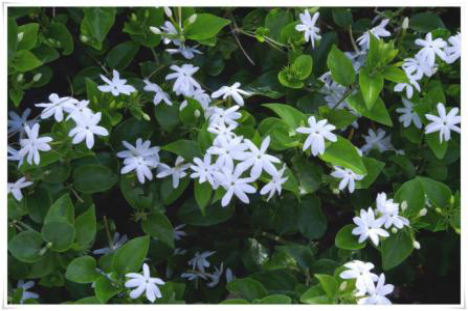
How to Grow Jasminum multiflorum, Growing Methods for Jasminum multiflorum
Jasminum multiflorum is a type of jasmine; it can treat diarrhea and abdominal pain, red swollen painful eyes, sores and swellings and other such conditions, and it can also be used as an ornamental plant. The flowers of Jasminum multiflorum are white, giving a plain and elegant feeling. The flowers give off a faint fragrance that can lift a person's mood. So how do you grow Jasminum multiflorum? Below let us take a look at how to grow Jasminum multiflorum, and its growing methods.
1. The Growing Environment of Jasminum multiflorum
Jasminum multiflorum likes a warm, sunny environment and loose, fertile soil; it likes fertilizer and is sensitive to cold. It grows in areas at an elevation of 1,000 m. In cold regions it needs to overwinter in a greenhouse. The stems are upright or climbing, the plant is 2-5 m tall, and the whole plant is covered with yellowish-brown soft hairs. The leaves are opposite, ovate, thinly leathery. The terminal compound umbel-like inflorescence has white flowers in a salverform shape, fragrant, with a flowering period from winter to early spring. After the flowers fade, the sepals remain. Mainly propagated by cuttings, in spring and summer, choose 1-year-old well-developed thick young shoots as cuttings, use plain sand as the substrate, keep the bed soil moist after planting, and they root in 20-30 days. Layering roots even more easily, and the plant takes shape faster. During the growing season apply a top dressing about once every 10 days, and stop fertilizing after the start of autumn. In winter place it in a sunny spot in the greenhouse; as long as the required temperature is maintained, it can also bloom. Move it out of the greenhouse in April, and after pruning repot it with fresh soil, place it in a shaded spot, and after about 30 days move it to normal care.
2. How to Grow Jasminum multiflorum, Growing Methods for Jasminum multiflorum
For potted Jasminum multiflorum, every 2-3 years it should be repotted in March or after flowering. The potting soil can be made from 2 parts garden soil, 1 part compost, and 1 part sand mixed well.
Fertilizing: apply 20% oil-cake fertilizer water once a week; in summer apply phosphorus and potassium 2 extra times to promote the maturing of new shoots and flower bud differentiation.
Watering: water to the extent of keeping the potting soil moist; when the air is dry, spray water around midday to increase humidity. In early November move it to a sunny spot in a greenhouse or inside a sealed balcony, and water as needed so the soil does not become too dry; in this way it will bloom around the Spring Festival, filling the holiday with fragrance.
Temperature and Light: during the growing season, apart from shading around midday in the height of summer, give it sufficient light at all other times.
Shaping and Pruning: along with repotting, appropriately thin out weak branches, dead branches, diseased branches and old roots, and shorten branches that have already flowered to stimulate the sprouting and growth of new shoots.
Propagation: propagation is mainly by cuttings, and layering can also be used. For cuttings, in June-July choose 1-year-old well-developed branches with 3 nodes, keep 2 leaves, and insert them in sand, shading and keeping them moist; they root in about 30 days. Layering also roots and survives easily, by the same method as general layering.
How to grow Jasminum multiflorum, the growing methods for Jasminum multiflorum may seem simple, but careful attention is needed when growing it. To learn more about Jasminum multiflorum, please follow Huobao Agricultural Materials News.
Growing Methods and Precautions for Jasminum multiflorum
Chinese scientific name: Mao MoliLatin scientific name: Jasminum multiflorum (Burm. f.) Andr.Other names: Mao'e Suxin, Duohua SuxinBinomial name: Jasminum multiflorumKingdom: PlantaePhylum: AngiospermsClass: DicotyledonsSubclass: SympetalaeOrder: LamialesSuborder: OleineaeFamily: OleaceaeSubfamily: JasminoideaeTribe: JasmineaeGenus: JasminumSpecies: Jasminum multiflorumDistribution area: India, Southeast Asia and China.Habitat: grows in areas at an elevation of 1,000 mNational flower: the national flower of IndonesiaJasminum multiflorum (scientific name: Jasminum multiflorum (Burm. f.) Andr.) is native to India. The flowers of Jasminum multiflorum are pure white and fragrant, with a scent like jasmine; the flowering period is long, and it blooms in winter and spring when few flowers are out, making it suitable for potted indoor decoration. Jasminum multiflorum is the national flower of Indonesia. It is distributed in India, Southeast Asia and mainland China, and grows in areas at an elevation of 1,000 m. It mainly treats diarrhea and abdominal pain, red swollen painful eyes, sores and swellings and other such conditions; the flowers are white and fragrant and can be used as an ornamental plant.1. Morphological Characteristics
Climbing shrub, 1-6 m tall. Branchlets slender, curved, cylindrical, densely covered with yellowish-brown tomentum, later gradually shedding. Leaves opposite or nearly opposite, simple; leaf blade papery, ovate or heart-shaped, 3-8.5 cm long, 1.5-5 cm wide, apex acuminate, acute or obtuse, base heart-shaped or truncate, upper surface smooth or short-pubescent, lower surface sparsely short-pubescent to densely tomentose, veins sometimes sunken above and raised below, lateral veins 3-6 pairs; petiole 5-10 mm long, jointed near the base, tomentose.Capitate inflorescences or dense conical cymes, terminal or axillary, densely covered with yellowish-brown tomentum; pedicels short or absent; flowers fragrant; calyx tomentose, lobes 6-9, cone-shaped, 2-6 mm long; corolla white, salverform, corolla tube 1-1.7 cm long, 2-3 mm in diameter, lobes 8, oblong or narrowly elliptic, 1-1.4 cm long, 4-6 mm wide. Fruit elliptic, brown. Flowering period from October to April of the following year.
2. Growth Habits
It likes a warm, sunny environment and loose, fertile soil; it likes fertilizer and is sensitive to cold. It grows in areas at an elevation of 1,000 m. In cold regions it needs to overwinter in a greenhouse. The stems are upright or climbing, the plant is 2-5 m tall, and the whole plant is covered with yellowish-brown soft hairs. The leaves are opposite, ovate, thinly leathery. The terminal compound umbel-like inflorescence has white flowers in a salverform shape, fragrant, with a flowering period from winter to early spring. After the flowers fade, the sepals remain. Mainly propagated by cuttings, in spring and summer, choose 1-year-old well-developed thick young shoots as cuttings, use plain sand as the substrate, keep the bed soil moist after planting, and they root in 20-30 days. Layering roots even more easily, and the plant takes shape faster. During the growing season apply a top dressing about once every 10 days, and stop fertilizing after the start of autumn. In winter place it in a sunny spot in the greenhouse; as long as the required temperature is maintained, it can also bloom. Move it out of the greenhouse in April, and after pruning repot it with fresh soil, place it in a shaded spot, and after about 30 days move it to normal care.3. Distribution
It is distributed in India, Southeast Asia, and in various places throughout mainland China, and is widely cultivated in China and around the world.