Crape Myrtle Blooming Season Care Methods and Precautions
1. Fertilizing
Crape myrtle needs a sufficient nutrient supply during its blooming season, so fertilizing must be done before flowering to ensure more vivid flower colors and more blooms. If no fertilizer is applied, the number of flowers will decrease and the ornamental period will be shortened.
2. Light
Crape myrtle likes ample light, so during the blooming season it must be kept in a place with sufficient light. Insufficient light can easily cause the plant to grow leggy and produce few flowers, and after blooming the flowers will quickly wither, affecting the ornamental effect and also harming the normal growth of the crape myrtle.
3. Watering
During the growing period, crape myrtle is generally watered when the soil looks dry, but this is not the case during its blooming season. The soil must be kept moist, because the crape myrtle blooms in summer, when temperatures are relatively high and water evaporates quickly, so it basically needs watering every day. When watering, it is recommended to use a spray bottle, so the water is applied more evenly and the crape myrtle can absorb it more easily.
After the crape myrtle blooms, do not just enjoy the flowers; pay attention to care as well so the flowers bloom even better! If you like the content above, follow Four Seasons Plants Website!
Crape Myrtle Care
Crape Myrtle
Crape myrtle is a deciduous tree, also known as the tickle tree.
Crape myrtle is a small tree native to China and a long-lived species with strong adaptability. The crape myrtle flower is the city flower of Anyang City and Xiangyang City. Because the tree is not tall, it is very suitable as a courtyard ornamental tree and a street landscaping tree. Crape myrtle has been cultivated in China for several thousand years, and as early as the Tang Dynasty it was widely planted in the palaces of Chang'an. In recent centuries it has been introduced around the world; Westerners discovered this tree in India, so in French it is called "Indian lilac."
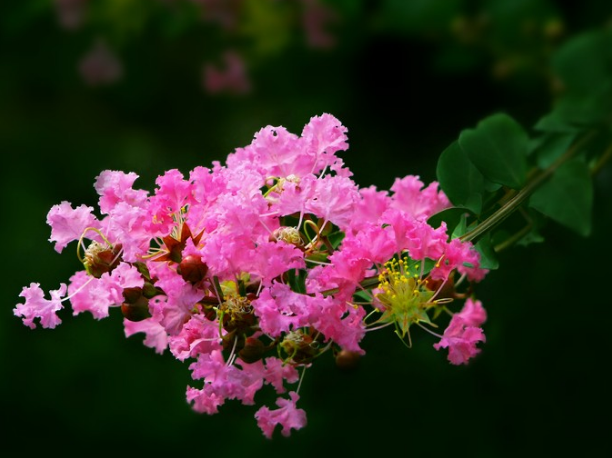
The tree shape is graceful, the bark is smooth, and the branches are twisted. It blooms in midsummer, with vivid flower colors, abundant blossoms, and unusual flower shapes. The corolla is soft, and the petal edges are crinkled, like patches of pink clouds swaying in the wind. It is suitable for courtyard planting or as a bonsai.
Cultivated varieties of crape myrtle are divided by flower color into silver crape myrtle (white), jade crape myrtle (purple), red crape myrtle (red), and crape myrtle (pink), among others.
It can resist sulfur dioxide (SO2), hydrogen fluoride (HF), chlorine (Cl2), and various other harmful gases.
(1) Growth characteristics: Crape myrtle has strong adaptability, likes a warm and humid climate, prefers sunlight but is fairly shade-tolerant, and has a certain cold resistance and drought tolerance. It grows well in well-drained fertile soil, and can also grow normally in slightly poorer soil.
(2) Propagation methods: Seed sowing and cuttings are commonly used.
① Sowing: Collect the capsules from October to November, dry them, rub out the seeds, and sow in early spring. Keep the soil moist during the seedling growth period. When the seedlings are 10-15 cm tall, apply a light fertilizer once every 15-20 days. After planting out, apply superphosphate once. With proper management on fertile nursery ground, seedlings can bloom in the second year.
② Cuttings: Before spring bud break, select vigorous 1- to 2-year-old branches and cut them into cuttings about 15-20 cm long, then insert them into a loose, fertile seedbed. After insertion, pay attention to keeping them warm. One-year-old seedlings grow to about 50 cm tall.
(3) Cultivation and management
① Planting: 2- to 3-year-old saplings can be planted out, from early March to April. Before planting, prune heavily, leaving only 2 buds above the ground, to encourage strong roots and cultivate a main trunk. When transplanting, the plant should be moved with a soil ball.
② Watering and fertilizing: Before spring bud break, water thoroughly 1-2 times, and keep the soil moist throughout the growing season. Apply a heavy base fertilizer in early spring, apply additional fertilizer as appropriate from May to June to promote flower bud growth, and apply fertilizer once more after leaf fall.
③ Pruning and shaping: Promptly cut out overly long and unevenly distributed branches to maintain a full crown and an abundance of flowers over the whole tree.
The branches of crape myrtle are pliable and very easy to shape. In spring, when the sap is flowing, the branches of several crape myrtles can be twisted and bound together to form shapes such as twisted wood, vases, and archways. After twisting and binding, the branches can heal together in 2-3 years. Peeling off the bark where the branches touch can promote healing. If only the buds are rubbed, a single-trunk crape myrtle can be formed, suitable for use as a street tree.
④ Pest and disease control: Common problems include sooty mold, powdery mildew, and scale insects.
Precautions for Crape Myrtle Care
1. Watering
Potted crape myrtles kept at home also need sunlight similar to that outdoors, and even in high-temperature conditions generally do not need shading.
The growing location should be chosen as far as possible on brick ground or bare soil away from walls, to prevent poor ventilation near the wall from raising the temperature of the micro-environment, which is unfavorable to the growth of crape myrtle.
Watering in all four seasons should follow the principle of "do not water until dry, and water thoroughly when you do." The specific amount of water should be determined by the actual moisture level of the potting soil. If the potting soil leaks water, promptly add soil to increase the density of the potting soil.
Fertilizer solution should be applied during the spring bud break period, the summer bud development period, and the flowering period. From late autumn to early spring, water should be controlled, keeping the potting soil as dry as possible.
2. Cuttings
These are specifically divided into softwood cuttings and hardwood cuttings. Softwood cuttings are generally done during the plum rain season, and hardwood cuttings in spring; the survival rates are good for both.
For cuttings, select 1-year-old, thick, sturdy, and vigorous branches from a vigorously growing mother plant, trim them into branches about 10-15 cm long, and insert them to a depth of about 8-10 cm.
They usually take root after about 20 days. Provide appropriate shading and moderate watering. The survival rate of the branches is high, and they can grow to about 60-80 cm in the same year.
3. Blooming Period
Crape myrtle itself has strong branch-growing ability and produces many long shoots, so the spent flowers after the blooming period should be cut off to encourage new growth in the plant, so that the next round of flowering branches develops as soon as possible, thereby extending the blooming period.
At the same time, promptly cut off leggy branches, diseased branches, stacked branches, and crossing branches to prevent excessive consumption of nutrients.
4. Fertilizing
Potted crape myrtles should be given a base fertilizer. Additional fertilizer can be applied before new branches sprout or from May to June. Apply less in autumn and not at all in winter.
In addition, fertilizing is also unsuitable during hot summer weather and rainy weather. At other times, fertilizing should follow the principle of "light fertilizer applied frequently."
Excess fertilizer easily causes leggy branches and leaves, while too little fertilizer easily makes branches weak and leaves yellow, and in severe cases weakens the growth of the whole plant, resulting in few or no flowers.
5. Repotting
Potted crape myrtles should preferably have their potting soil changed once every 2-3 years.
The growing soil can be mixed in the ratio of loose mountain soil : garden soil : fine river sand (5:3:2). Organic fertilizer (bone meal, soybean cake meal, etc.) can be used as the base fertilizer.
Be careful to avoid direct contact between the roots and the fertilizer, otherwise it will scorch and damage the roots and harm the normal growth of the plant.