Soil
Lychnis coronaria is not very demanding about soil in cultivation; as long as the soil is loose, breathable, and well-draining, it is fine. This soil can either be mixed yourself or you can buy soil specially for Lychnis coronaria from a flower shop.
Light
Lychnis coronaria loves sunlight very much, and it is also fairly shade-tolerant. The plant generally grows in some damp, shady places. Be careful to maintain sufficient light during the growing period.
Temperature
Lychnis coronaria is very cold-hardy, and the suitable temperature for seed germination is about 20 degrees. In winter, if the temperature is too low, it should be moved indoors for care to prevent the plant from freezing.
Humidity
Lychnis coronaria likes a cool, moist growing environment. During the plant's growth period, it should be given enough water, which can also allow the plant to produce more flowers and extend the flowering period. However, because the plant is afraid of hot, rainy conditions, be careful not to let water accumulate in the flowerpot when watering in summer, otherwise the plant's root system may very likely rot.
The above is an introduction to the question of how to grow Lychnis coronaria. I believe that after learning these, you will be able to grow very good Lychnis coronaria! So next, let's take a look at what Lychnis coronaria needs attention.
Care methods for Lychnis coronaria
Growth habits of Lychnis coronaria
Lychnis coronaria is native to our country. Its characteristics are that it is relatively cold-hardy, likes a cool climate, and requires sufficient light, though it can tolerate shade.
Care methods for Lychnis coronaria
Soil
When growing Lychnis coronaria, it is necessary to choose suitable soil. It does not have high requirements for soil; generally, choosing well-draining soil is enough. Basically, calcareous soil rich in humus is fine, and sandy soil is also a very good choice.
Watering
When growing Lychnis coronaria, watering is also very important. It relatively likes moisture. During cultivation, in spring it should be watered more frequently, 3-6 times per month.
Light and temperature
In terms of light and temperature, the needs of Lychnis coronaria must be met. It requires sufficient light, and the temperature should be suitable. Its suitable growing temperature is between 15°C and 35°C.
Propagation methods
For the propagation of Lychnis coronaria, seed propagation or division propagation is generally chosen, and either can be done in spring or autumn.
Notes on growing Lychnis coronaria
Pruning
When growing Lychnis coronaria, pruning should be done at the right time. This can extend the flowering period and also allow it to grow well. In the early stage of growth, when the plant grows to about 20 cm and has 7-8 leaves, pinching should be done in time.
Pests and diseases
Leaf spot is a common disease of Lychnis coronaria. In addition, there is Lychnis rust. When Lychnis coronaria begins to develop the disease, treatment should be carried out in time. Fungicides or chemical agents can be used for treatment.
Cultivation methods and precautions for Lychnis coronaria
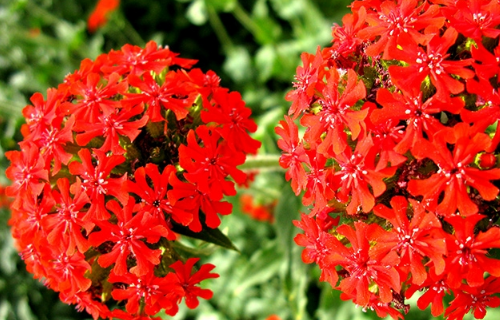
Chinese scientific name: Mullein-pink Lychnis coronariaLatin scientific name: Lychnis coronaria (L.) Desr.Other names: Maolu, ZuixianwengKingdom: PlantaeFamily: CaryophyllaceaeGenus: LychnisSpecies: Lychnis coronariaLychnis coronaria, also known as Maolu and Zuixianweng, Latin name: Lychnis coronaria (L.) Desr. It is a perennial herb in the Caryophyllaceae family and Lychnis genus, 40-80 cm tall, with the whole plant densely covered in gray-white down. The stem is erect, stout, and sparsely branched. The basal leaves are oblanceolate or elliptic, gradually narrowed at the base into a stalk-like form, with an acute tip; the cauline leaves are sessile and smaller. The dichasial cyme is sparse; the gynophore is short and inconspicuous; the petals are deep red, the claw is oblanceolate, hairless, with a missing auricle, the limb outline is obovate, and the apex is slightly emarginate; the corona scales are narrowly lanceolate, and the stamens are not exserted. The capsule is oblong-ovoid, and the seeds are kidney-shaped, blackish brown, with small tubercles. The flowering period is May-June, and the fruiting period is June-July.1. Morphological characteristics
Perennial herb, 40-80 cm tall, with the whole plant densely covered in gray-white down. The stem is erect, stout, and sparsely branched. The basal leaves are oblanceolate or elliptic, 5-10 cm long and 1-3 cm wide, gradually narrowed at the base into a stalk-like form, with an acute tip; the cauline leaves are sessile and smaller. The dichasial cyme is sparse; the flowers are about 25 mm in diameter, the pedicels are thick, 2 to several times longer than the calyx; the calyx is elliptic-campanulate, 15-17 mm long, nearly leathery, with subulate calyx teeth 4-7 mm long, often twisted; the gynophore is short and inconspicuous; the petals are deep red, 25-30 mm long, the claw is oblanceolate, hairless, with a missing auricle, the limb outline is obovate, and the apex is slightly emarginate; the corona scales are narrowly lanceolate, 1.5-2.5 mm long; the stamens are not exserted. The capsule is oblong-ovoid, about 15 mm long; the seeds are kidney-shaped, about 1 mm long, blackish brown, with small tubercles. The flowering period is May-June, and the fruiting period is June-July.2. Growth habits
It is cold-hardy, likes fertile soil and does not tolerate barren conditions, requires well-draining soil, and is averse to high temperatures and waterlogging. The description of its habits is unclear.3. Geographical distribution
Produced in southern Europe and western Asia. The type specimen was collected from Italy.4. Taxonomy
Lychnis coronaria, also known as Maolu and Zuixianweng, Latin name: Lychnis coronaria (L.) Desr. Angiospermae; Dicotyledoneae; Centrospermae; Caryophyllaceae; Lychnis; Lychnis coronaria.5. Species under the genus
Lychnis coronaria(Latin-Chinese names of seed plants) Maolu (North China Economic Flora), Zuixianweng (Taxonomy of Chinese Seed Plants) Plate 65: 1-5 Lychnis coronaria (L.) Desr. in Lam. Encycl. 3: 643. 1789; Pax et Hoffm. in Engler u. Prantl, Nat. Pflanzenfam. 2. Aufl. 16c: 340. fig. 140c. 1934; Supplement to the Illustrated Guide to Higher Plants of China 1: 317. fig. 8559. 1982.——Agrostemma coronaria L., Sp. Pl. 436. 1753.——Lychnis coriacea Moench, Meth. Pl. 709. 1794. ——Coronaria coriacea (Moench) Schischk. in Kom. Fl. USSR 6: 699. 1936.
6. Main value
Garden ornamental: cultivated in urban gardens in our country for ornamental purposes.