What are the care precautions for ornamental peach blossoms
The care of ornamental peach blossoms is simpler than that of other ornamental flowering trees and shrubs. The main care points are:
1. Flower pot and soil
For potted ornamental peach, choose a flower pot of an appropriate size, neither too large nor too small, and use a sandy culture soil rich in humus and with good drainage. Before filling the soil, you can place a small amount of bone meal or hoof pieces under the soil as a base fertilizer.
2. Fertilizing and watering
During the growing period of ornamental peach, fertilize in a timely manner according to the growth condition of the peach plant. Generally, applying fertilizer once each in spring when it blooms and before leaf fall in autumn is enough. Watering should be moderate. During high-temperature and drought in summer, water sufficiently, while in the rainy season avoid water accumulating in the tree pit and drain promptly to prevent root rot and death.
3. Pruning
After ornamental peach blooms, prune promptly. For branches that have bloomed, leave only two to three buds at the base and cut off all the rest, and remove overly dense, thin, and weak branches. In summer, when new branches grow to an appropriate height, pinch the tips to promote flower bud growth. In northern regions, once a year at the Spring Equinox, the pot can be repotted and the soil changed. When repotting, moderately prune overly dense roots.
4. Temperature
Although ornamental peach is relatively cold-tolerant, do not place it outdoors during severe winter cold. It is best to overwinter it in a cold room. Three to five days before the Spring Festival, move the potted plant indoors and keep the temperature rising slowly. In an environment of 20 to 25 degrees, ornamental peach will gradually begin to bloom.
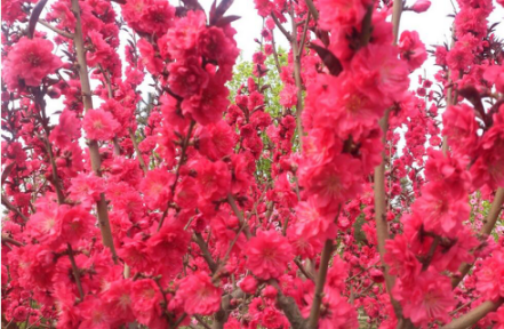
I believe that after reading the above introduction, friends have also gained an understanding of the propagation of ornamental peach blossoms. In this way, when caring for and propagating ornamental peach blossoms, the survival rate can certainly be greatly improved. Thank you for reading!
Household care techniques for potted ornamental peach blossoms
Ornamental peach is a deciduous small tree in the rose family and the plum genus. Usually, the double-flowered types belonging to ornamental peach blossoms are collectively called ornamental peach, and all are variations or forms of fruiting peach. Its plant height can reach 7 m, while dwarf small types are only 2 m to 3 m tall or even shorter. The branchlets are reddish brown or green, smooth on the surface, and the winter buds have white soft hairs. The buds are borne side by side, with mostly leaf buds in the middle and flower buds on both sides. The leaves are elliptic-lanceolate, long and pointed at the tip, broadly wedge-shaped at the base, smooth and hairless on the surface, with coarse serrations along the leaf margin and glands at the leaf base. Flower buds are axillary, blooming before leaves unfold, and flowers are solitary with very short pedicels. The flowers of the original species are pink or white, single, while cultivated varieties have diverse flower colors and semi-double to double forms. There are 5 or 10 sepals. The drupe is nearly spherical or long ovoid, densely covered with fuzz on the surface. The flowering period is from March to April, and the fruit ripens from June to September.Ornamental peach likes sunlight, is not tolerant of shade, is cold-tolerant, drought-tolerant, and not tolerant of waterlogging. In areas south of North China, it can overwinter in the open field; in areas north of North China, it needs protection to overwinter in the open field. It requires loose, fertile, well-drained sandy loam soil, and gumming disease easily occurs in heavy clay soil. It likes ventilated and bright environmental conditions.
Ornamental peach is usually propagated by sowing or grafting. Use seedling plants as rootstock, preferably by autumn sowing. Cultivated varieties are often propagated by grafting. In the south, wild peach is mostly used as rootstock, as it can resist hot and humid environments. In the north, mountain peach is mostly used as rootstock, as it is more tolerant of drought, salinity, and alkalinity. Seedling rootstock needs to be cultivated for 2 years before grafting. Cleft grafting can be done in early spring when growth just begins, or bud grafting can be done in late August. After the grafted seedling survives for 1 year, it needs to be transplanted, and the spacing between plants and rows should be increased. At the same time, shaping and pruning begin. First, cut back at about 30 cm above the ground to form a section of trunk, then evenly retain 3 lateral main branches on the trunk. After the lateral main branches grow for 1 year, they can be shaped and potted for planting.
For potted ornamental peach, the flower pot should not be too large or too deep. Use a sandy culture soil rich in humus and with good drainage, and place a small amount of bone meal or hoof pieces at the bottom as a base fertilizer when potting. After flowering, prune promptly. For branches that have bloomed, leave only 2 to 3 buds at the base and cut off all the rest, and thin out overly dense, thin, and weak branches. In summer, when newly grown branches reach an appropriate length, pinch the tips to promote flower bud formation, and apply a dilute liquid fertilizer once a week. In the later stage, pay attention to increasing the application of phosphorus and potassium fertilizers and reduce watering to benefit flower bud growth. In the Beijing area, repot and change the soil once a year at the Spring Equinox. When repotting, moderately prune overly dense roots. During Heavy Snow, move it into a cold room to overwinter. About 35 days before the Spring Festival, move the potted plant to an indoor room at about 10°C, then gradually raise the temperature. In an environment of 20°C to 25°C, it can bloom after 15 days to 20 days.
Care techniques for potted ornamental peach blossoms
Ornamental peachIt is a deciduous small tree in the rose family and the plum genus. Usually, the double-flowered types belonging to ornamental peach blossoms are collectively called ornamental peach, and all are variations or forms of fruiting peach. Its plant height can reach 7 m, while dwarf small types are only 2 m to 3 m tall or even shorter. The branchlets are reddish brown or green, smooth on the surface, and the winter buds have white soft hairs. The buds are borne side by side, with mostly leaf buds in the middle and flower buds on both sides. The leaves are elliptic-lanceolate, long and pointed at the tip, broadly wedge-shaped at the base, smooth and hairless on the surface, with coarse serrations along the leaf margin and glands at the leaf base. Flower buds are axillary, blooming before leaves unfold, and flowers are solitary with very short pedicels. The flowers of the original species are pink or white, single, while cultivated varieties have diverse flower colors and semi-double to double forms. There are 5 or 10 sepals. The drupe is nearly spherical or long ovoid, densely covered with fuzz on the surface.
The flowering period is from March to April, and the fruit ripens from June to September. There are more than 40 cultivated varieties. Common cultivated ones include: White ornamental peach, with a flower diameter of 3 cm to 5 cm, white semi-double, and petals round to elliptic. Sajin ornamental peach, with a flower diameter of about 4.5 cm, semi-double, petals oblong, often curled, capable of producing two colors of flowers on the same flowering branch, mostly pink or white, and some with pink stripes embedded on white petals or white stripes embedded on pink petals. Qianban red ornamental peach, with more than 3 whorls of petals, the outer whorl pink and the inner whorl red, wrinkled in appearance. Shouxing peach, a dwarf type, with small semi-double flowers, white or red, extremely short internodes on the branches, and densely borne flower buds. Weeping ornamental peach, with soft drooping branches, double flowers, and colors including deep red, pure white, pink, and others.
Yuanyang peach, with double flowers, water-green, flowering relatively late, and bearing fruit in pairs. Ornamental peach is native to our country, and wild plants are found in the mountainous areas of northwest and southwest China. It is now widely distributed around the world. It likes sunlight, is not tolerant of shade, is cold-tolerant, drought-tolerant, and not tolerant of waterlogging. In areas south of North China, it can overwinter in the open field; in areas north of North China, it needs protection to overwinter in the open field. It requires loose, fertile, well-drained sandy loam soil, and gumming disease easily occurs in heavy clay soil. It likes ventilated and bright environmental conditions.
It is usually propagated by sowing or grafting.
Use seedling plants as rootstock, preferably by autumn sowing. Cultivated varieties are often propagated by grafting. In the south, wild peach is mostly used as rootstock, as it can resist hot and humid environments. In the north, mountain peach is mostly used as rootstock, as it is more tolerant of drought, salinity, and alkalinity. Seedling rootstock needs to be cultivated for 2 years before grafting. Cleft grafting can be done in early spring when growth just begins, or bud grafting can be done in late August. After the grafted seedling survives for 1 year, it needs to be transplanted, and the spacing between plants and rows should be increased. At the same time, shaping and pruning begin. First, cut back at about 30 cm above the ground to form a section of trunk, then evenly retain 3 lateral main branches on the trunk. After the lateral main branches grow for 1 year, they can be shaped and potted for planting.
For potted ornamental peach, the flower pot should not be too large or too deep.
Use a sandy culture soil rich in humus and with good drainage, and place a small amount of bone meal or hoof pieces at the bottom as a base fertilizer when potting. After flowering, prune promptly. For branches that have bloomed, leave only 2 to 3 buds at the base and cut off all the rest, and thin out overly dense, thin, and weak branches. In summer, when newly grown branches reach an appropriate length, pinch the tips (remove the tips) to promote flower bud formation, and apply a dilute liquid fertilizer once a week. In the later stage, pay attention to increasing the application of phosphorus and potassium fertilizers and reduce watering to benefit flower bud growth. In the Beijing area, repot and change the soil once a year at the Spring Equinox. When repotting, moderately prune overly dense roots. During Heavy Snow, move it into a cold room to overwinter. About 35 days before the Spring Festival, move the potted plant to an indoor room at about 10°C, then gradually raise the temperature. In an environment of 20°C to 25°C, it can bloom after 15 days to 20 days.