How to grow gaillardia (blanket flower) from seed? Sowing methods and care tips
Sowing time
This plant likes a hot, dry environment, so it is usually sown in summer, a period with plenty of light.
Pre-treatment
1. Soak the seeds in warm water for seven to eight hours so they fully absorb water and swell up. Even after swelling, the seeds are still very small.
2. Sterilize the prepared growing medium; high-temperature sterilization can be used.
Sowing method
1. Choose a pot with good aeration and drainage, and put the sterilized medium into it. Because the seeds are already very small, when sowing you can press the seeds in with your finger or use tweezers to pick them up and place them one by one on the growing medium; if using tweezers, be careful with the pressure so as not to damage the seeds. After placing them, cover the surface with a layer of the same soil as the sowing medium, about 1 cm thick.
2. Prepare a large basin, place the flower pot in the basin, and pour water into the large basin until the water level reaches two-thirds of the flower pot. Let it sit for a few minutes, and once the water in the large basin has soaked all the soil in the flower pot, take it out.
3. If there are larger seeds, put them directly into the soil and sow them at a spacing of 3 cm. After sowing, cover with soil, controlling the thickness to two to three times that of the seeds. Water with a shower head or spray bottle to avoid washing the seeds away.
4. Pay attention to observing whether the soil is dry or wet; when it looks dry, replenish water promptly to keep it moist.
5. Cover with a layer of plastic film on top to retain moisture and warmth.
The above is an introduction to the issues of sowing gaillardia. Next, let's see how to care for gaillardia after sowing so it can grow healthily.
Gaillardia seed growing method, suitable for sowing in summer
Gaillardia seed growing method 1. Planting timeThe planting time for gaillardia seeds is generally best in summer.
2. Sterilize the mediumBefore sowing gaillardia, sterilize the medium used for sowing. The best method is to put it in a pan and heat it until hot, so any pests and diseases are killed by the heat.
3. Soaking the seedsSoak the seeds in warm hot water for 3 to 10 hours, until the seeds absorb water and swell up; this helps the seeds germinate.
4. Sowing the seedsFor fine seeds that are difficult to pick up with your hands or other tools, you can moisten one end of a toothpick with water and stick the seeds one by one onto the surface of the medium, cover with medium 1 cm thick, then place the sowing pot into water with a depth of 1/2 to 2/3 of the pot's height, and let the water slowly soak upward.
For larger seeds that can be picked up with your hands or other tools, put the seeds directly into the medium and sow them in spots at a spacing of 3×3 cm.
5. Covering the sown seedsAfter sowing, cover with medium to a thickness of 2 to 3 times the size of the seeds. After sowing, use a sprayer or a fine-holed shower head to moisten the sowing medium; afterward, when the pot soil is slightly dry, water again. Still be careful not to water too forcefully, so as not to wash the seeds out.
6. Later care and managementa. After sowing, once the seedlings emerge, uncover the plastic film in time, and let the seedlings receive sunlight every day before 9:30 in the morning or after 3:30 in the afternoon; otherwise the seedlings will grow very weak and spindly.
b. After most of the seeds have sprouted, appropriate thinning is needed: pull out the diseased and unhealthy seedlings so that the remaining seedlings have some space between them; when most of the seedlings have grown 3 or more leaves, they can be transplanted into pots.
How to grow gaillardia: Gaillardia growing methods and precautions
"Stunning as a heavenly being" is a very high praise we give to a person of great beauty. People often think that heavenly fairies are beyond the reach of mortals, so if a person is beautiful, we can say she is a celestial immortal, or "tianren" for short. However, in our daily lives, beauties are common, but heavenly beings are hard to speak of. In the plant kingdom there is also something called tianren; why not follow the editor to see its beauty.
How to grow gaillardia
Gaillardia is relatively easy to grow. Gaillardia is fairly drought-tolerant and heat-tolerant, likes high temperatures, but is not cold-tolerant. As for sunlight, it likes light and can also tolerate partial shade.
When choosing soil for gaillardia, sandy soil is generally sufficient, and it requires good drainage. During cultivation, fertilizer needs to be applied in time.
Gaillardia growing methods and precautions
1. Light and temperature
Gaillardia likes a high-temperature, sunny growing environment, can tolerate heat, is slightly intolerant of cold, and its suitable growing temperature is between 15°C and 35°C. It requires ample sunlight, but can tolerate partial shade.
2. Soil
To grow gaillardia, you need to choose suitable soil; generally you need to choose soil with good drainage and a loose texture, but be careful not to choose acidic soil, which will cause the plant to grow poorly.
3. Watering and fertilizing
Gaillardia has a relatively high demand for fertilizer. It is fairly drought-tolerant and dislikes being drenched by rain, but it also needs a certain level of air humidity. Generally, gaillardia should be watered and fertilized little and often. During the growing period, fertilize early and apply more phosphorus and potassium fertilizer; after fertilizing, keep the plant dry, and during the flowering period appropriately control water and fertilizer.
4. Propagation methods
The propagation methods for growing gaillardia are usually sowing and cuttings. Sowing is done in summer; before sowing, the soil needs to be sterilized, and after sowing, care and management should be noted. Cuttings can be done together with pinching, using the pinched-off branches directly for cuttings; after cutting, pay attention to the management of light, temperature and humidity.
5. Potting up
When potting up gaillardia seedlings, first place broken tiles or coarse sand grains at the bottom of the flower pot as a drainage layer, sprinkle some decomposed fertilizer as a base fertilizer, place a layer of prepared soil on top of the base fertilizer, and finally set the plant in place. After potting up, water the pot thoroughly once and place it in a shaded environment for a period of care.
6. Pinching and pruning
Pinching and pruning are very important for the growth of gaillardia. When the gaillardia seedlings have grown more than 6 leaves, pinch them by removing the top shoots, which can promote branching in the gaillardia plant. After that, pinch once more during the growing process, which can shape the ideal plant form and promote more flowering.
Propagating gaillardia by sowing
Sowing propagation is often chosen to be done in summer. Before sowing, the seeds and medium should be treated. The medium should be sterilized to achieve the effect of killing pests and diseases. The seeds should first be soaked in warm water for 3 to 10 hours, depending on the situation; as long as the seeds swell up, that is enough. Some seeds are relatively small and difficult to sow by hand, so you can use tweezers to place them on the surface of the medium; after all are sown, cover with a layer of medium about 1 cm thick.
After sowing, you can choose to use a sprayer to gently moisten the medium, which can avoid washing the seeds out due to overly forceful watering. Finally, cover with plastic film. After sowing is complete, uncover the plastic film when the seedlings emerge, and let the seedlings receive light at regular times, being careful to avoid strong light, for example by letting them receive light before nine o'clock.
When does gaillardia bloom
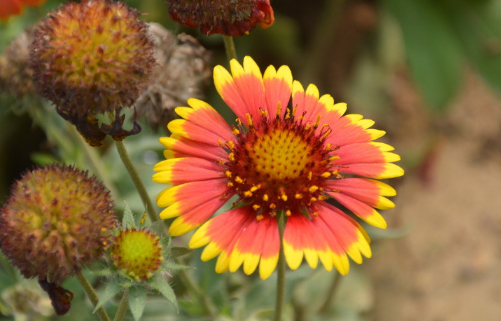
Gaillardia generally blooms in summer and autumn; its flowering period is from July to October, and it sets fruit after flowering, with the fruit generally ripening from August to October. The gaillardia plant is actually not very tall, and a single flower is usually a whole cluster. This single flower contains many ray florets and tubular florets, and the colors are also quite vivid. Generally, the ray florets surround the inner tubular florets; after the ray florets fade, the inner tubular florets develop into fruit, and once the fruit matures, seeds can be obtained.
A heavenly being must be as beautiful as a flower, so although calling gaillardia the heavenly being among flowers is somewhat undeserved, it is at least a beautiful flower, so it is not too much of an exaggeration to call it a heavenly being. But even a celestial immortal, once in the mortal world, must eat the five grains, so gaillardia also needs people's careful cultivation.