A Detailed Guide to Making a Weeping Crabapple Bonsai
Step 1: Prepare the Potting Soil
When making a weeping crabapple bonsai, we need to choose a suitable pot. In general, we can choose a medium-sized, relatively deep pot, which can be square, round, or any shape you like. As for the material of the pot, glazed ceramic pots or purple clay pots are generally chosen. In flower cultivation, the choice of soil is also very important. For the growing medium, a culture soil can be mixed from 4 parts leaf mold, 4 parts garden soil, 1 part organic fertilizer, and 1 part river sand, and some bone meal can also be added as a base fertilizer.
Step 2: Choosing the Bonsai Style
When making a bonsai, you can shape it according to the form of the tree. There are three styles to choose from: slanting trunk style, curved trunk style, or cascade style, and you can shape it according to actual needs. When styling, palm fiber is generally used for wrapping and bending, along with pruning as needed.
Generally, bonsai making is carried out during the dormant period of the weeping crabapple or after flowering
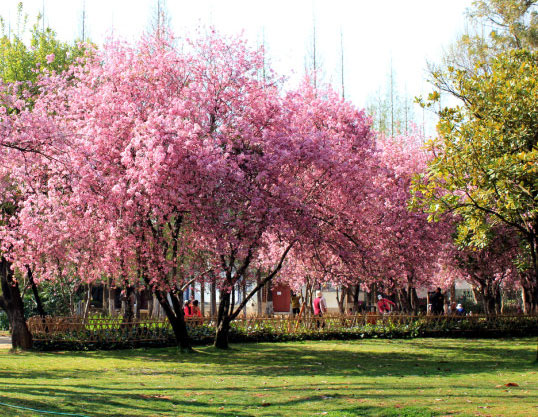
Making and Caring for a Weeping Crabapple Bonsai
Making a Weeping Crabapple Bonsai
Prepare the Potting Soil
When making a weeping crabapple bonsai, you need to choose a suitable pot.
In general, choosing a medium-sized, relatively deep pot is enough, and it can be a square or round pot. When choosing a pot, purple clay pots or glazed ceramic pots are better. It is best if the shape and color of the pot can harmonize with the tree form and flower color of the weeping crabapple.
Soil is also very important. When potting, a loose and fertile soil is generally needed, with leaf mold and garden soil being preferable. Adding some sandy soil and filling in some bone meal as a base fertilizer is also good.
Styling a Weeping Crabapple Bonsai
Style Selection
When making a bonsai, you can shape it according to the tree form. Generally, it can be made into slanting trunk style, cascade style, or curved trunk style, and the specific shaping can be done according to actual needs.
Generally, when styling a weeping crabapple bonsai, palm fiber is used for wrapping and bending, and this needs to be combined with pruning. Bonsai making is carried out during the dormant period of the weeping crabapple or after flowering.
Caring for a Weeping Crabapple Bonsai
Note that the palm fiber used for styling the weeping crabapple bonsai needs to be removed in time to avoid wire embedding, which would affect the growth of the weeping crabapple.
It is also important to note that branches and leaves need to be thinned regularly, which can make the flowers abundant and the leaves lush, improving its ornamental value.
How to Care for a Weeping Crabapple
A beautiful flower naturally cannot do without careful care. Do you know how to grow a weeping crabapple well?
The weeping crabapple should be placed in an environment with good air circulation, sufficient light, and a temperature of 15-28°C. The bonsai can tolerate low temperatures of -5°C. In summer, potted plants should be shaded, and water should be sprayed to increase humidity and lower the ambient temperature. In winter, there is generally no need to move the bonsai indoors; simply bury the pot in the soil. During the growing season, there must be sufficient water, but not to the point of waterlogging, to prevent root rot. In spring and summer, water more; during high summer temperatures, water once each in the morning and evening. If there is a plum rain season or prolonged rainfall, drain promptly to prevent waterlogging in the pot and root rot. In autumn, watering should be reduced to inhibit the growth of the weeping crabapple and prepare it for winter.
During the growing season, potted Malus halliana should be given a topdressing of dilute cake fertilizer water once a month; apply a quick-acting phosphorus fertilizer once when flower buds appear; during flower bud differentiation, continuously apply 2-3 topdressings of quick-acting phosphorus fertilizer, such as a mixed solution of 0.2% monopotassium phosphate plus 0.1% urea, to promote the completion of flower bud differentiation; from leaf fall in autumn to before bud break in spring, fertilization should be stopped. Pruning is best done during the dormant period or after flowering, cutting branches short to encourage side branches, increase the formation of flower buds, and promote a good plant shape. It is best to repot in early spring or late autumn, placing decomposed manure or cake fertilizer at the bottom of the pot as a base fertilizer.
With such a beautiful weeping crabapple, whose fruit after flowering is sweet and sour and can also be made into candied fruit, it offers both ornamental and edible value. What reason do you have to refuse to grow one indoors?