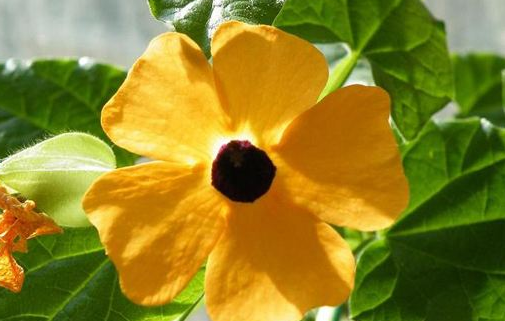
How to Grow and Care for Black-Eyed Susan Vine
Environment
It likes a warm and humid environment and prefers plenty of sunlight. The optimal growing temperature is 20-30°C. It is not cold-tolerant; once the temperature drops below 8°C, it is difficult to maintain normal growth.
Fertilizer
It is a plant that greatly loves fertilizer, and once it begins to grow, fertilizing must be carried out strictly, which helps with flowering.
Soil
The soil should be nutrient-rich. A suitable fertilizer can be used as a base fertilizer, and then continuously supplemented during the growing process. If fertilizing can be done regularly, it will be even more beneficial to the plant's growth.
Water
Black-Eyed Susan Vine is very intolerant of drought, so during cultivation it should be given plenty of water, but be careful not to let water accumulate in the pot, otherwise the plant's root system may very likely rot. Generally in summer, a spray bottle can be used to mist it to maintain the humidity of the environment around the plant.
Pruning
Pinching can be done at the appropriate time, which can promote branching. After flowering, the flower stems can be pruned in a timely manner.
The above is an introduction to how to grow Black-Eyed Susan Vine. Now let's take a look at the editor's summary about the flowering of Black-Eyed Susan Vine!
Summary of Black-Eyed Susan Vine Flowering
1. The pot must be large, with plenty of soil. There do not seem to be too many requirements for fertilizer; I just applied a flowering fertilizer a few times, and there was nothing special about the soil either.
2. If conditions allow, it must be planted in the ground and grown outdoors; the natural environment is most suitable for plants.
3. Spring is too short, and before it has time to bloom, the hot summer arrives, especially in the south. In summer, you can plant one under a shed that provides shade, letting it not bloom and only grow leaves. Then wait until autumn, transplant it out, give it plenty of light, and after that you can quietly wait for it to bloom.
After reading this article, I hope it can be helpful for growing Black-Eyed Susan Vine, and I also look forward to you growing better and more beautiful Black-Eyed Susan Vines.
Tips for Caring for Black-Eyed Susan Vine
Black-Eyed Susan Vine
Acanthaceae, Thunbergia
Annual herbaceous plant
It is not considered particularly easy to grow, and its flowering period is not long either. There is only one reason it appears here - it is truly the editor's favorite plant (I fell in love with it the first time I saw it). In short, it has beauty, so it can do as it pleases!
Wuli Susan is generally sown in spring (specifically referring to the north; in some places in the south it can be sown in autumn). The flowering period is from June to September, and if cared for well, it can last from summer all the way to autumn!
Care tips:
Black-Eyed Susan Vine is native to South Africa and likes a warm, humid environment with plenty of light. So when growing it in daily life, flower lovers should pay attention to maintaining air humidity and sufficient light hours! In the hot summer, you can also frequently spray water on the leaves to maintain air humidity.