Tuberose Growing Methods and Precautions
1. Soil
Tuberose is not strict about soil, preferring fertile clay soil that does not waterlog; it is not suitable for growing in sandy soil.
2. Light
Tuberose likes ample light and needs frequent ventilation; in summer it should be cared for on balconies and in courtyards to ensure sufficient sunlight.
3. Temperature
Tuberose likes a warm environment. The suitable growing temperature is 20-30°C. Flower buds begin to differentiate in late spring, and at this time the minimum temperature should be 20°C to ensure normal plant growth.
4. Water
Tuberose is rather fond of water but hates waterlogging. If it is too dry, the leaves will curl and the flower buds will shrivel, making it hard to bloom. Summer is the period of vigorous growth, so water once a day to keep the soil moist.
Tuberose Growing Methods
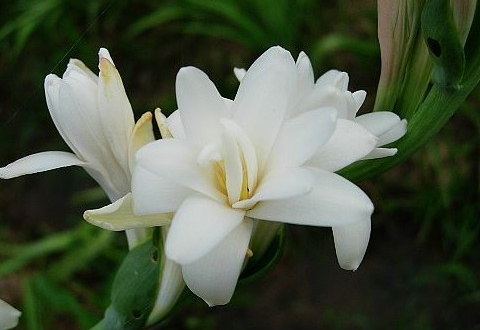
The tuberose's flowers are white and thick in texture, like jade carvings, with a fragrance that assaults the nose, especially intense at night, hence the name tuberose. On hazy moonlit summer nights, the tuberose is like a maiden draped in silver gauze, standing shyly in the flowerbed, secretly
casting amorous glances. Tuberose is a flower that wins admirers with its “night fragrance.”。
Tuberose can be used in flower borders or grown in pots for viewing. If combined with gladiolus in baskets, bouquets, or as cut flowers in vases to decorate interiors, it not only brightens the whole room but also fills it with fragrance that delights the heart. If tuberose cut flowers are placed in solutions of various colors, after about 1 hour the white tuberose blooms will turn into various different colors, quite a charming novelty. In addition, its flowers can be used to extract tuberose concrete, a premium cosmetic fragrance.
Tuberose, also known as night-blooming jasmine, is a perennial bulbous herbaceous flower of the Amaryllidaceae family. The underground tuber is bulb-shaped, much like an onion or garlic, with roots at the lower end and stems and leaves emerging from the upper end. The leaves are slender and strap-shaped, with entire margins, alternate. The raceme is terminal. The flowers are white, funnel-shaped, strongly fragrant, with an even stronger scent at night, hence the name “night-blooming jasmine.” The flowering period is long, blooming continuously from June 〜 mid-November.
Tuberose originated in Mexico. It likes sunlight and fears the cold. In tropical and subtropical regions it has no dormancy period and can bloom all year round, while in other regions it loses its leaves and goes dormant in winter. In the north, the underground tubers need to be stored indoors at around 8°C. It is not demanding about soil and tolerates salinity and alkalinity, but fertile, loose soil is best.
The potting soil can use the following formula: 7 parts garden soil, 2 parts leaf mold, 1 part river sand; or 6 parts peat soil, 1 part leaf mold, 2 parts river sand, 1 part perlite.
It goes dormant in winter and is not cold-tolerant. Indoor temperature should not be lower than 5°C. If the room temperature is too low, the bulbs can be wrapped in cotton wadding or similar material.
It likes a long-day environment with ample light. It should be placed in a sunny spot, maintaining no less than 6 hours of direct sunlight per day.
It likes moist soil and fears waterlogging. At the initial planting stage and when leaves first emerge, do not water too much; slightly dry soil is better, to promote root growth and development. Once the flower stem emerges, provide ample water and fertilizer. After blooming stops, there is no need to water further; let it go dormant.
No additional fertilizer is needed at the initial planting stage. Before the flower buds emerge, apply nitrogen fertilizer 2 times. When the flower scape begins to emerge, apply phosphorus and potassium fertilizer to promote vigorous growth of the flower spike. After flowering, apply 1 more application of compound liquid fertilizer to promote full growth of the tubers.
Propagation is by dividing the bulbs. At the end of spring when the frost has passed, plant the small bulbs or offset bulbs separately. Before planting, soak the dry bulbs in cool water for half a day to promote sprouting. Large and small bulbs should be planted separately. Plant small bulbs slightly deeper and large bulbs shallower. When covering with soil, the tips of the sprouts can be left exposed above the surface.
There are two reasons why tuberose grows only leaves and does not bloom: one reason is that the flower buds of tuberose have already formed on the bulb the previous year; if the bulb is too small or clustered and has not developed into a flower spike, it will not bloom after planting. The other reason is that tuberose bulbs fear cold and moisture; if during winter storage the temperature is low and the humidity is high, the flower buds are damaged by cold or rot, and it will not bloom after planting. When planting tuberose, the clustered small bulbs must be separated into individual plants and cultivated so they can grow and develop fully that year. In winter they should be placed in a dry environment and stored at a temperature above 20°C.
For potted tuberose, the planting depth should follow the principle of “deep for growing bulbs, shallow for sending up scapes” - that is, shallow planting promotes flowering. The usual practice is to bury 2/3 of the bulb in the soil, or to leave the top of the bulb slightly exposed above the soil surface.
Tuberose Growing Methods and Tuberose Benefits
Tuberose is what is commonly called night-blooming jasmine. Its fragrance is very strong and many people like it. Below let us take a look at the growing methods and benefits of tuberose.
Tuberose Introduction:
Tuberose, scientific name: Polianthes tuberosa, is a perennial vine-like twining herbaceous plant, often called night-blooming jasmine, night clove, or night orchid fragrance, among other names. Tuberose was originally an ornamental flowering plant of tropical America, native to South America, and today it is also distributed in Yunnan, Guangxi, Guangdong, and Taiwan, China. Tuberose is a perennial bulbous flowering plant of the Amaryllidaceae family. Its rhizome is tuberous; the flower stems are weak, hairy, and contain milky sap. It blooms white flowers in summer and autumn with a strong fragrance. Tuberose is most fragrant when it blooms at night, hence it is called night-blooming jasmine. In eastern India, it is called "Ratkirani," meaning "queen of the night."
Tuberose Growing Methods:
1. Soil: Tuberose is best grown in fertile, well-drained sandy loam soil and has a certain tolerance for salinity and alkalinity.
2. Watering: Tuberose likes moisture but hates waterlogging, and grows well in low-lying, moist places that do not waterlog.
3. Sunlight: Tuberose likes an environment with ample sunlight; during the growing period, provide plenty of sunlight.
4. Temperature: Tuberose likes a warm environment and is not tolerant of frost. The most suitable growing temperatures are 25-30°C during the day and 20-22°C at night.
5. Fertilizing: Tuberose likes fertilizer and should be given regular topdressings. Generally, apply once 1 month after planting, once before flowering, and thereafter once every 1.5 or 2 months.
6. Pests: The main pests of tuberose are the yellow-breasted flower thrips and the North China mole cricket. For yellow-breasted flower thrips, spray with 10% cyhalothrin emulsion at 200-300 times dilution.
Tuberose Benefits:
1. Ornamental
Tuberose has white flowers and a strong fragrance, especially intense at night. Its flower stems are slender and its lines are soft. It is easy to plant and to regulate its flowering period, making it one of the very important cut flowers and a major companion flower in bouquets, flower arrangements, and other uses, with a definite ornamental value.
2. Medicinal
The leaves, flowers, and fruits of tuberose can all be used as medicine. It is slightly sweet and bland in taste and cool in nature, with effects of clearing the liver and brightening the eyes, drawing out toxins, and promoting tissue regeneration. It is often used to treat carbuncles, sores, swellings, and toxic conditions.
3. Mosquito Repellent
Tuberose gives off a rather strong scent, which has the effect of repelling mosquitoes.