How to grow Chinese roses? These cultivation points need to be known
1. Cold protection.
Chinese roses are very cold-hardy and can withstand low temperatures of -10°C. Generally speaking, in the south they can be placed directly under a south-facing eaves to overwinter, while in the north potted Chinese roses should be moved indoors to a ventilated spot when the temperature drops below 10°C. Note that after the flowers fade in October, do not prune; apply one dose of decomposed phosphorus fertilizer to promote sturdy, well-filled branches and enhance cold resistance. In addition, when winter temperatures are very low, water appropriately during slightly warmer periods to prevent the plant from dying from dry freezing.
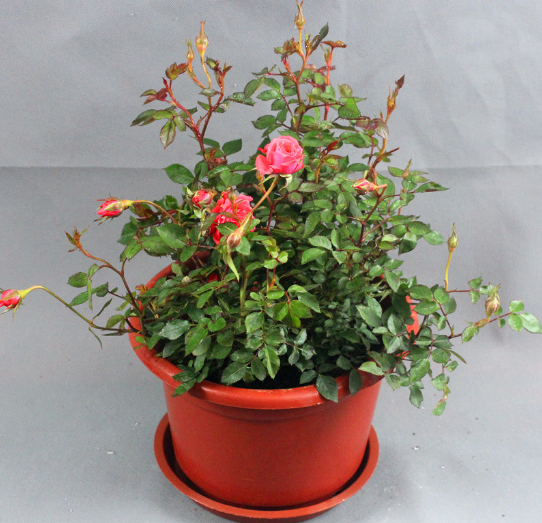
2. Pruning.
When the new shoots of the Chinese rose grow to 15-20 cm, about 3 cm should be cut off the top to encourage branching. When the side branches reach a certain length, they can also be pinched back. Repeating this continuously can make the Chinese rose plant full in shape and produce more flowers.
3. Potting.
After being grown in pots for a certain period, Chinese roses need to be repotted and transplanted. Repotting is generally done in early spring before budding. Replace part of the soil with new soil, water thoroughly, place in a shady spot, and after one week move to a sunny place for care.
4. Pest and disease control.
Be careful to maintain good ventilation and sufficient light in the growing environment, otherwise Chinese roses are very prone to pest and disease problems, such as aphids, powdery mildew, and black spot. When pests or diseases appear, spray pesticides promptly to avoid affecting flowering.
Flower lovers who like Chinese roses should take a look at the cultivation methods introduced above and quickly get started growing one themselves.
How to grow large-flowered Chinese roses: points to note in growing large-flowered Chinese roses
Although the cultivation methods and points to note for large-flowered Chinese roses are fairly comprehensive, they are all easy to understand. Even beginners can easily learn to grow large-flowered Chinese roses after studying them.
Cultivation methods and points to note for large-flowered Chinese roses
Seed selection: Choose varieties that are cold-resistant, highly stress-resistant, resistant to pests and diseases, vigorous in growth, with stiff peduncles, abundant flowering, early flowering, large and brightly colored flowers, good flower shape, and a long individual flowering period, and that are welcomed by the market. Varieties with closely spaced leaves, a short sturdy plant shape, and shorter, stiffer peduncles are better and more suitable for pot culture. In addition, new varieties should be introduced every year to replenish the population and eliminate poorer old varieties. For commercial cultivation, the varieties need not be too many; having around one hundred main varieties is enough, while other distinctive rare varieties favored by veteran flower lovers can be appropriately collected.
Planting: The spacing between plants and rows for large-flowered Chinese rose cultivation varies according to the purpose of cultivation. For variety nurseries used for breeding or scientific research, a spacing of 150 cm x 80 cm is often used. Before planting, the seedlings need to be pruned once, cutting off damaged branches, diseased branches, and weak branches, and damaged or overly long roots should also be cut off. After pruning, apply a wound healing and antiseptic membrane to the cuts so they heal quickly.
Environment: Large-flowered Chinese roses are light-loving plants. During cultivation, choose a sunny location and avoid planting beside tall buildings, under tree shade, or on the shady side of slopes. The ideal soil for cultivating large-flowered Chinese roses should have good granular structure and be rich in organic matter.
Watering: After the beginning of spring, to prevent young leaves from wilting, you can use your finger to check the pot rim. When the surface sand is dry to a depth of one horizontal finger, it is time to water. Spray with a watering can and water thoroughly in two passes. It is best to keep a record after each watering and also note the estimated date of the next watering. After a few times, you can find the general pattern. In short, do not water until dry, do not cause root rot, and do not let it grow leggy.
Fertilizing: The fertilizer requirement is not large. Since base fertilizer was already applied during soil preparation, there is no need to fertilize the soil again before transplanting the grown seedlings, but foliar fertilization should be carried out. That is, one month after cutting, apply foliar fertilizer once every half month, alternating between 0.3% urea liquid fertilizer and 0.2% potassium dihydrogen phosphate liquid fertilizer, to promote rooting.
Temperature control: A plastic shed can regulate the temperature and humidity of the soil and air, and a shade net can prevent direct sunlight and lower the temperature. The optimal temperature for rooting of large-flowered Chinese roses is 20°C to 25°C. When the temperature is too high, in addition to covering with a shade net, you can also water to cool down and ventilate to cool down.
Overwintering: During the long winter of more than 5 months, to ensure the seedlings "sleep" safely and comfortably, special care must be taken. After Cold Dew, before the cold wave arrives, move the seedlings into a greenhouse and ensure they receive at least 4 hours of sunlight each day. After that, management consists of watering and temperature control. The daytime temperature should be 3-4°C, preferably not exceeding 5°C, otherwise ventilate promptly to cool down; the nighttime minimum is -4°C.
Other varieties of Chinese roses
Miniature Chinese rose: Among Chinese roses there are large-flowered Chinese roses, and of course there are also miniature Chinese roses. Miniature Chinese rose plants are short and much branched, generally no more than 25 cm tall, with small narrow leaves and smaller flowers about 3 cm in diameter, rose red, double or single. This miniature Chinese rose is suitable for potted bonsai.
Color-changing Chinese rose: A Chinese rose that changes color, the name alone sounds quite eye-catching. The so-called color-changing Chinese rose does not mean the rose itself automatically changes color; its color change occurs because during the flowering process the corolla absorbs inconsistent acidity and alkalinity, resulting in a color-changing effect due to different flowering times.
Climbing Chinese rose: Climbing Chinese roses have very strong resistance, and the vines develop extremely quickly with vigorous growth. One climbing Chinese rose plant can produce 7-8 main branches in a year, and each main branch can branch further. It has disease resistance. Climbing Chinese roses bloom continuously through all four seasons, with brilliant colors, a light fragrance, and a long flowering period. They can be used for landscapes such as flower balls, flower columns, flower walls, flower seas, arch shapes, and corridor shapes.
Groundcover Chinese rose: The growth form of groundcover Chinese roses differs from that of ordinary Chinese roses. Groundcover Chinese roses grow in a creeping, spreading state and have a very strong tillering rate. Each plant can produce more than 50 branches in a year, and each branch can bear 500-100 flowers. It is also a plant that is cold-resistant and heat-resistant.
Regardless of the variety, Chinese roses all have high ornamental value, and large-flowered Chinese roses are undoubtedly outstanding among them. If there are friends who want to use some flowers to enrich their lives, then large-flowered Chinese roses would be a good choice.
How to grow potted Chinese roses: points to note in potted Chinese rose cultivation
There are many varieties of Chinese roses, with large and beautiful flower shapes and great ornamental value, so many flower lovers keep a pot indoors. So, how do you grow potted Chinese roses? What should be noted during cultivation? Below, we introduce the cultivation methods and points to note for potted Chinese roses.
How to grow potted Chinese roses
1. Choose a good pot. Use a purple clay pot; it is not hard to understand that this is related to the breathability mentioned above.
2. Use good soil. Choose loose soil with good breathability, and absolutely do not use sticky soil. Next, the soil should be rich in organic matter.
3. Plant at the right time. It is best to plant in spring. If you want to plant in autumn, it is best to plant with soil, and it is best to place the seedlings in a place with suitable sunlight brightness and good ventilation. After the seedlings survive, you can prune them slightly according to the appearance you want in the future, so that they branch reasonably and have a beautiful shape.
4. Water reasonably. Before the Chinese rose sprouts, try to keep the pot soil moist, so that the soil is not watered until dry. After sprouting, the watering frequency should gradually increase, generally about twice a day, watering once before 10 a.m., and then watering appropriately in the afternoon according to the dryness and wetness of the pot soil. Pay special attention at noon. During this period many friends may forget some common sense of daily life, which is that at noon, if the sun is especially strong, especially in summer, water should not be poured on the leaves of the Chinese rose, as this will scorch them. Because ordinary people's summer watering can kill Chinese roses, it is recommended here that in summer it is best to water once each in the morning and evening, and generally do not water at night.
5. Fertilize regularly. Chinese roses like fertilizer. Generally, during the two peak growing seasons of spring and autumn, fertilize once every 10-15 days. For fertilizer, both organic fertilizer and compound fertilizer can be used. Fertilizing should stop in the high-temperature summer and the low-temperature winter.
6. Growing location. Since Chinese roses like light, you can place your Chinese rose in a place with sufficient sunlight and good ventilation, but in summer you should provide appropriate shade.
7. Pruning. When the flowers fade, part of the branches should be cut off, leaving 2-3 nodes on new branches and then cutting. If the cut branches have more than 2 nodes, they can be used for cutting propagation. Winter pruning focuses on shaping. Generally, first cut off diseased and pest-infested branches, dead branches, and crossing thin weak branches. For Chinese roses with vigorous growth and a well-proportioned plant shape, cutting off 1/3 of the whole plant is enough. For weak-growing plants, cut off about 2/3 of the whole plant, leaving only 3-4 strong main branches.
8. Repotting. For repotting, it is best to repot once every 1-2 years, remove 2/3 of the old soil, and replace it with loose, fertile soil rich in organic matter. Repot mostly during the spring budding period. Along with repotting, cut off diseased and pest-infested branches, dead branches, crossing thin weak branches, shorten long roots, thin out overly dense roots and some old roots, and promote the sprouting of new roots so that growth is even more vigorous in the next growing season.
Points to note in potted Chinese rose cultivation
1. Temperature: It likes warmth, fears intense heat, and is relatively cold-tolerant. The most suitable growing temperature for Chinese roses: 22-25°C. (PS: the most suitable temperature is 15-26°C during the day and 10-15°C at night.)
2. Sunlight: Chinese roses like a sunny, well-ventilated, well-drained, and wind-sheltered environment. Dear, remember not to grow Chinese roses in a dark, damp place! In midsummer, provide appropriate shade for the flowers! Otherwise the blooming flowers are prone to drying out.
3. Moisture: Our Chinese roses like humidity (the relative air humidity should preferably be 75%-80%), and at the same time they can also tolerate a certain degree of drought. At a glance, they are clearly not hothouse flowers!
4. Soil: The soil for planting Chinese roses should be fertile, loose, and well-drained. When planting as a child, I often dug spring soil to plant them, and it felt good. In the city it is not so easy to find. Here is a reminder to flower-loving friends: the soil chosen must not be the kind that clumps, because drainage is poor. You can choose slightly acidic soil rich in humus. In fact, Chinese roses have a relatively wide range of adaptability to soil.
5. Fertilizing: After May is the peak growing season for Chinese roses. Every 10 days, apply topdressing once. You can use decomposed and fermented fishy juice or vegetable leaf juice, mixed at a ratio of 3 parts fertilizer to 7 parts water and applied. Stop fertilizing by November.
6. Watering: For watering Chinese roses, we first need to understand one point: because everyone's chosen soil quality, light, temperature, humidity, and other cultivation conditions differ, we can water according to the dryness of the pot soil. My principle for watering the flowers is: do not water until dry, water once dry, and water thoroughly when watering.
7. Loosening soil and weeding: Along with clearing weeds from the pot surface, you can use a fine wire rake to gently break the surface layer around the flowerpot, enhancing the looseness and aeration of the pot soil and promoting normal root growth.
The above are the cultivation methods and points to note for potted Chinese roses introduced for everyone. Is everyone clear now? For more home knowledge, please stay tuned.