What are the precautions for growing Magnolia coco?
Magnolia coco should not be watered too frequently, to prevent water accumulation at the bottom from causing root rot. You can often spray water on the leaves, in a mist form rather than a stream of water, to prevent root rot. It also loves to grow in a warm, humid environment with plenty of sunlight, but in the hot summer it also needs appropriate shading.
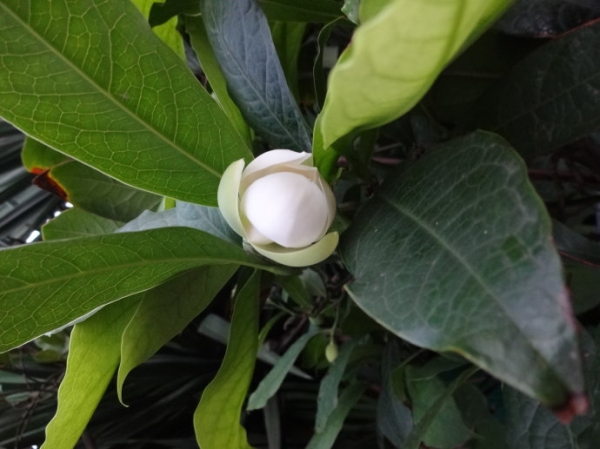
Do you all understand the effects and benefits of Magnolia coco? I hope this article can be of help to you! Thank you for reading!
Home growing methods and precautions for Magnolia coco
Home growing methods for Magnolia coco
Soil
Magnolia coco likes moist, fertile soil, so when growing it, remember not to let the soil get too dry! For potted plants, mountain soil is best; remember that calcareous soil must never be used for cultivation, the soil must be acidic, and if conditions allow you can test the soil's pH value; a pH of 5.5 to 8.5 is best. Of course, if you don't want the trouble of testing the pH value, I also have a little trick! That is to use 6 parts garden soil, 4 parts river sand, then add half a spoonful of black alum and mix, and it's done!
Light
Magnolia coco is fairly shade-tolerant, so don't expose it to scorching sunlight, but don't give it no sun at all either! It still needs to receive mild sunlight; Magnolia coco also needs photosynthesis!
Air
Wild Magnolia coco mostly grows under evergreen broad-leaved forests at an altitude of 600 to 900 m, and has poor resistance to toxic gases. So pay attention to the level of air pollution; if the pollution is too severe, there is nothing I can do either!
Temperature
The suitable temperature during the flowering period is 22-25°C; below 20°C flowering is delayed, so if you want Magnolia coco to bloom normally, you need to pay attention to the temperature!
Precautions for growing Magnolia coco
Summer
When the sun is scorching, be sure to shade Magnolia coco, otherwise it will be killed by the fierce summer sun!
Winter
In winter the temperature must not fall below 5 degrees, otherwise there is a risk of freezing to death!
Growing methods and precautions for Magnolia coco
Chinese scientific name: Yehehua (Magnolia coco)Latin scientific name: Magnolia coco (Lour.) DC.Kingdom: PlantaeDivision: AngiospermsClass: DicotyledonsOrder: RanunculalesFamily: MagnoliaceaeGenus: MagnoliaDistribution area: southern China and VietnamMagnolia coco, also known as Yexiang Yulan, is native to southern China. It likes a warm, humid, semi-shaded and semi-sunny environment, is shade-tolerant, fears scorching sun exposure, and requires fertile, loose, well-drained, slightly acidic soil, with winter temperatures not below 5°C. It is an evergreen shrub, 1 to 2 m tall.1. Morphological characteristics
Evergreen shrub or small tree, 2-4 m tall, all parts of the plant hairless; bark gray, branchlets green, smooth, slightly angular and glossy. Leaves leathery, elliptical, narrowly elliptical or obovate-elliptical, 7-14 (-28) cm long, 2-4.5 (-9) cm wide, apex long-acuminate, base cuneate, upper surface dark green and glossy, slightly wavy-wrinkled, margin slightly revolute, lateral veins 8-10 per side, areoles sparse; petiole 5-10 mm long; stipular scar reaching the apex of the petiole. Pedicel curved and drooping downward, with 3-4 bract detachment scars. Flowers spherical, 3-4 cm in diameter, tepals 9, fleshy, obovate, concave on the ventral side, the outer 3 tinged green with 5 longitudinal veins, about 2 cm long, the inner two whorls pure white, 3-4 cm long, about 4 cm wide; stamens 4-6 mm long, anthers about 3 mm long, connective extended into a short pointed tip; filaments white, about 2 mm long; gynoecium green, ovate, 1.5-2 cm long; carpels about 10, narrowly ovate, 5-6 mm long, with 1 longitudinal groove on the back extending to the base of the style, stigma short, apex truncate after falling off; aggregate fruit about 3 cm long; follicles nearly woody; seeds ovate, about 1 cm high, inner seed coat brown, with a lateral pore at the apex of the ventral side, ventral groove inconspicuous, base pointed. Flowering in summer, in Guangzhou it blooms almost continuously throughout the year, fruiting in autumn.2. Growing environment
Magnolia coco is native to China. It likes a warm, humid environment with plenty of sunlight, has strong adaptability to climate and soil, is shade-tolerant, and loves fertilizer. It likes to grow in a warm, humid, semi-shaded and semi-sunny environment. It prefers well-drained, fertile, slightly acidic sandy soil, and avoids calcareous soil but also tolerates poor soil and arid climates. The flowers open for a short time, each blooming for only 1-2 days, often opening in the early morning and closing at night, hence the name Yehehua (night-closing flower). The fragrance is subtle and sweet, becoming stronger at night. The suitable temperature during the flowering period is 22-25°C; below 20°C flowering is delayed.3. Distribution
Distributed in East China, South China, Southwest China, as well as Liaoning, Hebei, Henan, Shaanxi and other provinces.4. Cultivation techniques
Propagation methods
It likes moist, fertile soil, is shade-tolerant, mostly grows under evergreen broad-leaved forests at an altitude of 600 to 900 m, and has poor resistance to toxic gases. It is usually propagated by approach grafting or air layering. For grafting, Magnolia liliiflora, Michelia macclurei, Manglietia and others are used as rootstock; air layering propagation is carried out in early spring after the weather turns warm or in autumn, and after rooting the plants are moved into a nursery to grow into large seedlings before they can be planted out. In recent years, cutting propagation is also commonly used, cutting cuttings from one- to two-year-old seedlings and inserting them in sand, with a survival rate of up to 90%.Cultivation methods
For potted plants, mountain soil is best; calcareous soil must not be used, the soil must be acidic, with a pH of 5.5 to 8.5. For home planting, you can also use 6 parts garden soil, 4 parts river sand, plus half a spoonful of black alum mixed together. After Magnolia coco is brought outdoors in mid-April, place it in a spot with diffused light, with a light transmittance of 30 to 40% being suitable. In spring, water once every 2 to 3 days; northern springs are dry and easily cause yellowing of the leaves, so water with alum fertilizer solution three or four times in succession every two or three days. In summer it should be kept in semi-shade, with frequent spraying to increase air humidity. After the beginning of autumn, water less. Gradually increase light to make the plant sturdy. In autumn, prune and shape the dead branches and misplaced branches. In winter, bring it indoors and place it where sunlight does not shine directly; keep it between 10 and 12°C during the day, not below 5°C at night, and not above 10°C, so as not to be unfavorable for winter dormancy and affect the next year's flowering. In winter, just keep the potting soil slightly moist. During the growing period, apply a decomposed cake fertilizer liquid once every 15 days or so. Stop applying nitrogen fertilizer before the flowering period, and apply more phosphorus and potassium fertilizer to promote large, fragrant flowers. After bringing it indoors for the winter, no fertilization is needed.Pest and disease control
Common leaf blight is harmful, and can be sprayed with 65% zineb wettable powder at 600 times dilution. Pests include leaf beetles, aphids and scale insects, which can be killed by spraying with 50% fenitrothion emulsifiable concentrate at 1000 times dilution.5. Main value
It is usually planted in gardens or used as a street tree. The wood is resistant to water and moisture and can be made into furniture; the bark contains tannins, and the fibers can be made into artificial cypress; the seeds can be pressed for oil; the bark and flowers can be used medicinally, with effects of calming the nerves, promoting blood circulation and relieving pain; it has strong resistance to toxic gases such as sulfur dioxide and chlorine.Medicinal value
Magnolia coco ("Illustrated Catalogue of Plants")
[Synonyms] Yexiang Yulan ("Flora of Guangzhou").
[Source] The flowers of Magnolia coco, a plant of the Magnoliaceae family.
[Collection] Picked in April to May, sun-dried.
[Chemical composition] The stem contains oxo-huangxin-shuning alkaloid, salicifoline, magnoflorine, stepharine, lycopersicine and yehehua alkaloid. The alkaloids are mainly in the bark.
[Functions and indications]
① " Guangdong Traditional Chinese Medicine" II: "Treats qi pain due to liver depression."
② "Guangxi Medicinal Plant Directory": "Sets bones, calms the five viscera. Treats bruises, abdominal masses, and leukorrhea in women."
[Usage and dosage] Oral administration: decocted in water, 1.5 to 3 qian.
[Characteristics]
Dried flowers, slightly umbrella-shaped, inverted bell-shaped or irregularly spherical, 2 to 3 cm long, 1 to 2 cm in diameter, externally dark red to brownish purple. Calyx 3, long obovate, about 1.5 cm long, about 8 mm wide, with granular protrusions on both sides. Petals 6, obovate, curled, the outer 3 larger, about 2 cm long, about 1.2 cm wide, the outer surface with granular protrusions at the base, the inner surface smooth, thick in texture, firm and brittle. Stamens arranged spirally, rosette-shaped, each stamen narrowly long-triangular, about 6 mm long. Pistil about 7 to 8 mm long, composed of 7 to 8 carpels, carpels narrowly elongated-prismatic, purple-brown or brown, with small tubercles. The remaining pedicel is black-brown. Extremely aromatic in odor, bland in taste. Those with complete flowers and strong fragrance are considered best.
Ornamental value
ApplicationThe Magnolia coco tree has a small and exquisite form, and in summer it produces small greenish-white spherical flowers that open by day and close by night, with a subtle and elegant fragrance. In the south it is often planted in parks and courtyards; in the Nanjing area it is often grown as a potted plant for ornamental purposes, used to adorn living rooms and rooms.
References
1. Yexiang Yulan. Flora of China [cited 2013-12-12].
2. Yehehua. China Medical Network [cited 2013-12-12].