How to grow Magnolia sieboldii? Master these care tips
When growing Magnolia sieboldii in summer, you need to watch out for the high summer temperatures; do not let it be exposed to direct sunlight. You can place it in a cool, ventilated spot for care. Also, be sure not to use alkaline soil for cultivating Magnolia sieboldii. Alkaline soil may cause the plant to die.
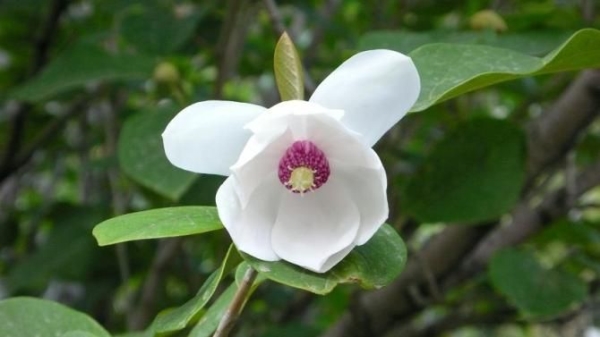
Home cultivation methods and precautions for Magnolia sieboldii
Growing requirements for Magnolia sieboldii
Soil
As everyone knows, the soil in Northeast China is black earth, rich and fertile. Therefore, the native "Northeast flower" - Magnolia sieboldii - also likes deep, fertile soil rich in humus.
The soil pH should be slightly acidic, with a pH between 5.5 and 7 being most suitable.
Temperature
Magnolia sieboldii likes cool environments. It is not tolerant of high temperatures. In the wild, it grows in valleys at altitudes above 1000 m, and can withstand low temperatures of -30°C.
Therefore, Magnolia sieboldii is mainly grown in the northern regions of our country.
Humidity
Magnolia sieboldii likes moist, shady environments. It is not tolerant of drought.
Normally you should observe the plant often and water it regularly to maintain a certain level of humidity. Avoid letting it dry out.
Precautions for growing Magnolia sieboldii
Soil
For soil, you can use sandy loam, forest soil rich in leaf litter and humus, and so on, but be sure not to use alkaline soil. Alkaline soil may cause Magnolia sieboldii to die.
Temperature
When growing Magnolia sieboldii at home, you should pay attention to its care during periods of high summer heat. Do not let it be exposed to direct sunlight, and maintain appropriate ventilation.
In terms of climate, Magnolia sieboldii is more suitable for growing in northern regions or in high-altitude mountain areas in the south.
Fertilizing
Fertilizer should be mild rather than too concentrated. The humus already present in the soil can provide good nutrition on its own.
Growing methods and precautions for Magnolia sieboldii
Chinese scientific name: TiannühuaLatin scientific name: Magnolia sieboldiiAlso known as: Xiaohua Mulan, Tiannü MulanKingdom: PlantaeDivision: AngiospermaeClass: DicotyledoneaeSubclass: MagnoliidaeOrder: MagnolialesFamily: MagnoliaceaeGenus: MagnoliaSpecies: Magnolia sieboldiiDistribution: the adjacent mountainous areas of Liaoning and Jilin provinces and localized mountain areas in certain provinces of East China and South ChinaEndangered category: near threatened speciesProtection level: Level 3Flowering period: April-MayFruiting period: September-OctoberAssociated species: Cornus controversa, Carpinus cordataStatus: provincial flower of Liaoning, city flower of BenxiMagnolia sieboldii, a deciduous small tree, 5 to 15 cm, with white powder on the leaf underside; flowering from early June to mid-July, fruit ripening in early to mid-September. Originating in Liaoning, China, it is the only wild Magnolia species in China. Within Asia, it is also distributed in Korea and Japan. It is an endangered plant and a national Level 3 key protected plant. Magnolia sieboldii is the provincial flower of Liaoning and also the city flower of Benxi, Liaoning.1. Morphological characteristics
Deciduous small tree, up to 10 m tall; current-year branchlets slender, about 3 mm in diameter, pale grayish brown, initially covered with silvery-gray appressed long pubescence. Leaves membranous, obovate or broadly obovate, (6) 9-15 (25) cm long, 4-9 (12) cm wide, apex abruptly acute or shortly acuminate, base broadly cuneate, obtusely rounded, truncate or nearly cordate; midvein and lateral veins on the upper surface covered with curved pubescence, lower surface pale white, usually covered with brown and white multicellular hairs, with scattered small golden dots; midvein and lateral veins covered with white long silky hairs; lateral veins 6-8 per side; petiole 1-4 (6.5) cm long, covered with brown and white appressed long hairs; stipular scar about 1/2 the length of the petiole. Flowers opening at the same time as the leaves, white, fragrant, cup-shaped, saucer-shaped when fully open, 7-10 cm in diameter; pedicel 3-7 cm long, densely covered with brown and grayish-white appressed long pubescence, bearing horizontally spreading or slightly nodding flowers; tepals 9, nearly equal in size; outer whorl of 3, oblong-obovate or obovate, 4-6 cm long, 2.5-3.5 cm wide, base covered with white hairs, apex broadly rounded or rounded; inner two whorls of 6, narrower and smaller, base gradually narrowed into a short claw; stamens purplish red, 9-11 mm long, anthers about 6 mm long, the two anther cells adjacent, introrse longitudinally dehiscent, apex slightly concave or connective flat, not extended, filaments 3-4 mm long; gynoecium ellipsoid, green, about 1.5 cm long. Aggregate fruit red when ripe, obovoid or oblong-cylindric, 2-7 cm long; follicles narrowly ellipsoid, about 1 cm long, dehiscing completely into two valves along the dorsal suture, apex with a beak about 2 mm long; seeds heart-shaped, aril orange-red, outer seed coat dark brown, 6-7 mm long and wide, apical pore small with a pointed tip.2. Origin and habitat
Produced in Liaoning, Anhui, Zhejiang, Jiangxi, northern Fujian, Guangxi. Grows in mountainous areas at altitudes of 1600-2000 m. Also distributed in Korea and Japan.3. Uses
The wood can be made into farm tools, and the flowers can be used to extract aromatic oil. The flowers are beautiful, with long pedicels, swaying in the wind, making it a famous ornamental garden tree both in China and abroad. The flowers are used medicinally and can be made into extract.4. Growth habits
It likes cool, moist environments and deep, fertile soil. It is suited to shady slopes and moist valleys. It fears high temperatures, drought and alkaline soil. It grows in shady slopes and valley forests at altitudes above 1000 m.5. Variety classification
There are 90 species in the same genus, native to East Asia and North America; China has more than 30 species, all of which are beautiful flowering trees. Commonly cultivated elsewhere are also:Yulan magnolia is a famous ornamental plant in China. The flowers open before the leaves, upright, bell-shaped, fragrant.
Wangchun magnolia, also known as Wangchunhua, has flowers in 2 whorls, nearly spoon-shaped, white, with purplish red at the base outside.
Night-fragrant magnolia, also known as Yehe. The pedicel bends downward, the flower is nearly spherical, yellowish white, extremely fragrant at night.
Lotus magnolia, also known as Guangyulan. The flowers are large, white, fragrant.
Purple magnolia, also known as Xinyi. The flowers open together with the leaves or slightly after the leaves; the outer whorl of tepals is greenish, and the inner 2 whorls of tepals are purplish red.