How to grow Tabernaemontana divaricata? A detailed guide to care precautions
Tabernaemontana divaricata has a fairly high demand for nutrients, so we need to fertilize in time before it blooms; it is best to alternate compound fertilizer and nitrogen fertilizer, which helps it bloom more vigorously and increases the number of flowers.
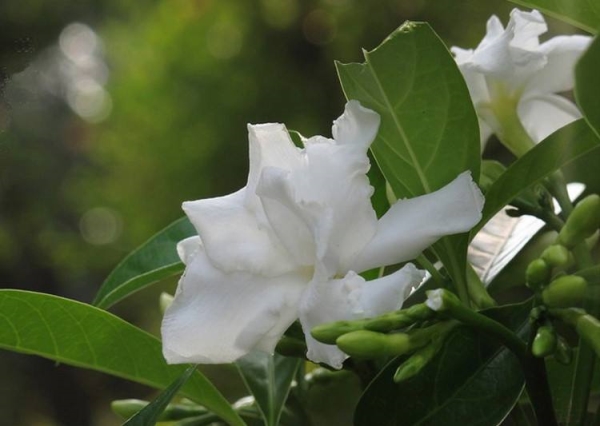
Growing methods and precautions for Tabernaemontana divaricata
Growing methods for Tabernaemontana divaricata
Soil
Tabernaemontana divaricata is not strict about the soil in its growing environment, but it grows best in fertile, loose, well-drained acidic soil.
Watering
During routine care, keep the soil moist; do not wait until the potting soil is completely dry before watering. In summer, spray water around it frequently to increase air humidity.
Temperature
The suitable growing temperature for Tabernaemontana divaricata is above 10°C. If it is lower than this temperature, the leaves of Tabernaemontana divaricata will turn yellow, and below 0°C the branches will suffer frost damage.
Light
Tabernaemontana divaricata likes warmth and humidity and prefers plenty of sunlight. During cultivation, maintain good light, otherwise the leaves will turn dull yellow and may even drop.
Fertilizing
Tabernaemontana divaricata likes fertile soil, and its flowering period is fairly long, so it needs timely fertilizing.
Every 7-10 days, it is best to alternately apply compound fertilizer and manure water.
Precautions for growing Tabernaemontana divaricata
Water appropriately in winter
At the end of October, Tabernaemontana divaricata needs to be moved indoors for growing; at this time, generally water once every 5-7 days, and the soil only needs to be slightly moist.
Repot on a regular schedule
Move Tabernaemontana divaricata outdoors in April and repot once every 1-2 years. When repotting, add compound fertilizer or soybean cake as a base fertilizer, prune dead branches and weak branches, then place it in semi-shade for care.
Maintain light
Tabernaemontana divaricata likes a sunny environment, so it should normally be placed in a spot with sunlight to absorb scattered sunlight.
In summer, when the sun is scorching, place it in semi-shade to avoid burning the leaves.
Growing methods and precautions for Tabernaemontana divaricata: pest and disease control of Tabernaemontana divaricata
Tabernaemontana divaricata likes warmth and humidity, is not cold-tolerant, and prefers semi-shade. It is suitable for planting in fertile, well-drained acidic soil. Tabernaemontana divaricata is mainly propagated by cuttings, which can be done year-round in a greenhouse; outdoors, cuttings are best taken in June-July. What are the growing methods and precautions for Tabernaemontana divaricata? Today, the editor will share them with you.
Growing methods for Tabernaemontana divaricata
Water management
Usually keep the soil moist, and water before it dries out completely. In summer, spray water around it frequently to increase the air humidity of the environment.
Fertilizer management
Tabernaemontana divaricata likes fertilizer and has a long flowering period. From May to September, it is best to alternately apply compound fertilizer and manure water every 7-10 days. After moving indoors at the end of October, generally water once every 5-7 days, just keep the soil slightly moist, and maintain good light.
Temperature management
Room temperature should be kept above 10°C, otherwise the leaves will turn yellow and drop; below 0°C the branches will freeze.
Light management
Tabernaemontana divaricata is a sun-loving tree, so during cultivation it must maintain good light, otherwise the leaves will turn dull yellow and may even drop.
Disease and pest control of Tabernaemontana divaricata
Aphids
Body length 1.5-4.9 mm, mostly about 2 mm. Sometimes covered with wax powder, but lacking wax plates. Antennae 6-segmented, rarely 5-segmented, rarely 4-segmented; sensoria circular, rarely oval; the tip of the terminal segment is often longer than the base. Eyes large, with many ommatidia, often with prominent 3-ommatidium eye tubercles. Rostrum terminal segment short and blunt to long and pointed. Abdomen larger than the sum of head and thorax. Pronotum and abdominal segments often have marginal tubercles. Siphunculi usually tubular, length often greater than width, thick at the base, tapering toward the tip, sometimes swollen in the middle or at the tip, apex often with a flange, surface smooth or with imbrications or reticulations at the tip, rarely with few or many hairs, rarely siphunculi annular or absent. Cauda conical, finger-shaped, sword-shaped, triangular, pentagonal, helmet-shaped to crescent-shaped. Anal plate rounded at the tip. Integument smooth, reticulated or wrinkled, or with markings composed of minute spines or granules. Body hairs pointed or with swollen heads or fan-shaped tips. Antennae of winged aphids usually 6-segmented, with secondary sensoria on segment 3 or 3 and 4 or 3-5. Media of forewing usually divided into 3 branches, rarely 2. Hind wing usually with 2 cubital veins, rarely the hind wing reduced and venation degenerated. Veins sometimes edged in black.
Control
In controlling aphids, various means should be used to stop their damaging activity, mainly including the following points:
1. Eliminating aphids should begin from the overwintering period of the flowers, which can achieve twice the result with half the effort. If relying solely on the spring and autumn when aphid damage is most severe, the control effect is not significant.
2. Newly introduced flower seeds and seedlings should be strictly inspected to prevent the invasion of new pests from other places, and the soil and old flower pots should be disinfected to kill residual eggs.
3. Combined with pruning, thoroughly remove the remaining flowers and diseased or dead branches and leaves where aphids have lived or eggs have lurked, and burn them in a centralized manner.
4. Different flower varieties have different insect resistance, so pest- and disease-resistant varieties should be selected, which both reduces aphid damage and saves on pesticide costs.
5. When a small number of aphids are found, they can be brushed clean with a writing brush dipped in water, or the potted flower can be tilted and rotated under running tap water to wash them off. This both kills the aphids and cleans the leaves, improving ornamental value and promoting leaf respiration; if conditions permit, natural enemies such as ladybugs and lacewings can also be used for control.
6. When a large number of aphids are found, they should be isolated in time, and pesticides or traditional methods should be immediately used to eliminate the pests. The specific measures are as follows:
1. Prepare tobacco leaf water at a ratio of 1:15, soak for 4 hours, then spray.
2. Prepare a solution of washing powder, urea, and water at a ratio of 1:4:400 and spray it.
3. Spray with 10% omethoate emulsifiable concentrate at 1000 times dilution, or malathion emulsifiable concentrate at 1000 to 1500 times dilution, or dichlorvos emulsifiable oil at 1000 times dilution.
4. For aphids such as the peach powdery aphid that are themselves covered with wax powder, when applying any pesticide, add 1‰ neutral soap water or washing powder.
The above is all the content I have learned today about Tabernaemontana divaricata. I hope flower lovers will find it helpful after reading this article. To learn more about Tabernaemontana divaricata, please continue to follow Duorou Huapu, and we will provide you with more related knowledge!