Why does variegated greater periwinkle fail to bloom?
Soil problems
If, during cultivation, the potting soil for greater periwinkle uses clayey soil that is on the alkaline side and has poor aeration, it may lead to poor drainage, poor air permeability, or even soil that is too poor, causing poor growth of greater periwinkle and resulting in failure to bloom.
Overwatering
During the blooming period of variegated greater periwinkle, watering should be reduced so that the flowers of greater periwinkle will be brightly colored. However, if watered too much, it can easily fail to bloom.
Improper fertilizing
If greater periwinkle lacks elements such as nitrogen, phosphorus, and potassium during growth, it will fail to bloom. However, if fertilized excessively, it can cause root burn and, in severe cases, bring adverse effects to the entire plant.
Now that you understand the reasons why greater periwinkle fails to bloom, do you know what the flower language of greater periwinkle is?
The flower language of variegated greater periwinkle
The flower language of variegated greater periwinkle carries the meanings of pleasant memories, everlasting youth, and steadfastness. Because it is a rooting plant, its ability to adapt to the environment is very strong, so some people call its flower language "adaptation." A person born under the blessing of variegated greater periwinkle is unafraid of adversity, has the mindset to face harsh environments, and even suffering one or two breakups does not count as much.
The above is an introduction to the reasons why variegated greater periwinkle fails to bloom. If you encounter any other problems during cultivation, please pay more attention to Four Seasons Plant Network!
How to grow variegated greater periwinkle
Morphological characteristics: An evergreen trailing subshrub. Vegetative stems lie prostrate or flat on the ground, and flowering branches are upright. Plant height is 30-40 cm. Leaves are opposite, elliptical, with acute tips; the petioles on flowering branches are short. The whole plant is hairless except for hairs on the leaf margins, petioles, calyx, and throat of the corolla. The leaves are dark green with yellow-white markings. Flowers are solitary in the leaf axils of flowering branches, with a salverform corolla, 5-lobed, and blue. The flowering period is April-May. The follicles are paired and upright.Habits: It prefers a warm, humid environment with ample sunlight. It is not strict about light requirements, and grows best especially in semi-sunny conditions. As an evergreen plant, it has a certain cold tolerance, and its growth peaks are from June to August and in October each year. Cold-tolerant and tolerant of waterlogging. It is suitable for fertile, loose, and well-drained sandy loam soil. Propagation and cultivation management: It is mostly propagated by division, and can also be propagated by cuttings and layering. The propagation period is in early April in spring or early September in autumn. During the growing period, keep the potting soil moist for a long time. During the growing period, apply fertilizer once every half month, and apply phosphorus fertilizer and potassium fertilizer 2-3 additional times. In winter, the temperature must not exceed 0°C. Wilt disease, canker disease, and leaf spot often occur, and Bordeaux mixture of equal parts can be sprayed. Pests include scale insects and root-knot nematodes. For scale insects, spray with 25% phosmet emulsifiable concentrate at 1000 times dilution to kill them, and for root-knot nematodes, use 3% carbofuran granules for control.
Landscape application: In landscaping, greater periwinkle is mostly used as ground cover for foliage viewing. It can be used as a flower border plant, planted around rockery stones, cobblestones, or other plants, and can be used for rock edges, high banks, flowerbed edges, and vertical greening. In addition, its trailing stems grow quickly and hang beautifully, so it can also be used as an indoor ornamental plant, placed beside stairs, on railings, or in pots on counters.
Native to the Mediterranean coast, India, and tropical America. It is cultivated in Jiangsu, Zhejiang, and Taiwan, China.
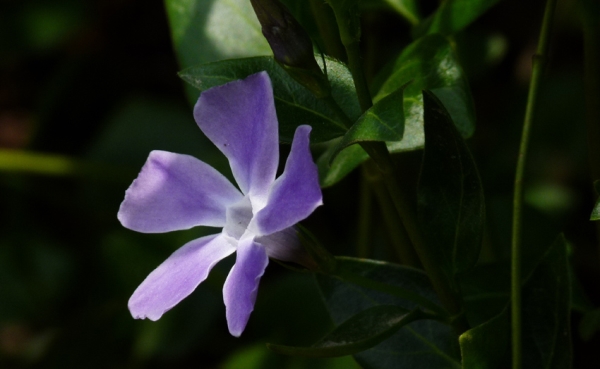
Variegated greater periwinkle is an evergreen trailing subshrub, clump-forming. Vegetative stems lie prostrate or flat on the ground. Flowering branches are upright, 30~40 cm tall. Leaves are opposite, elliptical, with acute tips, and the leaves have yellow markings and are slightly glossy; the petioles on flowering branches are short. The whole plant is hairless except for hairs on the leaf margins, petioles, calyx, and throat of the corolla. Flowers are solitary in the leaf axils of flowering branches, with a salverform corolla, blue, and 5-lobed. The follicles are paired and upright, and the flowering period is April~May.
Variegated greater periwinkle has strong adaptability and grows rapidly, with growth peaks from June to August and in October each year. It is not strict about light requirements, and grows best especially in semi-sunny conditions.