How to Grow Jatropha integerrima? Detailed Guide to Cultivation Methods and Precautions
1. Temperature
Jatropha integerrima is a tropical plant that likes high temperatures, so it is best to maintain a temperature of 26-28°C. This temperature range is the most suitable for the growth of Jatropha integerrima. However, Jatropha integerrima is not cold-tolerant and needs to be kept above 12°C during winter, otherwise there is a risk of frostbite or freezing to death. So for gardening enthusiasts in the north, if you want to grow Jatropha integerrima, pay attention in winter and maintain the growing temperature for Jatropha integerrima; it must not be too low.
2. Soil
It does not have high requirements for soil,
and likes acidic, sandy, loose, fertile soil rich in organic matter.
3. Watering
Jatropha integerrima likes humid environments and is not drought-tolerant, so if gardening enthusiasts live in the north, the editor suggests that you may temporarily not consider this plant. However, liking humid environments does not mean it can tolerate waterlogging, so be sure to note that the flower pot and soil used must be loose and breathable.
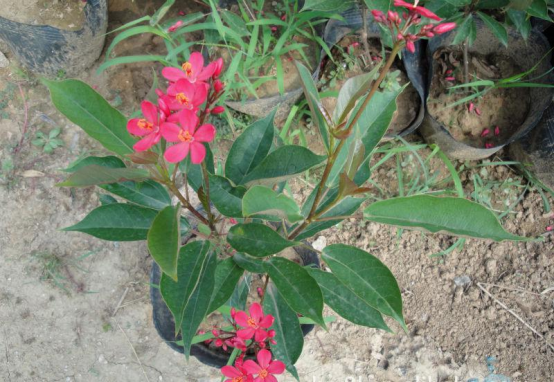
4. Sunlight
It likes a warm, dry growing environment with plenty of sunlight, so remember to find a shaded spot for Jatropha integerrima at noon in summer. No matter how much it likes sunlight, it will not want to be exposed to the scorching sun, as that will cause sunburn.
5. Pruning
Jatropha integerrima can also be maintained as a potted plant. It is a shrub flower, but the plant stands upright. When grown in a pot, the plant shape can be controlled to just over one meter. Regular pruning can also promote continuous branching, which helps form more flower buds and improves its ornamental value.
Cultivation Methods and Precautions for Jatropha integerrima
The Temperature Jatropha integerrima Likes
Jatropha integerrima likes high-temperature environments, so it is best to maintain a temperature of 26-28°C. This temperature range is the most suitable for the growth of Jatropha integerrima. However, Jatropha integerrima is not cold-tolerant and needs to be kept above 12°C during winter, otherwise there is a risk of frostbite or freezing to death. So gardening enthusiasts in the north, if you want to grow Jatropha integerrima, you still need to be cautious!
The Soil Jatropha integerrima Likes
Acidic, sandy, loose, fertile soil rich in organic matter. Breaking it down one by one, I wonder if everyone can see it a little more clearly?
The Moisture Jatropha integerrima Likes
Jatropha integerrima likes humid environments and is very afraid of drought, so if you are from the north, you may temporarily not consider this plant. However, liking humid environments does not mean it will like waterlogging, so be sure to note that the flower pot and soil used must be loose and breathable.
The Sunlight Jatropha integerrima Likes
Warm, dry conditions and plenty of sunlight, so remember to find a shaded spot for Jatropha integerrima at noon in summer. No matter how much it likes sunlight, it will not want to be exposed to the scorching sun, as that will cause sunburn~
Propagation Methods of Jatropha integerrima
Jatropha integerrima is generally propagated by cuttings, usually carried out in spring.
Jatropha integerrima Jatropha integerrima Jacq. Jatropha integerrima Illustrated Guide: How to Grow Jatropha integerrima / How to Propagate Jatropha integerrima
Jatropha integerrima ProfileJatropha integerrima Jatropha integerrima Jacq.
Cultivation Methods and Precautions for Jatropha integerrima: Introduction to Jatropha integerrima
Jatropha integerrima, also known as variable-leaf coral flower, fiddle-leaf cherry, South Seas cherry, and everyday cherry, belongs to the Euphorbiaceae family, genus Jatropha. It is an evergreen shrub with red flowers. The plant has milky sap, and the sap is toxic. It is native to the West Indies and is widely cultivated in southern China.
The corolla of Jatropha integerrima is red, and it can bloom throughout the year. Each flower stays open for a long time, so flowers can be seen all year round, and it looks like cherry blossoms, hence the name "everyday cherry";
Because its leaf shape resembles a fiddle, it is also called fiddle-leaf cherry; and because it looks like cherry blossoms, it is called everyday cherry. The other name, South Seas cherry, comes from being introduced from the South Seas.
Jatropha integerrima belongs to the Euphorbiaceae family and is native to Central America. It is widely cultivated in southern China.
Plant Toxicity
The milky sap is toxic and must not be swallowed by mistake. Accidental contact with the sap causes blisters or pustules and severe skin inflammation, and it is also extremely harmful to the eyes; livestock that mistakenly eat fallen leaves often develop severe blistering of the mouth.
First aid methods: induce vomiting and wash with water.
Morphological Characteristics of Jatropha integerrima
The biological characteristics of Jatropha integerrima are: the stem is about 1-2 meters tall; the leaves are simple and alternate, obovate-lanceolate, and often clustered at the tips of the branches.
The leaf base has 2-3 pairs of sharp spines, the leaf tip is acuminate, the upper leaf surface is dark green, the lower leaf surface is purple-green, the petiole is hairy, and the leaf surface is smooth;
The inflorescence is a cyme, with 5 petals and a red corolla; it is also a unisexual flower, monoecious, borne on different inflorescences, and there is also a pink variety;
The capsule turns dark brown when mature.
Stem: The plant is about 1-2 meters tall.
Leaves: Simple leaves are alternate, obovate-lanceolate, and often clustered at the tips of the branches. The leaf base has 2-3 pairs of sharp spines, the leaf tip is acuminate, the upper leaf surface is dark green, the lower leaf surface is purple-green, the petiole is hairy, and the leaf surface is smooth.
Flowers: The inflorescence is a cyme, with 5 petals and a red corolla, resembling cherry blossoms; it is also a unisexual flower, monoecious, borne on different inflorescences; there is also a pink variety. Flowering period: spring to autumn.
Fruit: The capsule turns dark brown when mature.
Leaves are papery, alternate, and variable in shape: ovate, obovate, oblong, or fiddle-shaped, 4-8 cm long and 2.5-4.5 cm wide, with acute or acuminate tips and obtuse-rounded bases. Near the base, the leaf margin often has several sparse sharp teeth, and the underside of young leaves is purple-red; stipules are small and fall early. Dioecious. Cymes are terminal and red, with unisexual flowers, 5 sepals, and oblong petals with a disc; male flowers: 10 stamens in two whorls, the outer whorl filaments slightly connate, the inner whorl filaments connate to the middle. Female flowers are slightly larger than male flowers, the ovary is hairless, the styles are 3, connate at the base, and the stigma is 2-lobed.
Ecological Habits of Jatropha integerrima
Jatropha integerrima likes high-temperature and high-humidity environments and is afraid of cold and dryness. It must be kept above 12°C during winter. It likes sufficient light and is slightly tolerant of semi-shade; it likes to grow in loose, fertile, acidic sandy soil rich in organic matter.
Therefore, Jatropha integerrima is more suitable for growing in Shenzhen.
Distribution Area of Jatropha integerrima
It is native to the West Indies and is widely cultivated in southern China.
When light is insufficient, it tends to produce many leaves and few flowers. The everyday cherry, native to the West Indies, has a native environment very similar to that of Taiwan, China, so it adapts very well and is widely used in landscapes.
Cultivation Techniques for Jatropha integerrima
Jatropha integerrima likes warm, dry conditions and sufficient sunlight. When grown at home, it cannot be placed in a place lacking direct sunlight. The suitable growth temperature is 26-28°C. If it is below 10°C, it tends to drop leaves but can still bloom.
Propagation Methods of Jatropha integerrima
Jatropha integerrima is commonly propagated by cuttings, carried out in spring.
Jatropha integerrima is an excellent courtyard ornamental flower. The results of cutting experiments show that hardwood cuttings have a high survival rate, more main roots, and longer roots; when cuttings are treated with CPD rooting powder at 400 mg/kg, with river sand as the cutting substrate, and the branches are spread out for 16-20 d before being cut into cuttings, the effect is best.
Uses and Ornamental Value of Jatropha integerrima
Throughout the four seasons, the blooming flowers are all red or pink and quite ornamental.
Although the flowers are not large, the flowering period is long. No matter when, you can see it blooming. It is a common ornamental flower in courtyards and is widely used in landscapes. It is suitable for courtyard planting or large potted plants.
Landscape Uses of Jatropha integerrima
Jatropha integerrima refers to shrub-type plants mainly grown for their flowers. As one of the plants used to purify air, fragrance the environment, green the city, and beautify courtyards, Jatropha integerrima occupies a fairly important position in landscaping in China.
With economic development, people's requirements for landscaping continue to increase, and the application of Jatropha integerrima has become more and more widespread. Because of its beautiful leaves, brilliant flowers, long flowering period, and ease of propagation and maintenance, Jatropha integerrima is used in gardens.
Jatropha integerrima is mainly used for courtyard planting or large potted plants.
Although the flowers are not large, because the flowering period is long, no matter when, you can see it blooming. It is a common ornamental flower in courtyards and is widely used in landscapes. Propagation is by cuttings, carried out in spring.
It is planted on a large scale in Shenzhen Bay Park, and is also partially planted in other parks and municipal roads. Citizens can go to admire it.
Jatropha integerrima Pictures