What are the key points of iris cultivation methods
1. Soil
Irises grow best in soil rich in humus, with good drainage and slightly alkaline; in heavy soil, add some peat, vermiculite, fine sand, etc. and mix to improve the soil.
2. Temperature
The most suitable temperature for irises is 16-18°C, the minimum soil temperature should be above 5°C, and the maximum should not exceed 20°C; too high a temperature will cause the flowers to wither.
3. Drainage conditions
Irises need a good drainage system so that water can be fully utilized and the problem of salt accumulation caused by water can be reduced.
4. Fertilizing
Generally, do not apply base fertilizer before planting, as it will delay the growth of the plant's root system, and phosphate fertilizer and triphosphate fertilizer should not be used either.
5. Bulb storage
The temperature for storing bulbs should be 30°C; bulbs for cut flowers should be planted immediately. The temperature should be suitable for bulb growth, maintained at around 2°C; above 2°C will prolong the treatment time and is unfavorable for flowering. While maintaining a suitable temperature, good air permeability should also be maintained, and bulbs should not be stored for a long time.
Iris cultivation methods
Iriscultivation methods Iris division propagation: It can be done after flowering in spring or in autumn, generally replanting once every 2〜4 years. When dividing the rhizomes, note that each piece should have 2〜3 adventitious buds; dip the wound in plant ash or sulfur powder for antisepsis before planting.
Seed propagation: Seeds should be sown immediately after maturing; seedlings need 2〜3 years to bloom. The planting distance is 40〜50 cm, and the planting depth is preferably 7〜8 cm. Forcing cultivation can also be carried out.
Cultivation management: Plant in loam rich in humus; it grows poorly in acidic soil. Before cultivation, fully apply decomposed compost, and apply bone meal and plant ash as base fertilizer. During the growing period, apply chemical fertilizer and organic liquid fertilizer as topdressing, which can make the plants strong and the leaves lush.
>, Ornamental and applied uses
Iris flowers are large and beautiful, like irises and resembling butterflies, and the leaves are fresh green and emerald, like swords and ribbons, with very high ornamental value, and can be regarded as a worldwide flower. The English and Latin names of iris are both Iris, meaning the flower of the rainbow. The ancient Egyptians believed that iris was a symbol of "power." The Slavs believed that iris was a lofty deity. Iris is the national flower of France; on the French coat of arms, the iris pattern has been painted since the 12th century. Legend says that when Clovis, king of the first dynasty of France, was baptized, God gave him a gift, which was the iris. Iris is a symbol of light and freedom. The name of this plant comes from the messenger of God and the rainbow that connects the earth with other worlds. There is also a legend that the rainbow once saved the life of a 6th-century Frankish king; when he saw the rainbow rising from the Rhine, he knew the river water was shallow enough at that time, so he crossed the river and escaped pursuit by the enemy. Because of this, the iris was greatly revered and regarded as the national flower.
Irises have long been planted in China's Central Plains and Yangtze River basin, and are no stranger to flower lovers. In China, iris flowers are often used to symbolize love and friendship, a bright future, and boundless prospects.
Iris leaves are emerald green and fresh, and the flower shape is large and unusual, like fluttering colorful butterflies, making it one of the important flowers in gardens. Iris is a beautiful potted flower, cut flower, and flowerbed flower. In recent years, with the construction of urban lakes and wetland ecological environments, planting irises in waterlogged places, by ponds and lakesides, is very suitable. In early summer each May, the green irises bloom with purple-blue butterfly-shaped flowers, as if dancing, adding color to the lake scenery. If blue, blue-purple, and white irises are planted together, the visual effect can be further enhanced.
Iris cultivation methods Must-see care methods
Iris flowers are large with unusual flower shapes, like butterflies, and the leaves are emerald green and fresh, with relatively high ornamental value. Many people choose potted irises to decorate their homes. Below, the editor will take everyone to learn about iris flower cultivation methods:
Basic information about iris:
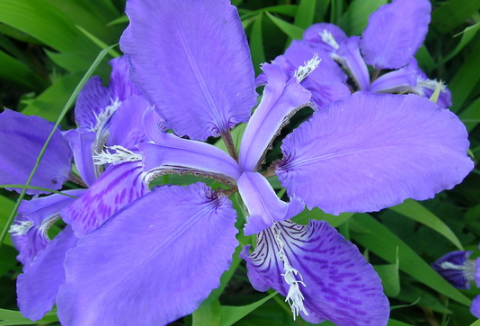
Iris (Latin scientific name: Iris tectorum), also called purple butterfly, blue butterfly, black iris, flat bamboo flower, butterfly orchid, etc., is a flower native to central China and is now mainly distributed in south-central China. Its flower shape is large and beautiful, and the flower color is mostly blue-purple, and it can be used for ornament. Its rhizome can be used as Chinese medicine, can be collected throughout the year, and has an anti-inflammatory effect.
Iris cultivation methods:
1. Soil:It requires moderately moist, well-drained, humus-rich, slightly alkaline clay soil.
2. Watering:Watering depends on the situation. For open-field cultivation, water once a week during the growing period. As the temperature decreases, gradually reduce the amount of watering. Generally, it is best to keep the soil slightly dry. Do not let the soil accumulate water or remain too wet for a long time, so as to avoid root rot or disease.
3. Sunlight:Irises like sufficient sunlight and are also slightly tolerant of shade. They can be cultivated in the open field. They have strong adaptability, and generally vigorous growth can be achieved with normal management.
4. Fertilizing:Base fertilizer can be applied before planting the plants. Fertilize once each autumn, and chemical fertilizer can be applied as topdressing during the growing period.
5. Pests:Common diseases of iris include rust and soft rot. In the early stage of rust, 25% triadimefon 400x solution can be used for control, and soft rot can be controlled with 1:1:100 Bordeaux mixture. Pests include the arctiid moth; 90% trichlorfon 1200x solution can be used for root irrigation control.
The flower color of iris flowers is mostly blue-purple, and the flower shape is like a butterfly. Seen from a distance, it looks like a butterfly flying among the green leaves, very beautiful. The iris flower cultivation methods have been introduced here. I believe everyone also has some understanding of iris flower care and can try planting iris flowers to decorate their homes.